
The Print Field / Essay 33
Yvonne Drewry’s Convolvulus Linocut
The Commons file record identifies this image as a linocut of convolvulus flowers by Yvonne Drewry, dated 1975. The photographed impression is the starting…
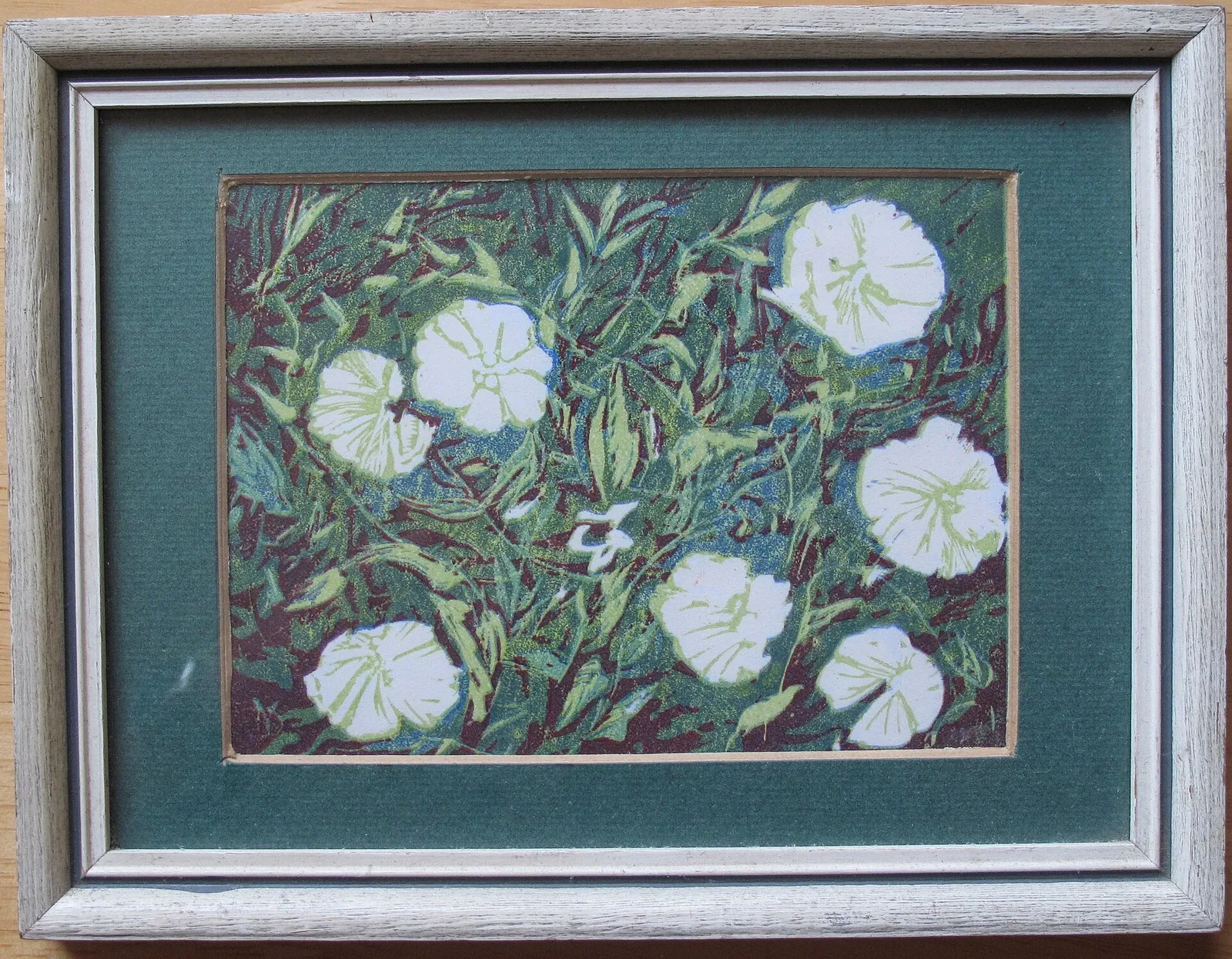
A flower drawn with the parts removed
The Commons file record identifies this image as a linocut of convolvulus flowers by Yvonne Drewry, dated 1975. The photographed impression is the starting evidence: flowers and stems form an arrangement on paper, while the title names the plant. The record does not provide an edition size, paper description, or statement from the artist about the composition. Those details should not be supplied by guesswork, even when the image invites a vivid botanical reading.
Linocut turns drawing into removal. The maker cuts away parts of a linoleum sheet, leaving a raised surface that can be inked and pressed against paper. A groove in the block may appear as a light line in the impression; a broad uncut region can carry the darkest ink. The plant's contour is therefore not only a pictured stem or petal. It is also a physical boundary between material kept and material taken away.
Convolvulus grows through connected forms
The flower's name suggests a plant with linked stems and blossoms. In the print, a viewer can follow how those forms connect, overlap, or turn back into the surrounding space. Look for the direction of a stem and the shape of the gap beside it. Does the composition present a single bloom as a focal point, or distribute attention across several flowers? These questions describe the image without claiming a botanical specimen or location that the source does not identify.
Botanical prints can sit between observation and design. A maker may simplify a plant's structure so that it reads clearly in ink. A leaf's edge can become a bold silhouette; a flower's interior can be reduced to a few contrasting shapes. The block's limits encourage an artist to choose which details survive. A digital reproduction can help readers notice those choices, though it may flatten the paper surface and alter the appearance of the ink.
Why the carved line changes the drawing
In a drawing, a line can be added directly. In a linocut, the line may be carved out of the block, leaving a channel that prints as paper. That reversal gives negative space an active role. The white line that separates two petals is not simply background; it is a cut with its own width and direction. The quality of the resulting mark depends on the tool's path, the material, the ink, and the pressure applied during printing.
This process affects how the viewer reads detail. Closely spaced cuts can merge if the ink spreads or the reproduction softens. A narrow stem can become fragile if too much material is removed. A broad plane can give a flower weight but may obscure internal structure. The image is a record of balancing these decisions. Without an artist's process notes, it is better to discuss the visible pattern than to claim a specific carving technique.
The 1975 date belongs to the record
The file page records 1975 as the date associated with the print and identifies Drewry as its maker. Its Commons upload record separately lists a later upload date and a photographer/uploader. Those dates describe different events. A source page needs to distinguish the artwork's recorded date from the date the digital file was uploaded or photographed. Confusing them would produce a false timeline.
The Commons file's CC BY-SA 4.0 license applies to the contributed photograph under its stated terms; it does not automatically provide a full biography of Drewry or an institutional catalogue record for the artwork. An article that wants to describe her broader printmaking practice should cite a reliable biographical or museum source. This page stays with the documented object and the image's visible structure.
A repeated image and a hand-made edition
Relief printing allows a carved surface to make more than one impression. Each pull can vary slightly depending on ink, paper, pressure, and handling. If an edition record is not supplied, the reader cannot determine how many copies were made or whether the displayed image belongs to a numbered set. Reproducibility is a property of the process; it is not evidence of an edition's size.
That distinction connects craft to access. A block can repeat a flower design, but each sheet is a physical encounter between the same raised surface and a new piece of paper. The printmaker can keep the result consistent or accept meaningful variation. A viewer sees the impression, not the number of proofs or rejected sheets that preceded it. The work's recorded date and medium make a firm frame; beyond that, the catalogue would need to say more.
The spaces connect the plant as much as the stems do
A botanical subject can be read through two interdependent networks. One is the network of depicted stems and flowers. The other is the network of paper visible between them. In a linocut these are materially related: removing one area makes room for a light passage, while preserving another allows an inked connection. The analysis asks how those two networks help a viewer follow the plant, rather than treating negative space as everything left over after drawing the flowers.
One useful test is to follow an interval between forms until it widens, closes, or meets the image boundary. Does the neighboring flower become easier to distinguish because of that interval? Does a repeated gap connect separate blooms into a rhythm? These are questions to answer from the reproduction. They do not establish a species beyond the caption's convolvulus identification, and they do not supply an undocumented location where Drewry might have drawn it.
The record's two dates add a separate clarity. The description assigns 1975 to the linocut, while the digital file records a later photographic event. The image can preserve a view of an older print without making the photograph contemporaneous with its creation. Keeping that provenance concise leaves the article room for its real subject: how a relief image organizes a connected plant through a connected arrangement of ink and paper. That is a closer reading than using the floral title as permission for an invented biographical episode.
Further reading
Sources & records
Linked records provide object descriptions and historical context. Comparisons, close readings, and explicitly hypothetical examples are editorial analysis. This essay was revised on 22 October 2026; it does not report first-hand workshop research. The image source and license appear in its caption.
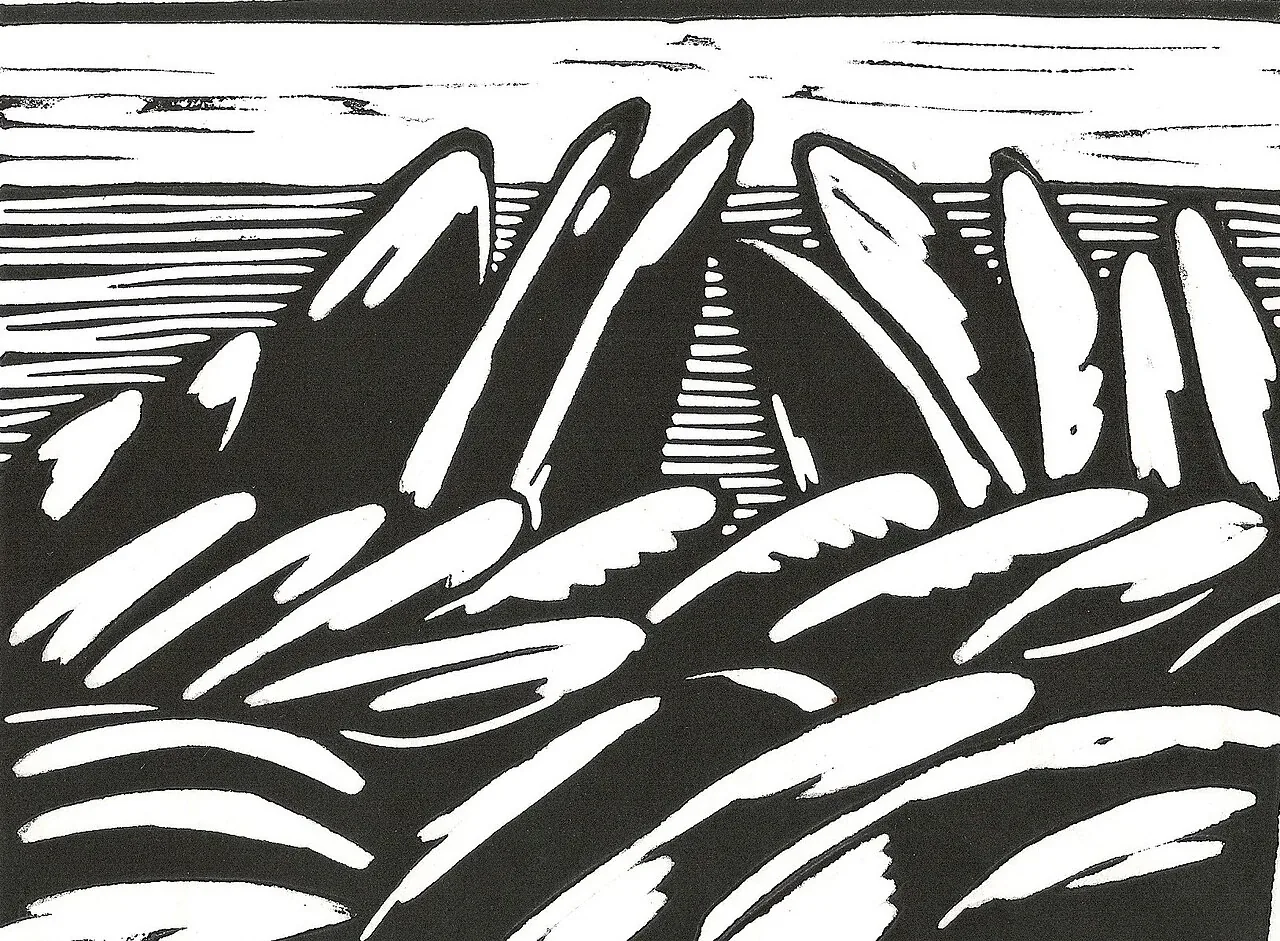
Rocks in Bretagne
The Commons object description identifies Ingeborg Bernhard's linocut as *Rocks in the Bretagne, France*, dated 1977, with dimensions of 21 by 30 centimetres. The…
5 min read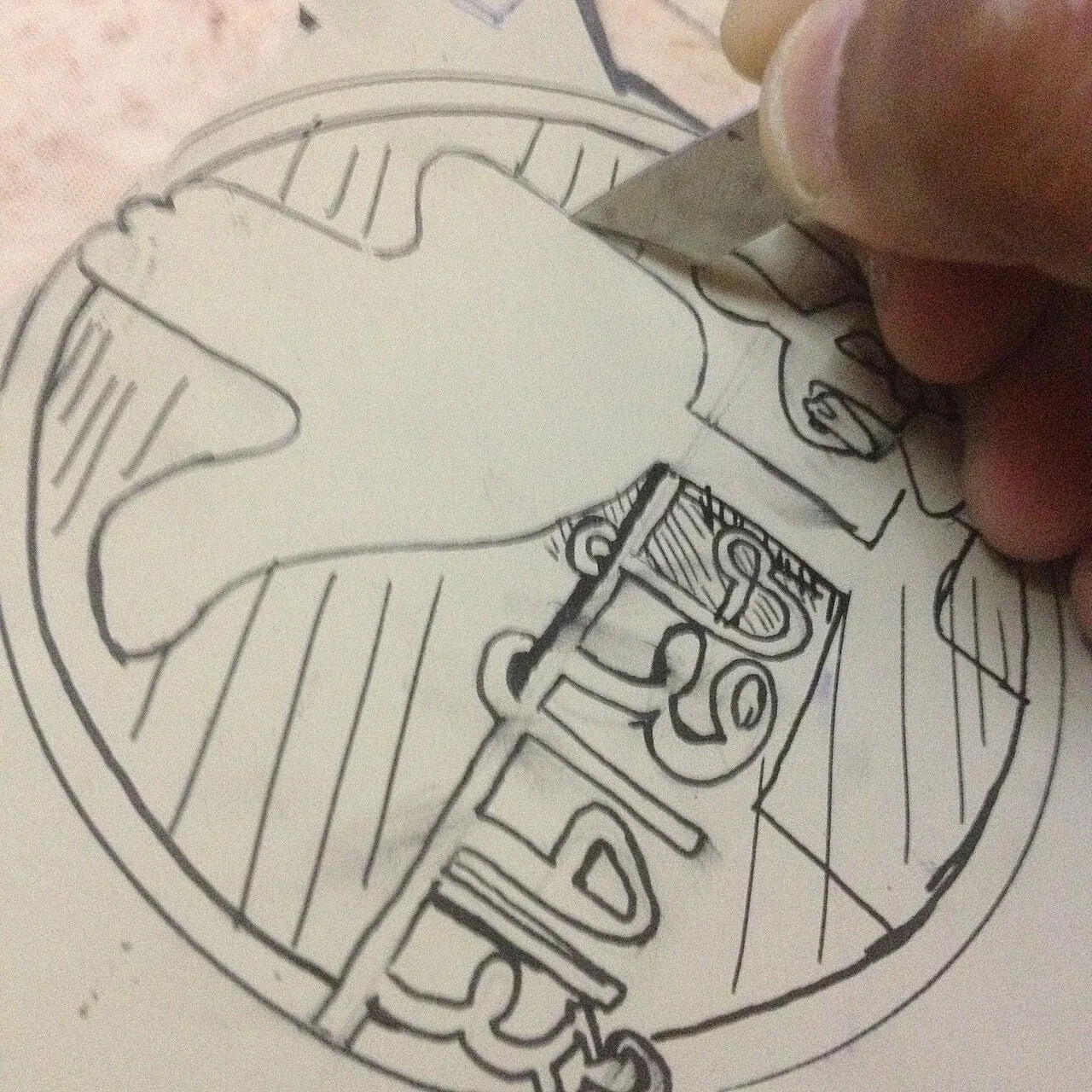
Carving a Chandigarh Stamp in Linoleum
The photograph shows a sheet of linoleum being carved for a stamp. Its caption identifies the design as a stamp featuring Chandigarh's Open Hand Monument, the Rock…
5 min read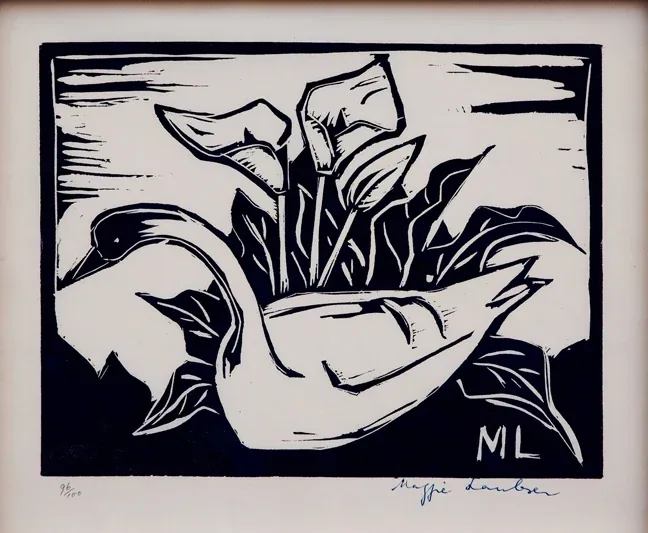
Maggie Laubser’s Swan and Arum Lilies
The work titled *Swan and Arum Lilies* is attributed to Maggie Laubser and described in its Commons record as a linocut measuring 25.5 by 30 centimetres. The file…
5 min read