
The Print Field / Essay 32
Carving a Chandigarh Stamp in Linoleum
The photograph shows a sheet of linoleum being carved for a stamp. Its caption identifies the design as a stamp featuring Chandigarh's Open Hand Monument, the Rock…
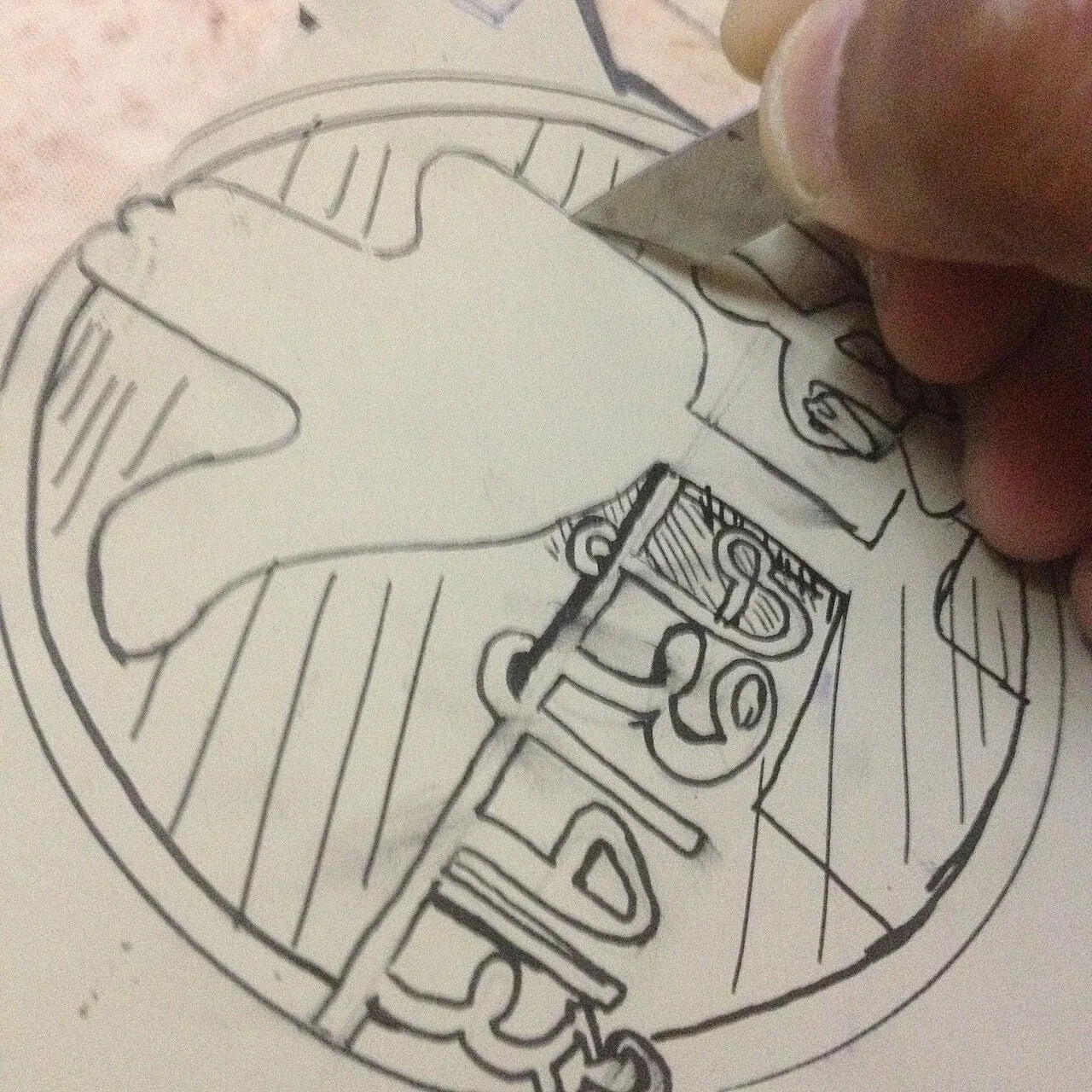
A monument reduced to a hand-sized mark
The photograph shows a sheet of linoleum being carved for a stamp. Its caption identifies the design as a stamp featuring Chandigarh's Open Hand Monument, the Rock Garden, and the Gurmukhi text “Chandigarh.” The image links three kinds of scale: a city landmark, a public garden, and a small printable surface shaped by hand. The carved design is not the monument itself. It is a translation of recognizable forms into the limits of a block.
The Chandigarh Administration identifies the Open Hand as the city's official emblem and describes its credo as “open to give, open to receive.” The monument stands in the Capitol Complex, part of Chandigarh's modern urban plan. That official context gives the stamp's central motif a documented civic association. The printed object nevertheless has its own design and purpose; the presence of the emblem does not make every stamp an official city publication.
Cutting is an act of subtraction
Linoleum is a relief surface. A cutter removes areas that should remain blank, leaving ridges that can take ink. The image on the block is reversed when printed. Each carved line therefore joins a technical and visual decision: how narrow can a channel be before it disappears, how much space does a letter need, and which contours can survive the pressure of printing?
The stamp in the photograph brings these questions into a compact field. A complex architectural form must be simplified. A garden's sculpture or path has to be represented with fewer shapes than a full drawing would use. The Gurmukhi lettering needs sufficient separation to remain recognizable after the block is inked and pressed. The photograph records carving in progress; it does not document the printmaker's exact tool set, order of cuts, or final impression count.
A script belongs in the image
The caption identifies the text as Gurmukhi and gives its meaning as “Chandigarh.” That is a factual detail with visual consequences. Letterforms occupy space, carry sound and meaning, and interact with the pictorial elements. In a small stamp, the script must remain legible at the intended size. A designer cannot treat text as a decorative row of shapes without risking its readability or its cultural meaning.
When lettering is transferred into a relief block, reversed orientation becomes a practical concern. The block's face and the printed impression do not read in the same direction. The maker has to plan the text so that its printed form is correct. The cover photograph shows a process stage; a final proof would be the evidence needed to confirm whether the text prints cleanly and in the intended orientation.
City symbols move between materials
Chandigarh's Open Hand exists as a monumental sculpture and an official emblem. A stamp adapts the symbol to an everyday printed object. The change in scale changes what the designer can preserve. Large structural elements may become outlines or blocks; fine detail may disappear; the relationship between text and symbol may become more prominent. Such translation is a common problem in graphic design: a mark that works at one scale may need simplification at another.
The official city description provides a context for the monument, not an explanation of this individual stamp's commission. The Commons photograph credits Subhashish Panigrahi and documents the carving scene. Its file page is the source for the image's attribution and license. Keeping those records distinct avoids suggesting that the municipal administration produced or endorsed the stamp unless an additional source establishes that relationship.
Looking at a work in progress
A carving photograph is different from a finished print. It shows the block at a stage when material is still being removed. The viewer may be able to see raised areas, cut channels, and the relation between the maker's hand and the design. The image can establish that carving is underway, but it cannot reveal how many proofs have been pulled or how the final ink colors will appear.
That unfinished state can be instructive. A line that looks white in the final print is a trench in the block. A dark area remains raised. The relationship between empty space and printed shape is already being decided by the carver. This makes the photograph a useful record of process without requiring an exaggerated story about the artist's feelings or the stamp's reception.
A city emblem has to survive a change of scale
The stamp photograph brings a monument, a garden reference, and Gurmukhi lettering into one small relief design. The most useful comparison is not whether the block reproduces every feature of Chandigarh. It is which features must remain recognizable after reduction and reversal. A monument can lose fine architectural detail while retaining an identifying outline; text may become unreadable if its internal spaces are compressed too far. Image and script therefore place different demands on the same limited surface.
This can be explored as a hypothetical design exercise. Describe the picture without the lettering, then describe what the lettering contributes that the picture alone cannot establish. Restore both and consider whether each has enough space to perform its task. The exercise is an editorial analysis of the format, not a claim about the carver's actual sequence of decisions or the success of an unseen final impression.
The fact that carving is still underway is central. A block face shows a design being prepared for transfer; a printed proof would show how its orientation and spacing survive that transfer. Those are different stages of evidence. The image thus offers a compact lesson in graphic translation: recognizable civic references, readable language, and printable relief must coexist. Calling the object a stamp does not establish postal status or official endorsement. Its documented value here is the way a hand-sized design negotiates between a named city and the material limits of a carved surface.
Further reading
Sources & records
Linked records provide object descriptions and historical context. Comparisons, close readings, and explicitly hypothetical examples are editorial analysis. This essay was revised on 22 October 2026; it does not report first-hand workshop research. The image source and license appear in its caption.
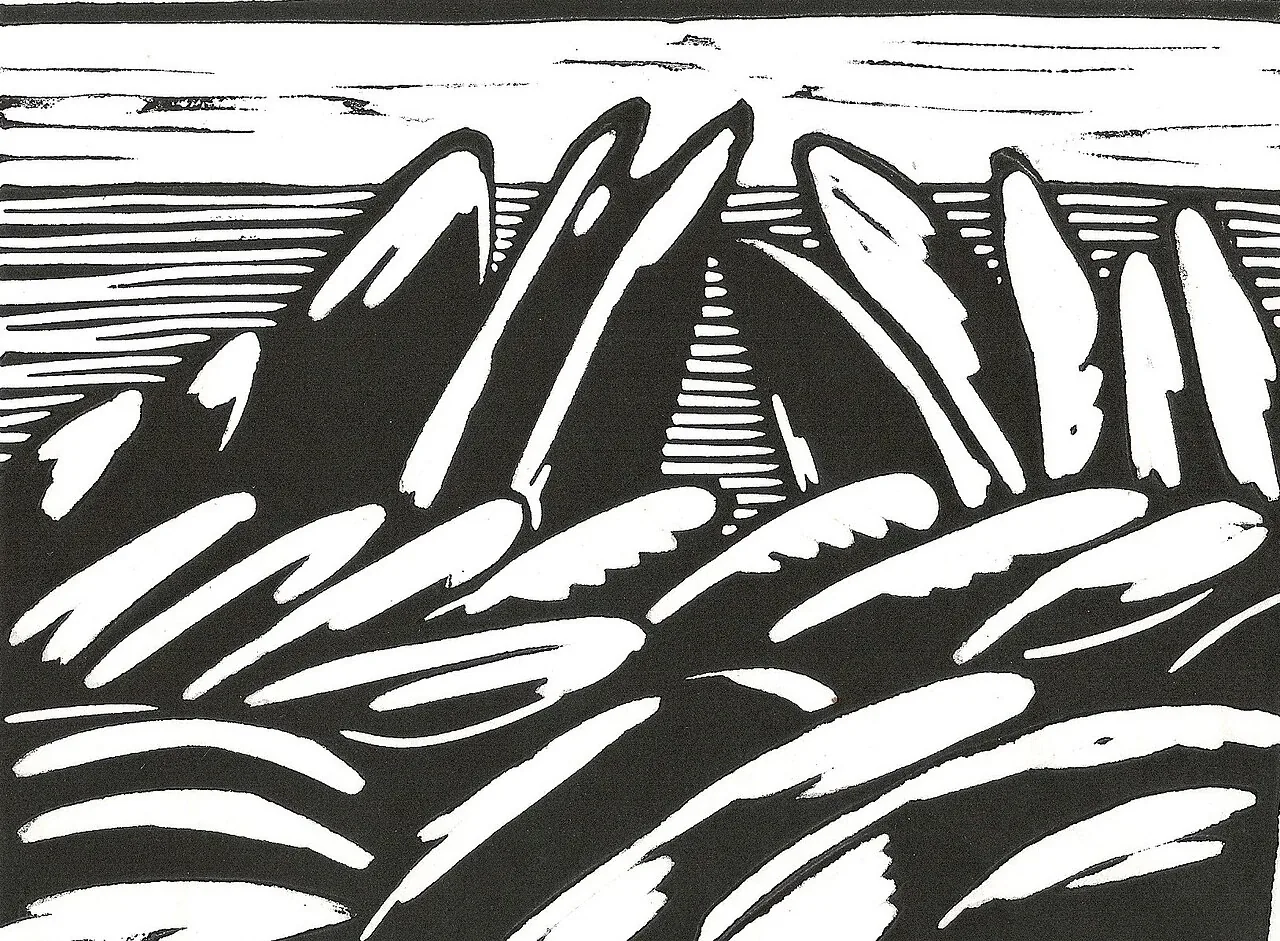
Rocks in Bretagne
The Commons object description identifies Ingeborg Bernhard's linocut as *Rocks in the Bretagne, France*, dated 1977, with dimensions of 21 by 30 centimetres. The…
5 min read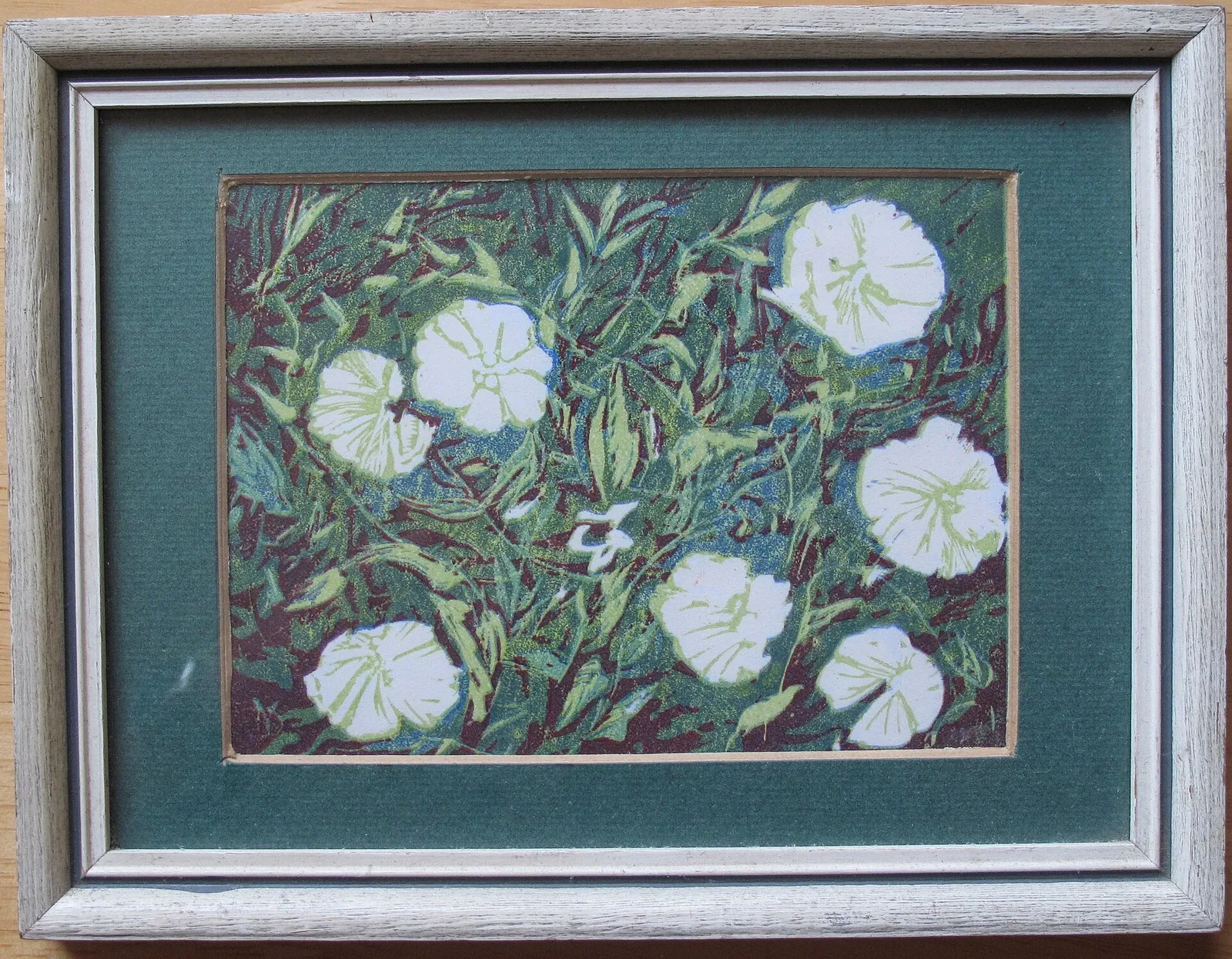
Yvonne Drewry’s Convolvulus Linocut
The Commons file record identifies this image as a linocut of convolvulus flowers by Yvonne Drewry, dated 1975. The photographed impression is the starting…
5 min read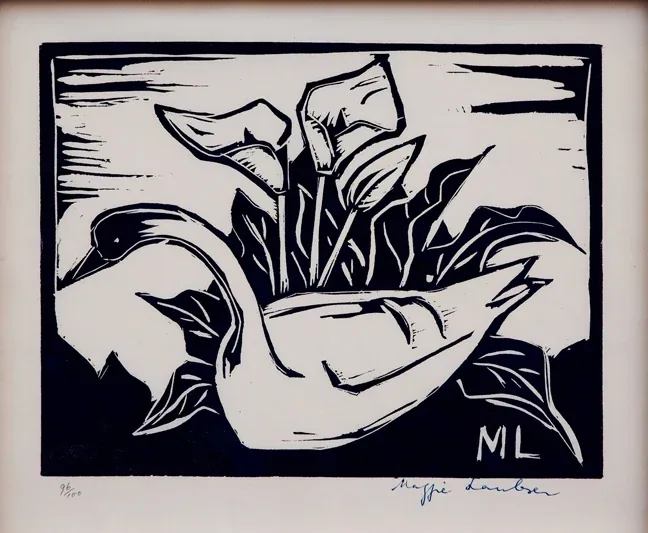
Maggie Laubser’s Swan and Arum Lilies
The work titled *Swan and Arum Lilies* is attributed to Maggie Laubser and described in its Commons record as a linocut measuring 25.5 by 30 centimetres. The file…
5 min read