
The Print Field / Essay 12
The Type Case as a Shop Index
A printer’s case is not a decorative box of letters. It is a working storage system that determines how a compositor reaches the type needed for a line. The cover’s…
Storage is part of composition
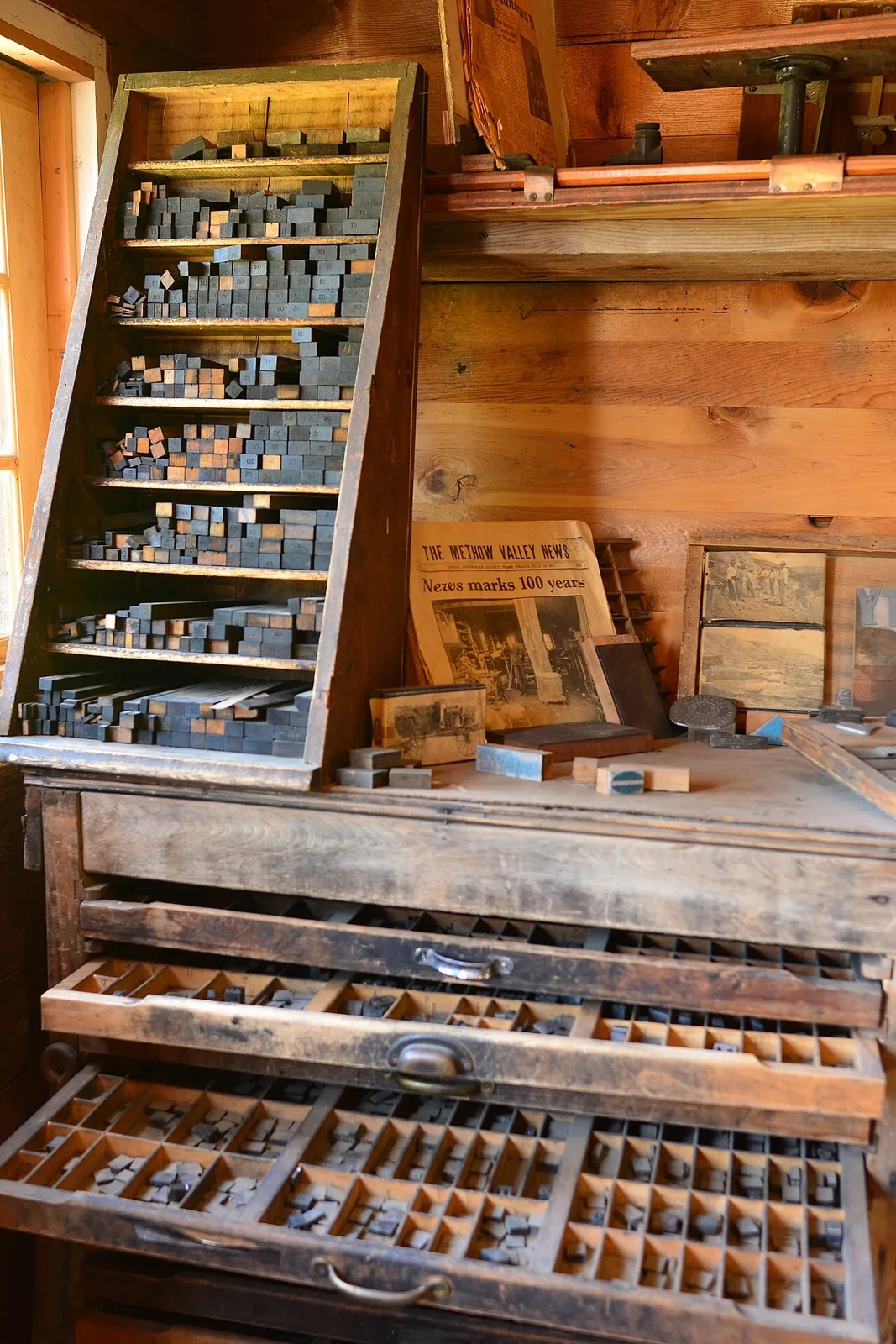
A printer’s case is not a decorative box of letters. It is a working storage system that determines how a compositor reaches the type needed for a line. The cover’s Commons record describes a printer’s job case at the Shafer Museum in Winthrop, Washington. The record identifies a place and an object, but it does not document how that case was arranged during a specific shop’s active years. For that, a researcher would need photographs, shop records, or a collection label that describes the compartments and type found there.
The composing stick and type case belong to a connected workflow. The compositor selects individual sorts from the case and assembles them in the stick. A well-maintained case makes common letters easy to reach and keeps small pieces separated. The layout is an interface between the stored inventory and the person composing. It can reflect the language, typefaces, sizes, and kinds of work the shop handled, although that interpretation should be tested against the case’s actual contents rather than assumed from its shape.
Cases differ because shops differ
There is no single neutral type case that suits every printer. A case for a small job shop may prioritize the letters and spaces used in common commercial work. Another case may hold display type, accented sorts, punctuation, or specialized characters. The arrangement can change between regions, periods, and printing traditions. A visitor looking at a cabinet should therefore ask what it contains and how its compartments are labeled before describing the design as standard.
The physical case also shapes how type is returned after use. Each sort must go back into the correct compartment so that the next compositor can find it. Misplaced letters create a practical problem and can also introduce errors into later work. This maintenance is part of composition, not an optional housekeeping task. A printing shop’s readiness depends on the condition of its type as much as on the press.
What a case can tell us
If a case preserves its original sorts, those pieces may reveal the sizes and styles a shop used. A mix of worn and clean faces can suggest different levels of use, but wear alone cannot establish a precise date or job. Labels may identify a typeface or body size, while a collection catalog can clarify who acquired the case and when. Each clue has a different strength. The object can support an account of its contents; an archive may be needed to connect it with a business or a person.
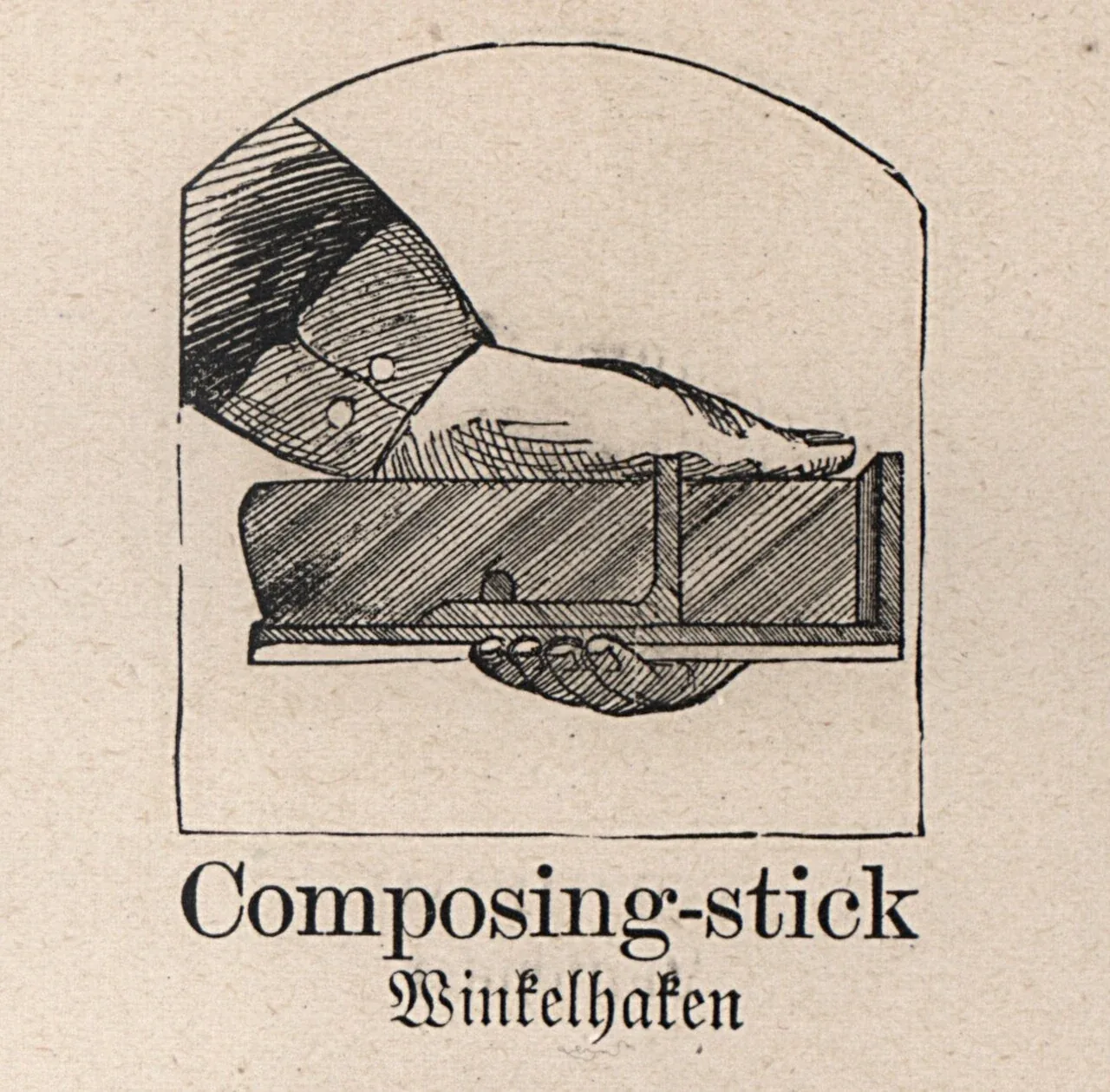
The Library of Congress’s historic illustration of a Roman letter case and composing stick puts type storage alongside hand composition. The combination shows that the case is not a background cabinet. It is a central workstation. The compositor reaches repeatedly between the case and stick, placing one sort at a time and keeping the work in sequence. That repeated movement links the cabinet’s architecture to the pace and accuracy of setting.
A case is an information design
Every compartment has a location, and every location carries an expectation. The compositor learns the map through repeated use. That map may feel intuitive to a trained printer but obscure to a new learner. A museum display can make the system more legible by showing a sample of the type, naming the arrangement when known, and explaining how the stick receives the selected sorts. Without that context, the case can look like an undifferentiated grid of small drawers.
The same principle applies when a case is repurposed for decoration or storage. Once type is separated from its original arrangement, information about the shop’s working system can be lost. A conservator or curator may photograph the case before moving its contents and record labels, missing sorts, and evidence of repair. Those documentation steps preserve not just an object but a set of relationships between letters, sizes, compartments, and work practices.
The return journey determines the next search
A type case is usually explained through retrieval: the compositor knows where to reach for a character. Its less visible operation is the return journey. Once a job is broken down, sorts must be distributed so that the expected location still corresponds to the expected character. An efficient reach is useful only when that correspondence holds. The case is therefore an information system maintained by repeated physical actions, rather than a permanent map that works automatically.
Imagine two hypothetical cases with identical compartment layouts. In the first, the contents match their locations; in the second, several similar-looking sorts have been mixed. The outward design is unchanged, yet the second case requires checking and correction that the first does not. A photograph of empty compartments would miss that difference completely. This comparison explains why the Winthrop image can document the form of a case without supplying an inventory of the shop's working knowledge.
For a museum display, a useful addition would be a clearly labeled demonstration of selection and distribution using identified sorts. That is a proposal for interpretation, not a report about the Shafer Museum's installation. It would show visitors that the compositor's fluency depends on both memory and maintenance. The cabinet's practical achievement is continuity between jobs: yesterday's type must become tomorrow's available vocabulary. That makes the case a different object of study from the stick, which temporarily holds the line being made now.
Further reading
Sources & records
Linked records provide object descriptions and historical context. Comparisons, close readings, and explicitly hypothetical examples are editorial analysis. This essay was revised on 22 October 2026; it does not report first-hand workshop research. The image source and license appear in its caption.
The Composing Stick, Line by Line
The composing stick is a small tool with an outsized role: it holds one line of type while a compositor assembles words from individual sorts. The Library of…
5 min read
Inking with a Hand Roller
The cover reproduces an illustration of a composition hand roller from an American Type Founders catalogue dated 1906, as identified in the source file. The file…
5 min read
Large Wood Type Beyond Metal
The wooden “Bodoni” type in this cover is identified in its Commons file record as a 120-point wood typeface. Rochester Institute of Technology’s Cary Graphic Arts…
4 min read