
The Print Field / Essay 13
Inking with a Hand Roller
The cover reproduces an illustration of a composition hand roller from an American Type Founders catalogue dated 1906, as identified in the source file. The file…
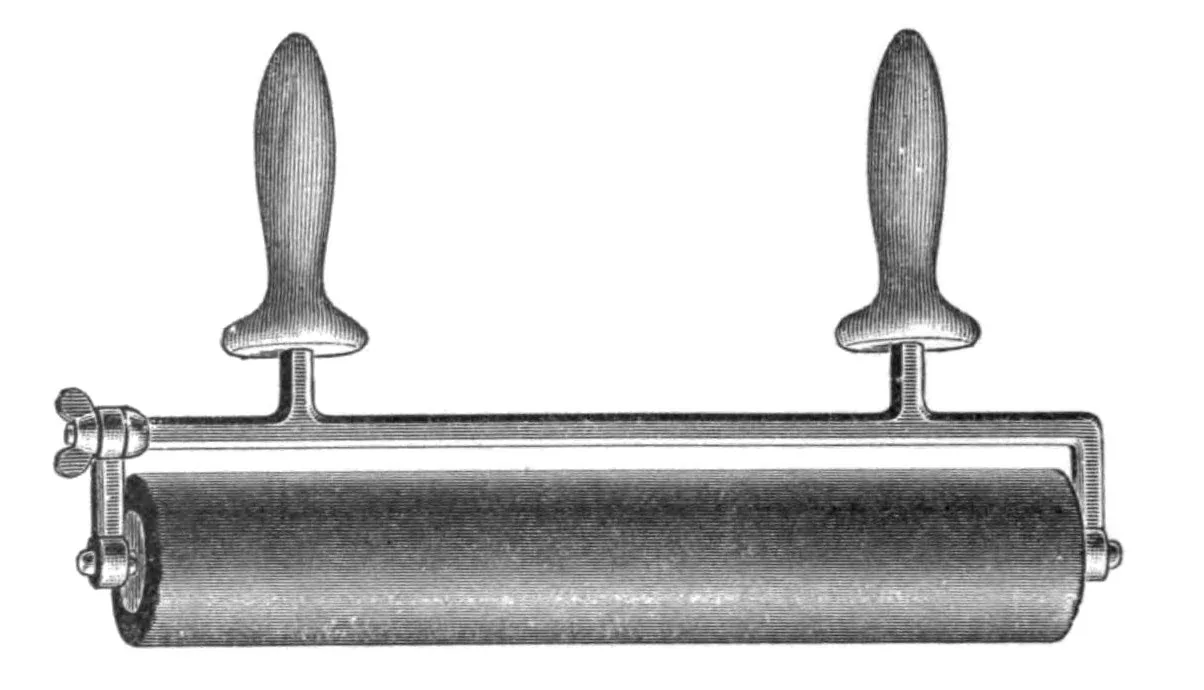
Before the press, an even film
The cover reproduces an illustration of a composition hand roller from an American Type Founders catalogue dated 1906, as identified in the source file. The file record identifies the object as a composition hand roller, a useful distinction from the powered inking rollers mounted on a press. Both tools distribute ink, but they sit at different points in the process. A hand roller can be used to prepare a surface or work ink by hand; a press roller train carries ink across the type during a printing cycle. The file identifies the catalogue context, while museum descriptions of printing machinery explain why roller materials mattered as presses accelerated.
The National Museum of American History notes that faster presses placed new demands on their inking rollers. If a machine moved quickly enough to damage the roller material, the material had to change. That observation reminds us that ink distribution is not a decorative stage. It is part of a mechanical system whose behavior depends on speed, pressure, viscosity, roller surface, and the condition of the type.
Rolling is a transfer problem
Ink must move from a source onto a printable surface in an amount that can transfer to paper without filling counters or flooding fine details. A hand roller gives the operator direct control over contact and movement. The printer can roll across a slab to work the ink, then transfer a thin layer to a block or type. The goal is not to coat the surface heavily. A controlled film is easier to distribute evenly and less likely to obscure the image.
The feel of a roller matters. A roller that is too hard, too soft, damaged, or uneven can leave stripes or bare spots. A dirty surface can carry unwanted particles into the print. These are practical observations, but the exact material and maintenance requirements vary by ink and tool. The 1906 record identifies one historic roller; it does not document its original composition or the particular ink used with it. Those details would require an object catalog or a period manual.
The press roller train
On many presses, rollers travel over the forme to distribute ink before each impression. The number and arrangement vary by press. RIT’s account of platen presses notes that semi-automated form rollers became part of the evolution from handpresses. The Smithsonian adds that the demands of faster machinery led to changes in roller materials. Together, these sources describe an evolving system: the press’s motion, the roller surface, and the ink must work together.
The operator’s task is to make that system predictable. A proof can show whether the inked surface reaches the type evenly. If a printed area appears weak, the cause may be uneven inking, a low piece of type, a packing problem, or a mismatch between ink and surface. Applying more ink immediately can make a problem worse. A careful printer observes the print, inspects the type, and changes one condition at a time.
Why uniformity is not sameness
An even ink film does not mean every printed sheet will look mechanically identical. Paper absorbs, texture varies, and the force and condition of the press affect transfer. A hand-pulled print can preserve small differences that are part of the process. The aim is to achieve consistency where it matters for the image while keeping the material character that the printmaker wants. There is no universal visual standard for all letterpress work.
That distinction is useful when discussing “heavy impression” or “crisp printing.” Those phrases can refer to different outcomes. A dark, filled area may indicate more ink; a visible deboss may indicate greater pressure; sharp type may reflect a well-made face, suitable paper, and good setup. No single adjustment produces every desired effect. A clear description names what is being observed instead of attributing it vaguely to the roller.
An old tool and a continuing lesson
The hand roller in the 1906 image belongs to a period when the printing trade included specialized tools for preparing and transferring ink. Its title makes the object legible, but its use is best understood through the broader workflow. Printers worked ink before it reached the form; roller trains then maintained transfer across repeated impressions. A shop’s equipment linked hand work and machine work rather than dividing them into separate worlds.
For a contemporary studio, the lesson is direct: begin with a clean surface, distribute a controlled amount of ink, and test the transfer on a proof. If marks are uneven, inspect the system before increasing pressure or adding more ink. The historical roller provides a material point of reference; the museum histories explain why ink handling had to change as presses became faster. Together they show that a good impression is produced through coordinated conditions, not by force alone.
Read the shape of a defect before naming its cause
Ink distribution can be discussed more precisely by comparing hypothetical defects. A stripe repeating along a roller's path suggests a different set of questions from a single weak letter surrounded by dark, clear printing. The first directs attention toward a recurring contact or distribution pattern; the second makes the local printing surface worth checking. These appearances are clues, not conclusive diagnoses. The point is to describe where the defect recurs before choosing a remedy.
A second comparison separates excess ink from insufficient contact. Filling a small counter and leaving an entire region faint are visibly different outcomes. Adding ink to both would treat unlike observations as the same problem. Likewise, increasing impression pressure cannot make an unsuitable ink film become suitably distributed. A proof is most useful when it records a specific change rather than several simultaneous interventions.
The historic hand roller provides a clear object around which to organize this reasoning. It transfers material across a surface; it does not determine the geometry of the composed page or correct every difference in printing height. Looking at it beside a press roller train helps separate preparation by hand from repeated machine distribution. The useful lesson is a vocabulary of patterns: stripe, filled counter, isolated weak character, broad pale area. Naming these differences gives readers a way to discuss an impression before appealing to the vague explanation that it simply needs more ink.
Further reading
Sources & records
Linked records provide object descriptions and historical context. Comparisons, close readings, and explicitly hypothetical examples are editorial analysis. This essay was revised on 22 October 2026; it does not report first-hand workshop research. The image source and license appear in its caption.
The Composing Stick, Line by Line
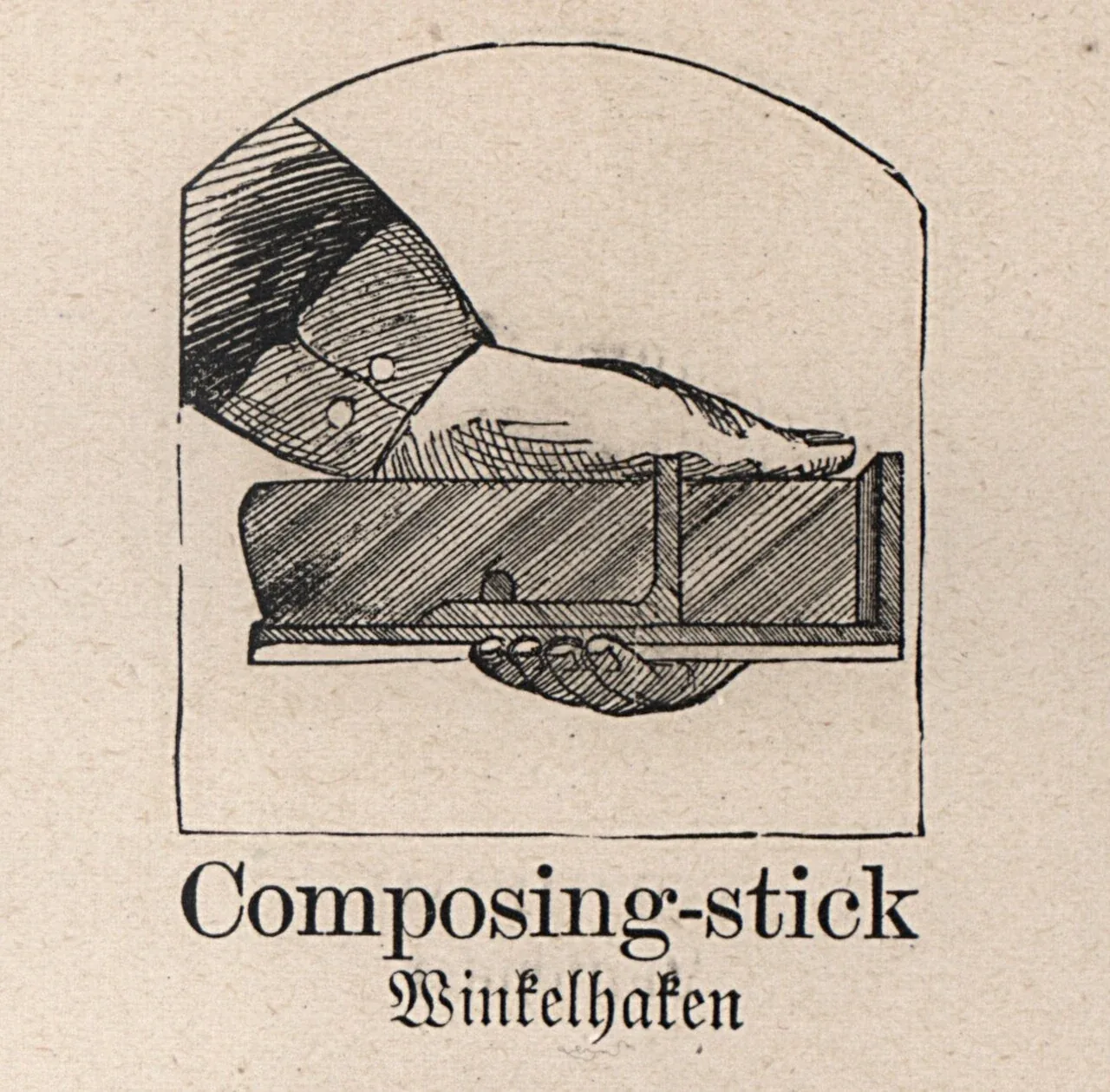
The composing stick is a small tool with an outsized role: it holds one line of type while a compositor assembles words from individual sorts. The Library of…
5 min read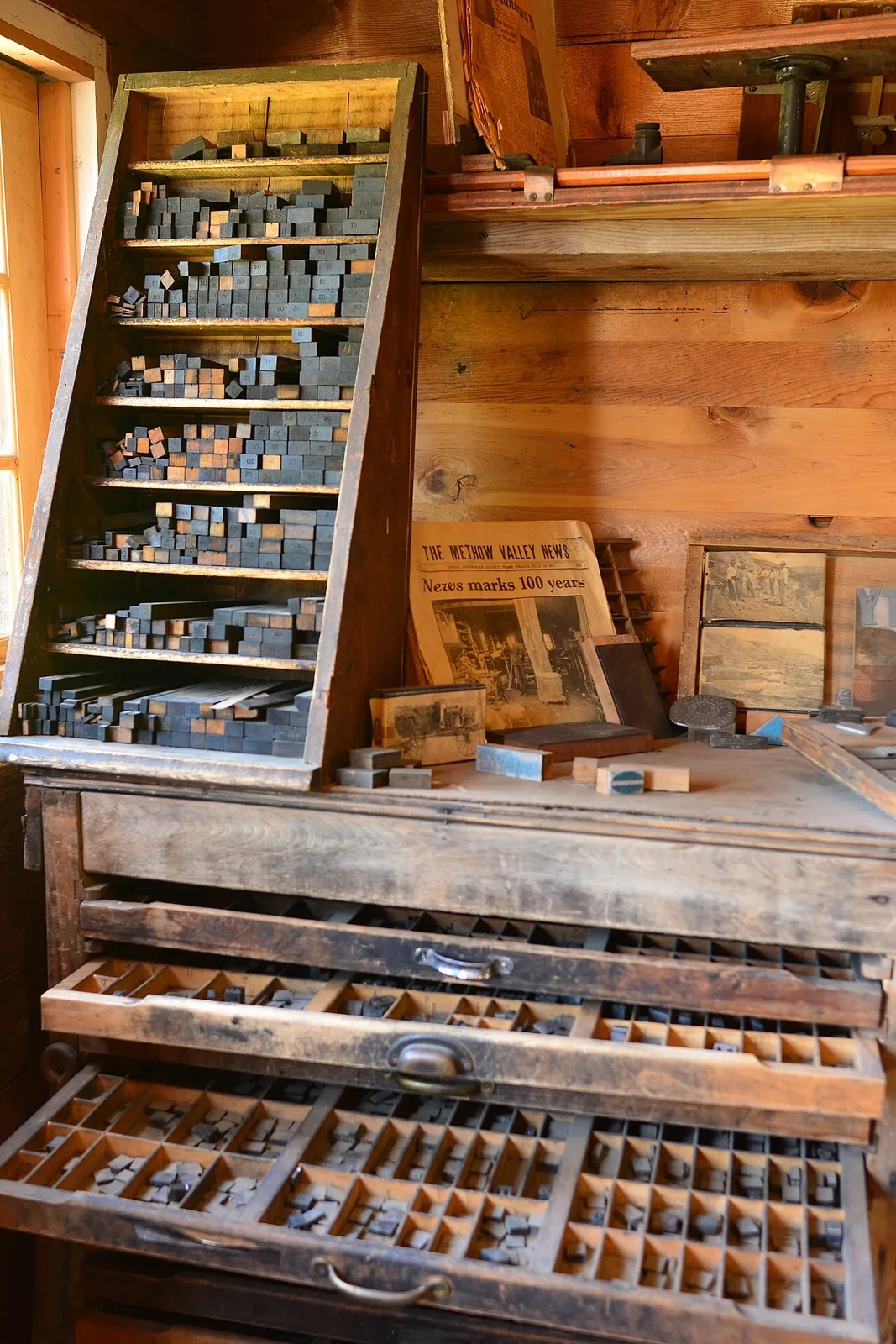
The Type Case as a Shop Index
A printer’s case is not a decorative box of letters. It is a working storage system that determines how a compositor reaches the type needed for a line. The cover’s…
4 min read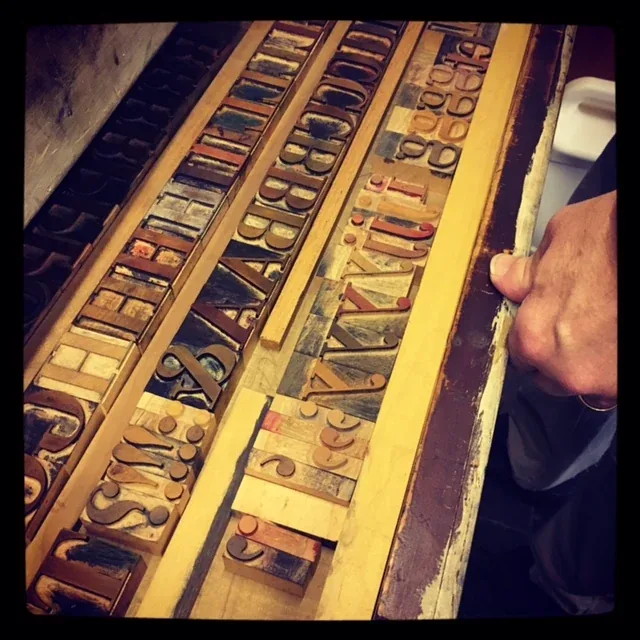
Large Wood Type Beyond Metal
The wooden “Bodoni” type in this cover is identified in its Commons file record as a 120-point wood typeface. Rochester Institute of Technology’s Cary Graphic Arts…
4 min read