
The Print Field / Essay 11
The Composing Stick, Line by Line
The composing stick is a small tool with an outsized role: it holds one line of type while a compositor assembles words from individual sorts. The Library of…
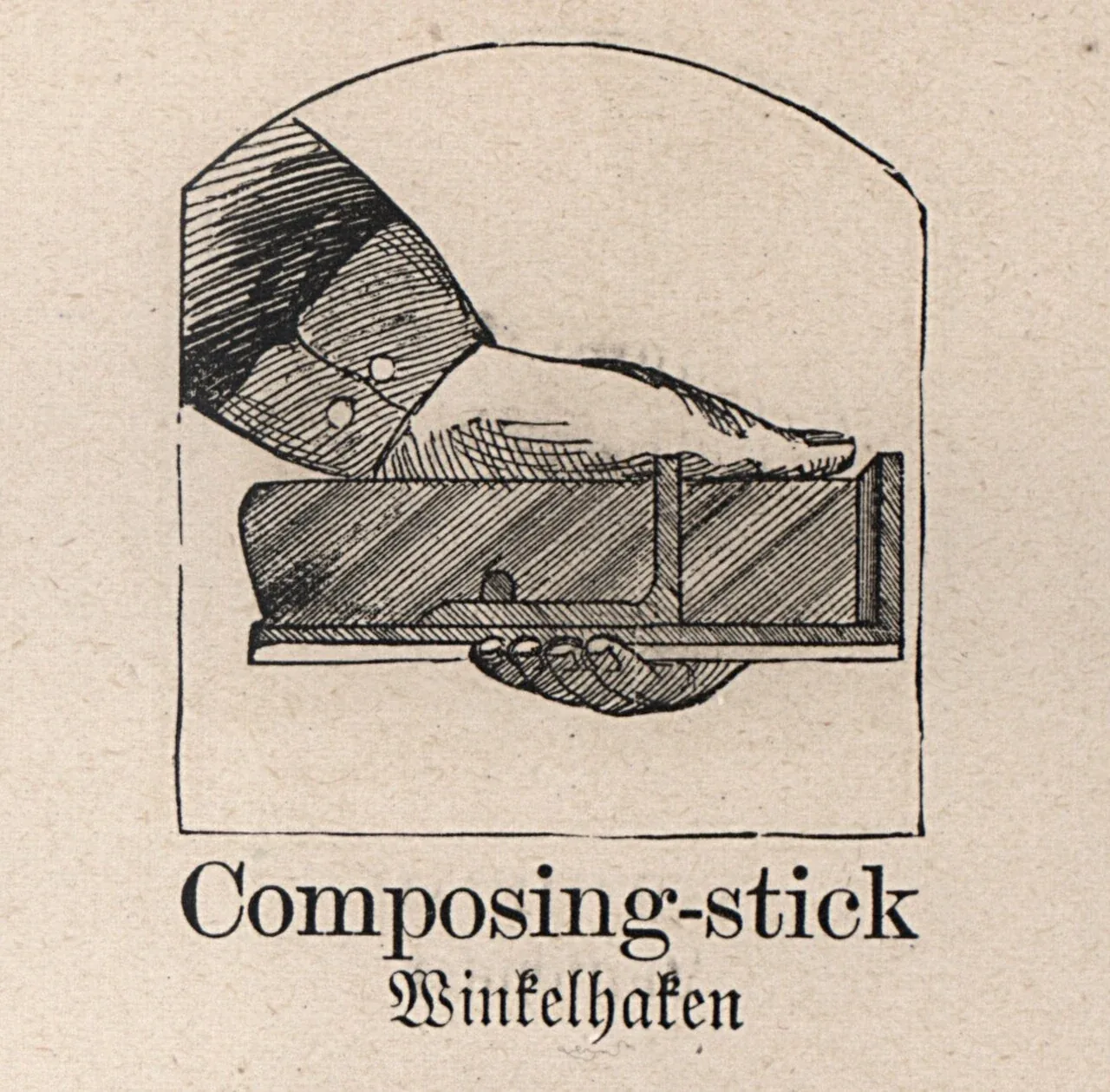
A sentence begins as separate pieces
The composing stick is a small tool with an outsized role: it holds one line of type while a compositor assembles words from individual sorts. The Library of Congress records an eighteenth-century image titled “The printing press; the letter case for the Roman type; composing stick,” placing the tool within a larger arrangement of type and press. A Science Museum Group object record also documents a historic composing stick, and the Museum of Victoria describes how a compositor selected type from a case and set it in a stick. These records help explain the tool without treating one example as universal.
The work begins with a manuscript or copy and a choice of type. Each letter is a separate piece with a body, a face, and a height that must align with the other sorts. The compositor places them into the stick in a sequence that will print correctly after the forme is locked and transferred to the press. Because metal type prints as a mirror image, the line appears reversed when viewing the printing faces before impression. This is why a compositor learns both the shape and the position of letters rather than reading them as if they were already on the page.
The stick makes a temporary line
A composing stick is adjustable so that a line can be set to a chosen measure. The specific mechanism depends on the object. Columbia University Libraries describes a historical stick with a movable knee and screw used to set the line length. The general purpose is easy to grasp: the tool creates a boundary within which words and spaces are arranged. A line that is too loose can fall apart when moved; one that is packed incorrectly may not justify evenly. The stick is a temporary container for a composition that will later be handled as part of a larger form.
The compositor’s hand must make a series of small judgments. A thin space may fit where a wider space will not. A word may be divided according to the copy and house rules; rewriting requires editorial permission. The line should fill the measure without forcing the type so tightly that it becomes difficult to transfer. No single tool solves those decisions. The stick holds the work while the person making it balances copy, measure, type size, and spacing.
Reading from the wrong side
Hand composition is often described as setting type backwards, but the phrase can make the task sound more mysterious than it is. The compositor works with individual sorts, each one physically oriented so that the face will print in the correct direction. The operator learns to recognize the type while it sits upside down and reversed in relation to the final impression. The work is tactile as well as visual: a sort’s body and nick help the hand orient it consistently.
The sequence of setting is also tied to how language is read and how the finished line is assembled. For Roman type, compositors traditionally set a line from left to right while viewing the characters reversed on their bodies. Other writing systems, languages, and type technologies can require different conventions. A historical stick does not prove that every compositor in every printing tradition used the same sequence. The specific source record should be read with its particular object and script in mind.
From stick to galley
When the line is complete, it can be moved from the stick into a galley or combined with other lines for later makeup. This is a vulnerable transition: an unsecured line can spill, a dropped sort can become a missing letter, and an uncorrected error can travel into the forme. The next proof is a check on both copy and physical assembly. The printer is not simply asking whether the words are right. They also need to know whether each sort is present, the spacing is controlled, and the line remains stable when handled.
The Library of Congress image groups the composing stick with the type case and the press, which is a useful visual shorthand for the process. The tool belongs between stored type and printed page. A case makes sorts available; the stick turns them into lines; a galley or chase organizes the lines; the press transfers ink to paper. Each stage has a distinct job, and each stage can introduce an error that becomes visible later.
A line has both a reading width and a physical width
The composing stick turns an apparently visual problem into a physical one. A line may look evenly spaced on a proof yet contain loose material before lock-up; another line may be physically secure but show distracting gaps between words. These are different failures. The first concerns whether the assembly can be handled and held. The second concerns how a reader experiences the distribution of space after printing. Solving one does not automatically solve the other.
Consider a hypothetical line that nearly fills the measure. Adding a word changes more than the meaning: it also changes how the remaining space must be distributed. A compositor cannot stretch the metal bodies as a digital layout engine might scale an image. The available choices involve spaces, line breaks, type selection, and editorial decisions permitted by the job. The stick makes those constraints tangible by giving the line a boundary.
This is why the adjustable knee described in Columbia's object record is more than a convenient fastening. It translates a page decision into a repeatable measure at the workstation. The line still needs to leave the stick, join other lines, and survive proofing. Follow those transfers and the small tool becomes an explanation of page construction: reading depends on words, while production also depends on making those words behave as an assembly of objects. The distinction clarifies the compositor's contribution without inventing the contents of a lost job.
Further reading
Sources & records
Linked records provide object descriptions and historical context. Comparisons, close readings, and explicitly hypothetical examples are editorial analysis. This essay was revised on 22 October 2026; it does not report first-hand workshop research. The image source and license appear in its caption.
- Library of Congress: 1747 engraving showing press, type case, and stick
- Library of Congress: English Print Guide
- Science Museum Group: historic composing stick
- Museums Victoria: Letterpress Printing
- Columbia University Libraries: composing stick and line measure
- The Composing Stick, Line by Line cover image source record
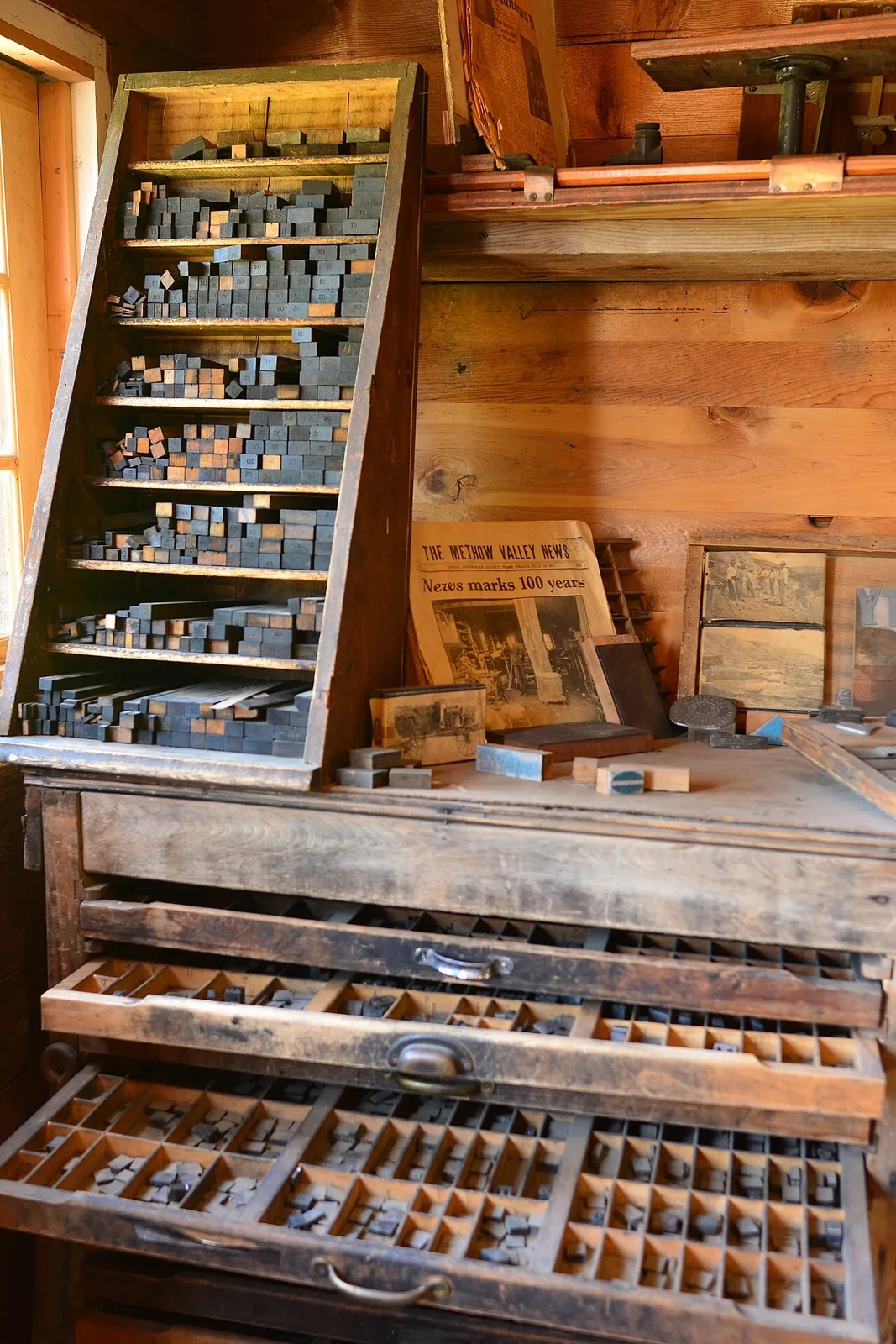
The Type Case as a Shop Index
A printer’s case is not a decorative box of letters. It is a working storage system that determines how a compositor reaches the type needed for a line. The cover’s…
4 min read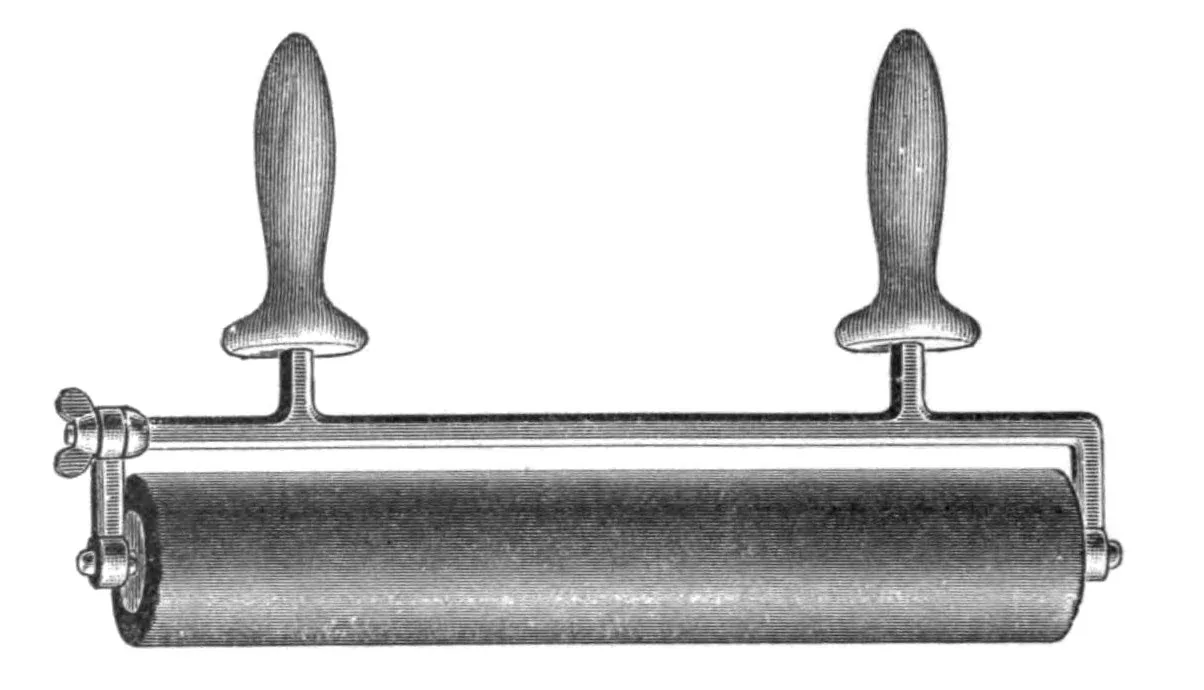
Inking with a Hand Roller
The cover reproduces an illustration of a composition hand roller from an American Type Founders catalogue dated 1906, as identified in the source file. The file…
5 min read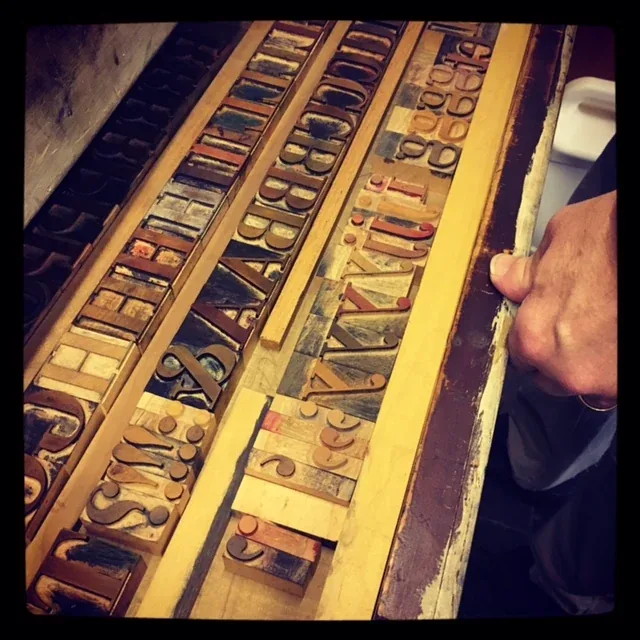
Large Wood Type Beyond Metal
The wooden “Bodoni” type in this cover is identified in its Commons file record as a 120-point wood typeface. Rochester Institute of Technology’s Cary Graphic Arts…
4 min read