
The Print Field / Essay 35
Sargis Hovhannisyan’s Antireligious Poster
The Commons record identifies this work as an antireligious poster by Sargis Hovhannisyan, made in linocut on paper, with a listed size of about 21.8 by 17.5…
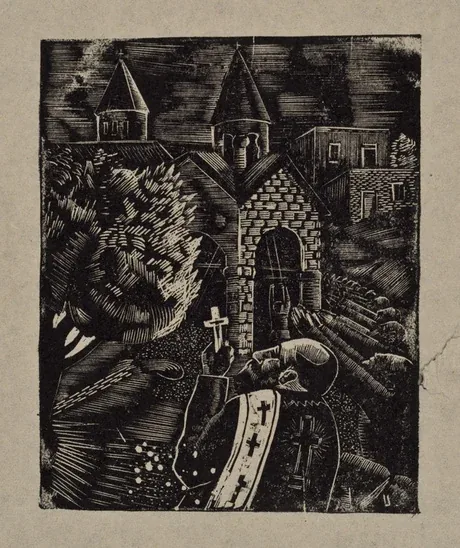
A poster title is not its whole history
The Commons record identifies this work as an antireligious poster by Sargis Hovhannisyan, made in linocut on paper, with a listed size of about 21.8 by 17.5 centimetres. The same file page gives the artist's dates as 1884–1940. It dates the work to before 1937 but gives no exact year, commissioning body, or original publication venue. Those missing fields matter. A political title can tempt a reader to supply a context that the surviving record does not establish.
The work can still be studied as a compact relief print. The file description identifies paper and linocut, while its title records the subject as antireligious. The subject label is reported here as catalogue language. It does not identify the circumstances of production or authorize a claim about a particular campaign. Those questions need records tied to the poster itself, rather than a general account of Armenian graphic arts or an unrelated nineteenth-century periodical.
Relief makes an argument reproducible
Linocut is a relief process. The maker removes parts of a linoleum surface, leaving raised areas that can receive ink. Pressure transfers the design to paper. The relationship between raised and cut-away areas determines which shapes print and which remain unprinted. In a poster, that graphic economy can make the image legible at a glance, though a specific poster's intended viewing distance should not be asserted without production evidence.
The poster's dimensions are relatively compact compared with a large public notice. The listed size, about 21.8 by 17.5 centimetres, describes the object in the file record. It does not tell us where it was displayed or how many copies were printed. A viewer can inspect the contrast, text, and depicted forms, but the social life of the poster requires archival records or scholarship that connects the image to a date and campaign.
Read the message and the medium separately
“Antireligious” is the catalogue's label for the poster's subject. That label names an ideological stance; it does not tell us whether the work was part of an institution's program, a private commission, or an individual publication. The artist's name and lifespan are documented in the file's creator record, but the poster has a recorded date limit of before 1937 rather than an exact year. The distinction prevents the artist's dates from being mistaken for the work's date.
The image can be read for its rhetoric. Which figures or symbols carry the argument? What does the lettering emphasize? Does the composition ask the viewer to compare two ideas, or does it present a single dominant image? These are questions about the visual evidence. A reader should consult a scholarly history of the relevant political moment before linking the poster to a specific law, campaign, or state policy.
Why uncertainty belongs in political art history
Posters are often treated as direct evidence of public campaigns. Many are, but a title and style alone cannot prove institutional use. A poster's production date, publisher, place, circulation, and audience can change how it should be interpreted. If those details are not in the record, the article should say so rather than borrowing context from another poster that looks similar.
This is especially important for works spanning political and religious themes. Terms such as “anti-clerical,” “secular,” and “anti-religious” may describe different arguments or contexts. The file title uses “antireligious.” That is the safest term for identifying this object unless a more detailed scholarly source explains its original wording and circulation. The article can examine the image's structure while leaving its precise historical campaign open.
The print as a material object
The paper carries a single impression, but the block could in principle have produced multiple impressions. No edition number is listed in the cited file record. That means we cannot state the number printed or the scale of distribution. The relief block's raised surface allows repetition; the historical reach of a particular work must be established separately.
The Commons record also identifies the work as public domain and gives a file history. A digital reproduction may preserve the design, but it may not communicate the original paper's color, condition, or printing pressure. For an object-level study, a collection page or physical examination would add information about the sheet and its provenance. The current image is a window into the artwork, not a substitute for all of its records.
A date limit narrows the question without answering it
The Commons description provides a meaningful boundary: before 1937. That is not a precise production year, but it is more informative than saying that no date is given. The artist's lifespan, 1884–1940, describes the person; the terminus attached to the work narrows the object's recorded chronology. Neither identifies a commissioner, an original venue, or a distribution campaign. Those would require additional object-level documentation.
There is another instructive inconsistency within the same record. The filename includes 21.8 by 17.8, while the descriptive measurement reads 21.8 by 17.5. This article follows the description and makes the discrepancy explicit rather than silently treating the filename as a second confirmed measurement. The difference is small numerically but useful methodologically: filenames, summaries, and catalogue fields are not guaranteed to repeat identical information. Their agreement should be checked, not assumed.
These distinctions make a restrained account more informative without reconstructing the poster's political history. A reader can identify the named artist, the relief medium, the recorded dimensional description, and the broad date limit. The visual composition can then be considered as a printed arrangement of lettering and image. A compact sheet may have strong rhetorical form, but its size cannot prove where it was displayed or how many people saw it. The article's contribution is an object reading with a more precise chronology, not an unsupported narrative of a campaign or an endorsement of the message identified by the catalogue.
Further reading
Sources & records
Linked records provide object descriptions and historical context. Comparisons, close readings, and explicitly hypothetical examples are editorial analysis. This essay was revised on 22 October 2026; it does not report first-hand workshop research. The image source and license appear in its caption.
Rocks in Bretagne
The Commons object description identifies Ingeborg Bernhard's linocut as *Rocks in the Bretagne, France*, dated 1977, with dimensions of 21 by 30 centimetres. The…
5 min read
Carving a Chandigarh Stamp in Linoleum
The photograph shows a sheet of linoleum being carved for a stamp. Its caption identifies the design as a stamp featuring Chandigarh's Open Hand Monument, the Rock…
5 min read
Yvonne Drewry’s Convolvulus Linocut
The Commons file record identifies this image as a linocut of convolvulus flowers by Yvonne Drewry, dated 1975. The photographed impression is the starting…
5 min read