
The Print Field / Essay 50
Pope’s Day in Boston, 1769
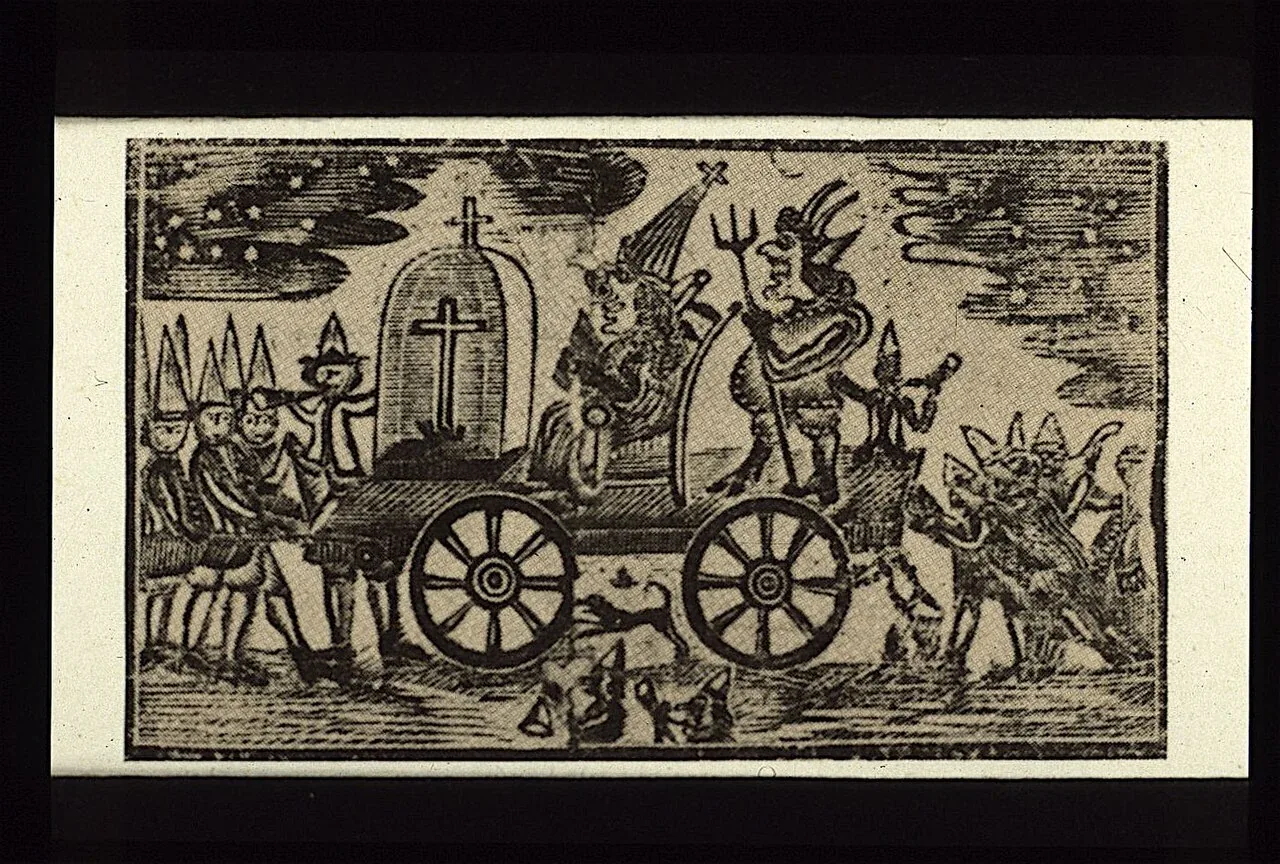
The cover file is catalogued as a woodcut broadside of “Pope's Day” in Boston, dated 1769. That caption identifies a subject and year but does not name the printer,…
A woodcut broadside with a charged title
The cover file is catalogued as a woodcut broadside of “Pope's Day” in Boston, dated 1769. That caption identifies a subject and year but does not name the printer, artist, or publication venue. A broadside is a single printed sheet meant to present information or imagery on an open page. The woodcut places an image into that public format, where readers could encounter it outside the sequential structure of a book.
Pope's Day was a New England observance associated with November 5 and the Gunpowder Plot. The Colonial Society of Massachusetts edition of Ashley Bowen's journals notes that in 1769 the observance was delayed by one day because November 5 fell on the Sabbath. Its account describes the event as a time of masquerades, bonfires, and temporary release from ordinary restraint. That provides context for the date without proving the exact circumstances in which this particular broadside was printed or viewed.
The broadside format makes a public surface
Broadsides often combine a large image with text that can be read at a glance. The sheet does not have to be folded into a book or bound into a volume. Its layout can direct attention through a title, verses, a woodcut, or an imprint. The exact hierarchy on this 1769 sheet should be read from the original scan; its file caption alone does not tell us which elements dominate or what words surround the image.
Woodcut printing allowed a block to be used alongside type in a printed composition. Raised parts carried ink; cut-away areas remained blank. The image could be printed as one part of the sheet, while letterpress type supplied text. The combined surface let a printer make an image and words available together. The file record identifies this as a woodcut broadside, but it does not establish the exact type arrangement or whether the image block was reused elsewhere.
The title tells us what the record calls the event
“Pope's Day” is a period label with a long and contested history. The Colonial Society describes it as a New England equivalent of Guy Fawkes Day and records bonfires, masquerades, and processions in the region. The Library of Congress preserves a separate Boston broadside from 1768 titled South End Forever [cut] North End Forever, with verses about Pope-night. That separate sheet illustrates how political and neighborhood identities could intersect with the observance, but it is not the same object as this 1769 woodcut.
The label also signals anti-Catholic sentiment. An image or text from such an event should not be repeated as neutral celebration. A historian can describe the visual record while making clear that the tradition targeted Catholic authority and communities. The available caption does not identify the depicted person or group, so the article should not infer who is shown or attach a specific incident to the print.
Evidence about one night and a broader custom
The 1769 date belongs to the file's description of the broadside. The Colonial Society source says the observance that year took place on November 6 because November 5 was Sunday. That is useful background, but it does not prove that the broadside was produced on that day, used at a particular procession, or distributed by a named printer. Those are separate historical questions.
The same journal edition includes an account of a Pope's Day celebration in Newbury in 1775. It describes boys carrying effigies and larger evening displays, but that event occurred six years later and in another town. It can show what an editor documents about the custom in a different place and year; it should not be silently applied to the 1769 Boston scene. Historical parallels are informative when their date and location stay attached.
The image is not the whole event
A woodcut can preserve a way of representing an event, but it is not a neutral photograph. The printer or artist selects a viewpoint, arranges figures, and chooses which details will survive carving. A broadside's text can guide the reader toward a particular interpretation. The sheet is evidence of visual culture and communication; it is not a complete record of every action that occurred in Boston.
The source file's licensing record identifies the image as public domain. Its creator field is unknown, so the article does not invent a name. An original library catalogue might clarify dimensions, imprint, or collection history. Until then, the file caption and the related scholarly source provide the boundaries for description.
The sheet's date is not automatically the event's date
A record identifying a 1769 broadside and an account describing a November observance supply different kinds of chronology. The first dates the printed object at a broad level. The second describes an event or a custom in a particular place and year. Joining them can provide context, but it cannot establish the day the sheet was printed, the procession at which it appeared, or the people who distributed it. Those are additional claims requiring additional evidence.
The comparison with the Library of Congress's 1768 sheet is useful for the same reason. A related broadside can show how an observance entered printed communication without becoming the source object for this reproduction. Similar subject matter does not make the two sheets interchangeable. Their wording, imagery, imprints, and collection records would have to be compared before a common production history could be proposed.
This article therefore reads the object as a historical communication surface rather than reconstructing an unrecorded scene around it. A single sheet can arrange an image and text for an encounter different from reading a bound sequence of pages. That formal capacity is observable in the medium; its actual historical audience remains a matter for records. The catalogue's anti-Catholic subject also requires attribution and context, rather than adopting the sheet's viewpoint. The original value of the comparison is precision about what survives: a printed representation, contextual accounts, and a related object, each contributing evidence without becoming a complete narrative of one night in Boston.
Further reading
Sources & records
Linked records provide object descriptions and historical context. Comparisons, close readings, and explicitly hypothetical examples are editorial analysis. This essay was revised on 22 October 2026; it does not report first-hand workshop research. The image source and license appear in its caption.
Robert Bryden’s Carlyle Woodcut
The file record identifies this image as Robert Bryden's woodcut of Thomas Carlyle, made for *Some Woodcuts of Men of Letters of the Nineteenth Century*. The file…
5 min read
Popular Irish Stories: A Glasgow Chapbook
*Popular Irish Stories* appeared in Glasgow in 1850 as number 23 in a “New and Improved Series.” The National Library of Ireland catalogue describes it as a 24-page…
5 min read
Monardes’s Armadillo Woodcut
The Commons record identifies this image as a woodcut illustration of an armadillo from Nicolás Monardes's 1574 *Historia medicinal*. The illustration belongs to a…
5 min read