
The Print Field / Essay 38
Maternity, 1971
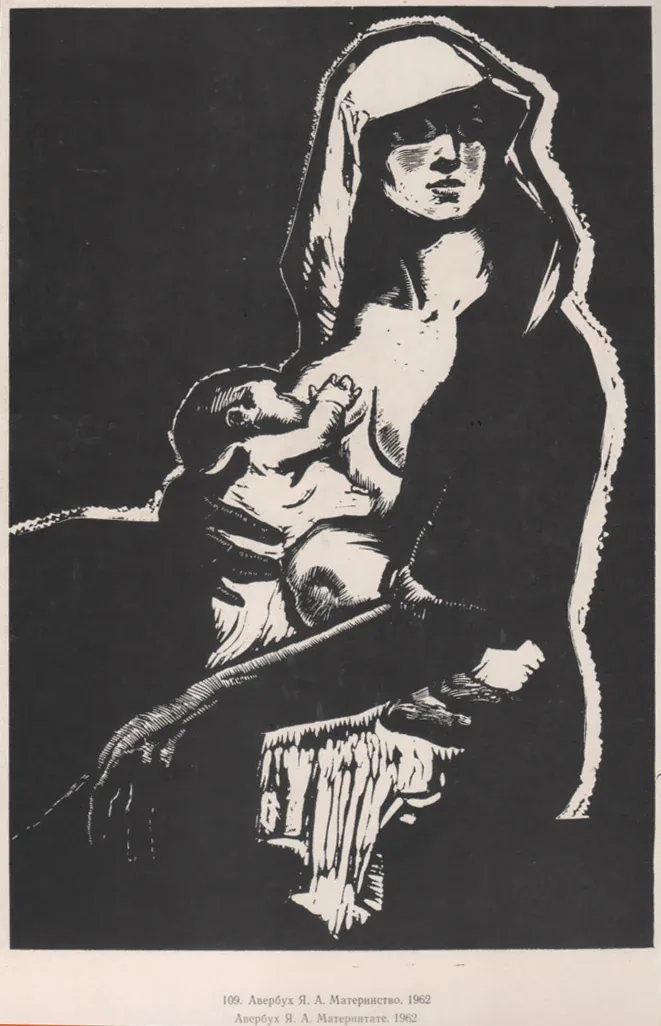
The Commons file for this tall linocut carries a Russian description: “Материнство, 60х30см., линогравюра.1971 год.” Translated, it identifies the subject as…
A title preserved in another language
The Commons file for this tall linocut carries a Russian description: “Материнство, 60х30см., линогравюра.1971 год.” Translated, it identifies the subject as “Motherhood,” gives dimensions of 60 by 30 centimetres, calls the medium linocut, and dates the work to 1971. The file credits the account Nikita MV and declares own work, without clarifying the relationship between that account and the 1971 artwork. It lists the user who uploaded the digital file, a separate fact that should not be treated as proof of authorship of the artwork.
The distinction between an artwork's maker and an image uploader is important in any online collection. The Commons entry says the file was uploaded by Nikita MV and licensed under CC BY-SA 4.0. It does not establish that the uploader carved or printed the original linocut. Until a museum catalogue or artist record identifies the maker, a responsible caption preserves the account credit and explains that the historical artist identification has not been independently established.
The long format shapes the reading
At 60 by 30 centimetres, the recorded dimensions give a two-to-one proportion; the field does not specify whether it measures the sheet or image. That proportion encourages a vertical reading. The viewer may follow a body, gesture, or repeated shape upward through the composition. The title supplies a subject category, but it does not specify which figures are depicted or how they are arranged. Those visual details belong to close looking at the image.
Linocut is a relief process. The printer inks raised areas of a carved block and presses them against paper. The cut-away areas remain blank. This means that the image's light and dark forms are linked to what was removed from the surface. A printmaker has to plan how those shapes will appear when reversed on paper. The final impression turns the block's material decisions into a vertical composition.
“Motherhood” is a broad title. It can frame the image around care, kinship, or the relation between bodies, but those are possible readings rather than documented intentions. A viewer should begin with visible evidence: scale, pose, negative space, and the way the forms meet the edge of the sheet. If a gesture appears protective or tender, that description can be presented as an interpretation of the composition, not as a verified statement from the artist.
Reading a work with incomplete attribution
Incomplete metadata does not make an artwork unworthy of attention. It changes the kind of claims we can make. The file provides a title, medium, dimensions, year, and image license. The name of the uploader is documented. What remains independently unconfirmed is the historical artist identification, the print's original collection, its edition size, and its exhibition history.
The gap is an invitation to research rather than an excuse to invent. A specialist catalogue could match the image to an artist. An inscription on the original might supply a signature or date. A collection record could identify a donor or owner. Until such evidence is found, the article should preserve the uncertainty explicitly. Readers benefit from knowing which parts of the description are secure and which need further work.
Relief and the figure
The medium can simplify anatomy into areas of light and dark. A cut line may define a shoulder or the gap between two bodies. A broad black shape can carry weight; an unprinted area can create space around a figure. The tall format gives these contrasts room to stretch vertically, while the carved edge can make the composition feel direct and tactile.
These observations are available from the image; the exact carving method is not. We do not know from the file record whether one block or multiple passes were used, what type of ink or paper was selected, or whether the work was printed by hand or on a press. Those details matter to a technical history of the piece and should not be guessed from the appearance of the reproduction.
Date, dimensions, and digital file
The Russian description dates the artwork to 1971; the file history lists 2019 as an upload event. These dates refer to different things. The first belongs to the print as described; the second records when the digital file entered Commons. The page's derivative WebP is further removed from the original object. It is a locally served conversion of the licensed image, not a new claim about the print's origin.
The wording “60х30см” uses a Cyrillic character that resembles the Latin letter x. Translating the record as 60 by 30 centimetres preserves the intended measurement while avoiding a false distinction between two alphabets. This is a small example of why multilingual object records should be read with care: script, transliteration, and translation all affect how a catalogue appears in English.
A tall format makes distance part of the subject
The description's 60-by-30-centimetre dimensions establish a two-to-one proportion, although the record does not identify whether they measure the sheet or the printed area. A vertical format creates a different set of compositional possibilities from a square: forms can be stacked, stretched, enclosed, or separated along a longer axis. The title Motherhood directs attention toward relationships between figures, but the format helps determine how those relationships can occupy space.
Consider how a viewer might move through a tall image. The eye can travel from an upper form toward a lower one, return along an enclosing contour, or pause at an interval of open paper. Such movements are interpretive possibilities to test against the reproduction. They do not identify the depicted people or disclose the unknown artist's personal experience. An account of care or intimacy should explain which spatial relationship supports it rather than derive an entire biography from the title.
The translated description is a limited record, not an authenticated artist catalogue. It supplies a title, medium, year, and dimensions, while the upload account identifies the digital contributor. Keeping those roles distinct leaves room for an original analysis of proportion without filling the attribution gap. The article can ask how vertical distance becomes expressive within a relief image, and why a long enclosing form might be read differently from a wide grouping. That is a claim about the possibilities of this format, with its application dependent on the visible arrangement rather than an invented authorial story.
Further reading
Sources & records
Linked records provide object descriptions and historical context. Comparisons, close readings, and explicitly hypothetical examples are editorial analysis. This essay was revised on 22 October 2026; it does not report first-hand workshop research. The image source and license appear in its caption.
Rocks in Bretagne
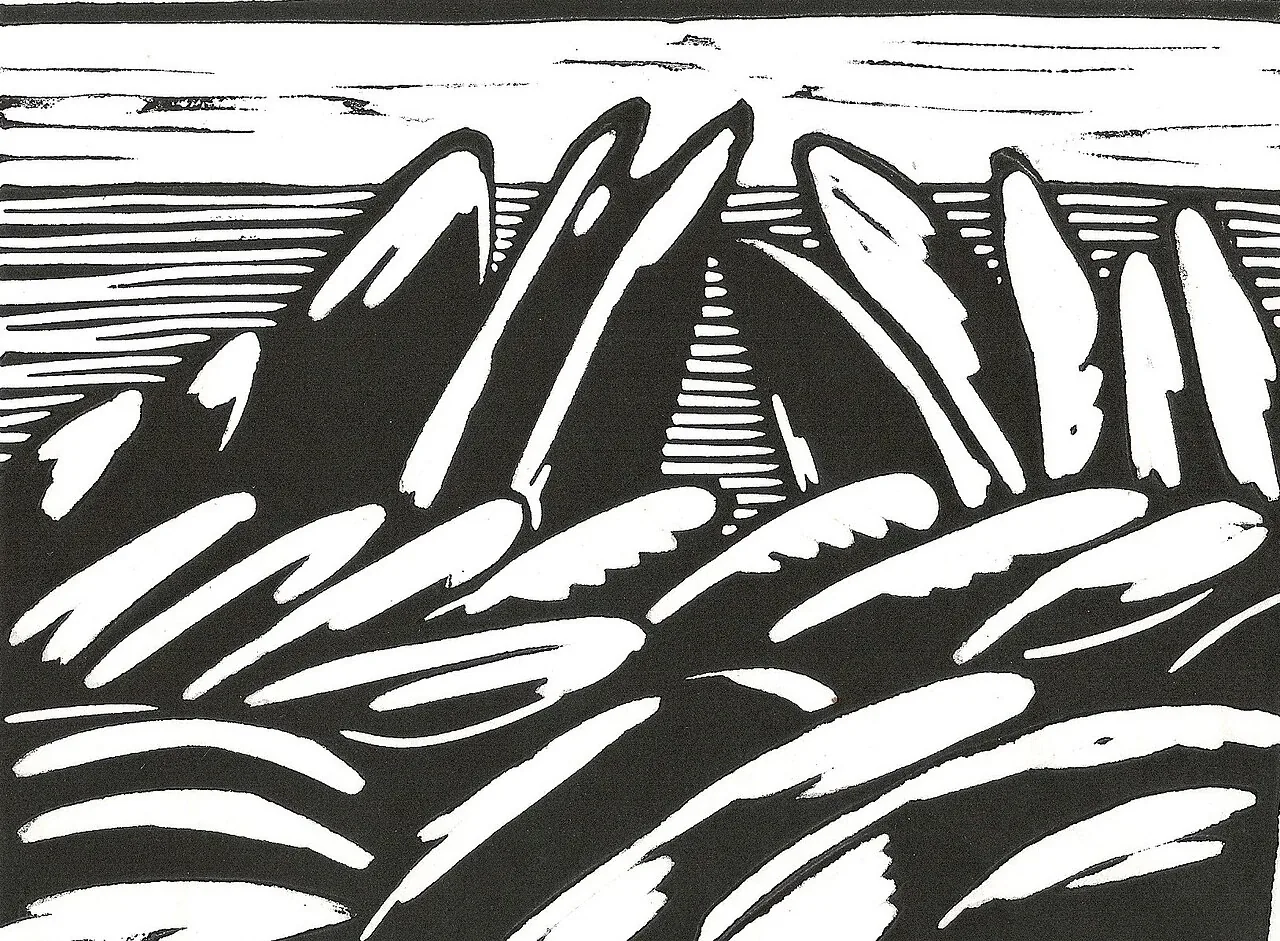
The Commons object description identifies Ingeborg Bernhard's linocut as *Rocks in the Bretagne, France*, dated 1977, with dimensions of 21 by 30 centimetres. The…
5 min read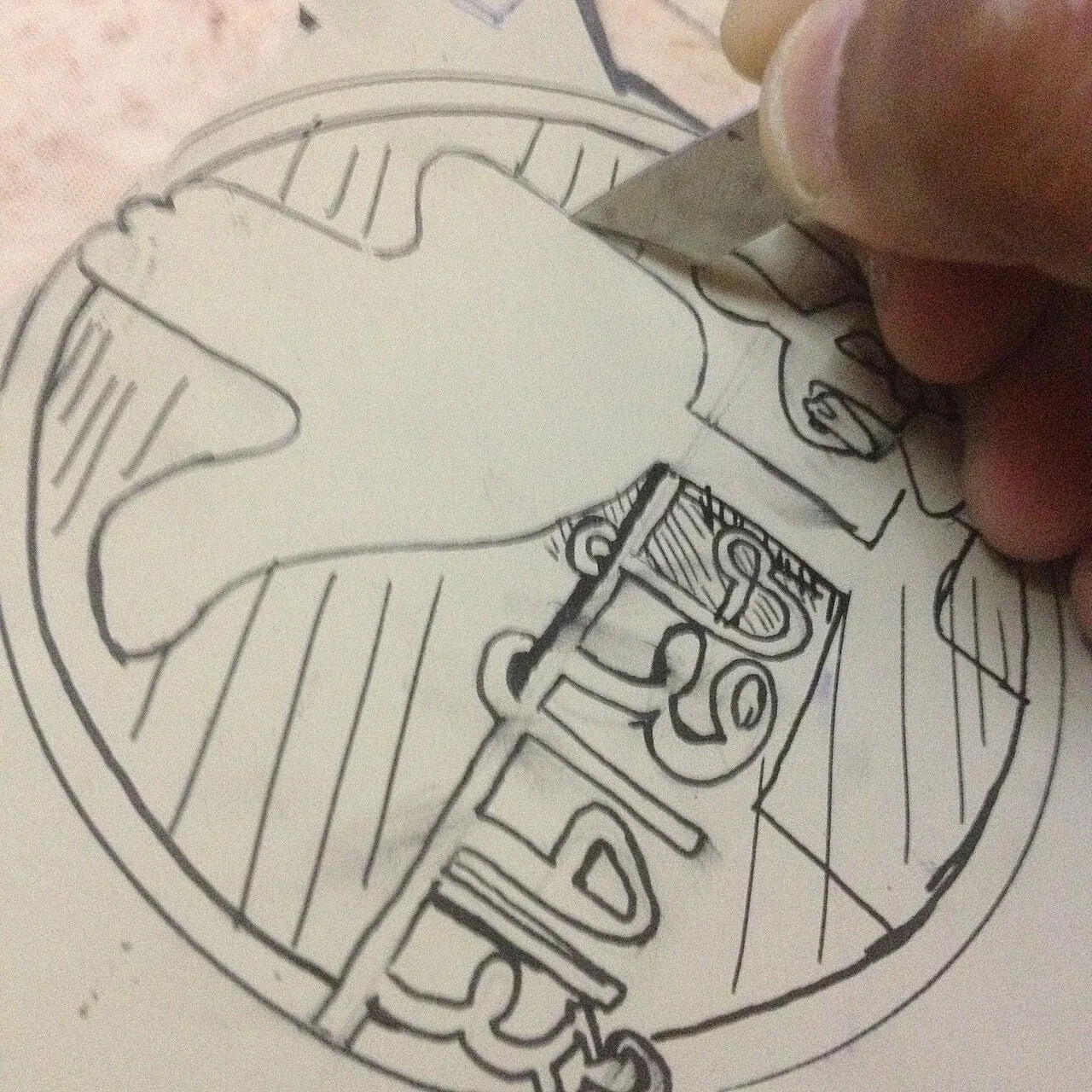
Carving a Chandigarh Stamp in Linoleum
The photograph shows a sheet of linoleum being carved for a stamp. Its caption identifies the design as a stamp featuring Chandigarh's Open Hand Monument, the Rock…
5 min read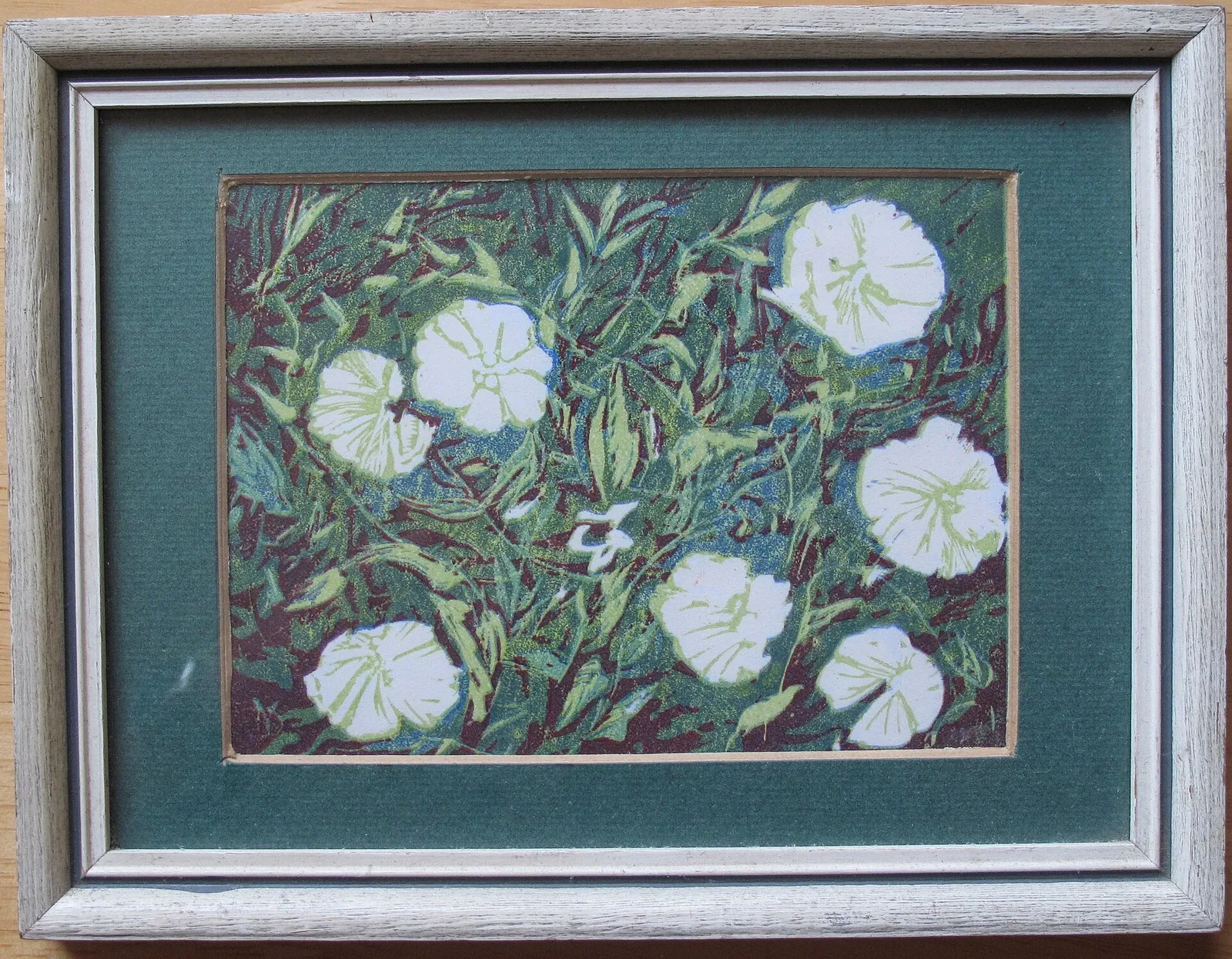
Yvonne Drewry’s Convolvulus Linocut
The Commons file record identifies this image as a linocut of convolvulus flowers by Yvonne Drewry, dated 1975. The photographed impression is the starting…
5 min read