
The Print Field / Essay 06
Marinoni’s Rotary Letterpress
The Marinoni press in this cover is described in its Commons record as a rotary letterpress dating to about 1883. The National Museum of American History’s history…
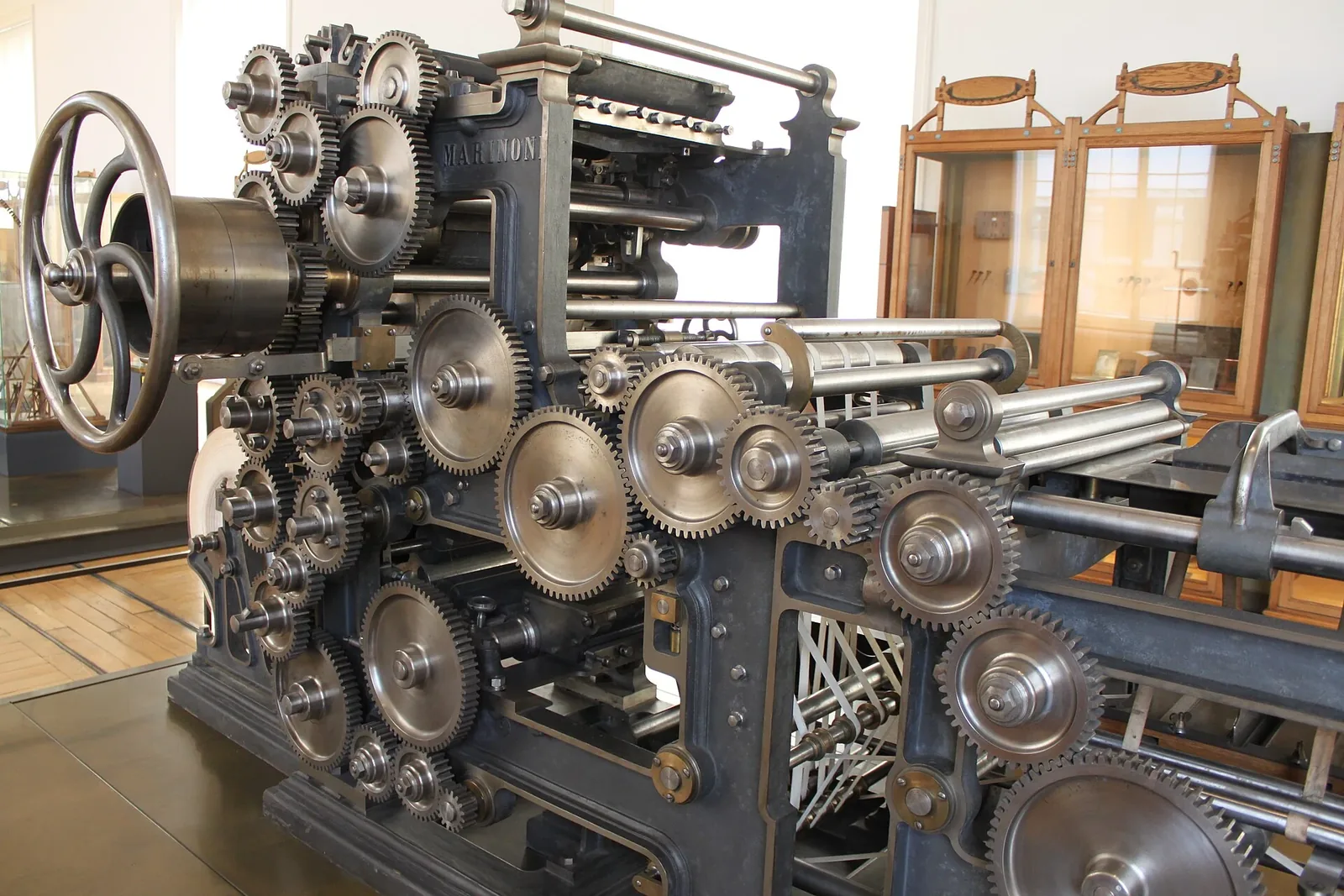
When the form begins to turn
The Marinoni press in this cover is described in its Commons record as a rotary letterpress dating to about 1883. The National Museum of American History’s history of printing machines explains the central change behind rotary presses: instead of making each impression with a form that travels back and forth, the type is arranged on a cylinder that turns against an impression cylinder. Paper can move through a more continuous path. The result is a different relationship between the printed form, the sheet, and time.
The Commons description dates the pictured machine approximately to 1883. That is the identification used here, while the Smithsonian machinery history supplies a separate explanation of flatbed-cylinder and rotary arrangements. The comparison concerns the geometry of the printing surface, rather than an unverified chain of dates for machines in several museums. A name associated with a manufacturer can cover more than one design, so the process term rotary letterpress remains important to the identification.
A cylinder changes the geometry
In a flatbed press, the type form lies on a flat bed and must travel through a printing cycle. The Smithsonian describes early American cylinder machines in which type stayed on a flatbed while an impression cylinder turned over it. The cylinder’s motion made paper feeding more continuous, even though the bed still moved back and forth. In a rotary press, the type itself is curved around a cylinder, so the printing form and impression cylinder rotate together. That distinction changes how movement is organized.
Curving the form is not simply a matter of bending metal type. A rotary letterpress uses plates or other prepared surfaces that can be mounted around the cylinder. Historical accounts of machine development describe stereotyping as a way to reproduce a type form in a durable curved plate. The exact process and press configuration varied by model; the article’s sources explain the broader shift, not the construction details of every Marinoni machine. A catalog entry or technical manual should be consulted before making a claim about one particular model’s plates.
Speed has a supply chain
Mechanization promised more impressions in less time, but speed depended on the rest of the shop. The Smithsonian points out that a faster press could damage inking rollers, requiring changes to roller materials. It also notes that a high-speed machine cost more, so the shop needed larger editions to reduce the cost per copy. These are not side effects. They determine whether a press is practical for a newspaper, a small book job, or a printer who handles varied work.
Continuous movement changes the operator’s tasks. Instead of applying force to each pull, the operator monitors feeding, delivery, and the steady supply of ink and paper. A stoppage can affect more than one sheet. The machine may be faster, yet the work demands maintenance, coordination, and a sufficient volume of orders. The story of the rotary press is therefore an economic story as well as a mechanical one.
Letterpress is not one machine
The word “rotary” can describe machines that use different printing surfaces and processes. A rotary letterpress prints from raised type or a raised plate. A rotary gravure press uses an intaglio cylinder; offset presses transfer images through an intermediate surface. These technologies may share cylindrical motion while differing in how ink is carried and transferred. The Marinoni name is associated with several kinds of press building, so the adjective “letterpress” in the cover record matters. It identifies the process being discussed and guards against treating every machine with cylinders as the same device.
The move from handpress to powered cylinder also did not make the earlier machine obsolete everywhere. The Smithsonian notes that flatbed presses continued to hold a place in fine book work because of the quality of their output. Different presses served different needs. A shop choosing a machine weighed print area, repeatability, investment, edition size, maintenance, and available labor. There was no single best press for every kind of printing.
Continuous motion changes the cost of an interruption
Rotary motion makes a useful comparison possible even without a speed figure for the pictured Marinoni. In a reciprocating arrangement, a bed changes direction during its cycle. A rotary arrangement organizes printing around repeated turning. Removing one kind of reversal changes the mechanical problem, but it also increases the importance of supplying paper, ink, and prepared printing surfaces at a compatible pace. Continuity at the impression point is useful only when the surrounding operations can support it.
Consider a hypothetical stoppage caused by an unsuitable supply of paper. A press advertised through its nominal speed is now producing no finished copies. If the run is short, preparation and interruptions may dominate the job; if it is long, uninterrupted production has more opportunity to repay setup. This is a qualitative comparison, not a calculation of Marinoni's historical costs. It explains why the Smithsonian discusses larger editions alongside more expensive high-speed machinery.
The distinction between a flat forme and a curved printing surface matters for the same reason. Preparing the surface belongs to the investment made before the run, while continuous rotation belongs to the repeated work during it. The machine's geometry joins those two stages in a particular way. Read from that perspective, the Marinoni is not merely a faster-looking press. It is an example of production being arranged around sustained flow, with preparation and interruption becoming central to whether speed yields useful printed matter.
Further reading
Sources & records
Linked records provide object descriptions and historical context. Comparisons, close readings, and explicitly hypothetical examples are editorial analysis. This essay was revised on 22 October 2026; it does not report first-hand workshop research. The image source and license appear in its caption.
Albion and the Press Lever
The Albion press is easiest to understand when it is treated as a working arrangement rather than as a sculptural object. A frame holds a bed and a platen in…
5 min read
Kelmscott and the Goudy Albion
The press shown here is identified in its Commons file record as the Kelmscott–Goudy press at the Cary Graphic Arts Collection. RIT’s collection record gives the…
5 min read
Babcock’s 1857 Jobbing Press
The file record for this cover identifies a Babcock jobbing press dated 1857. Its subject is a useful doorway into a part of printing that can disappear from…
5 min read