
The Print Field / Essay 01
Albion and the Press Lever
The Albion press is easiest to understand when it is treated as a working arrangement rather than as a sculptural object. A frame holds a bed and a platen in…
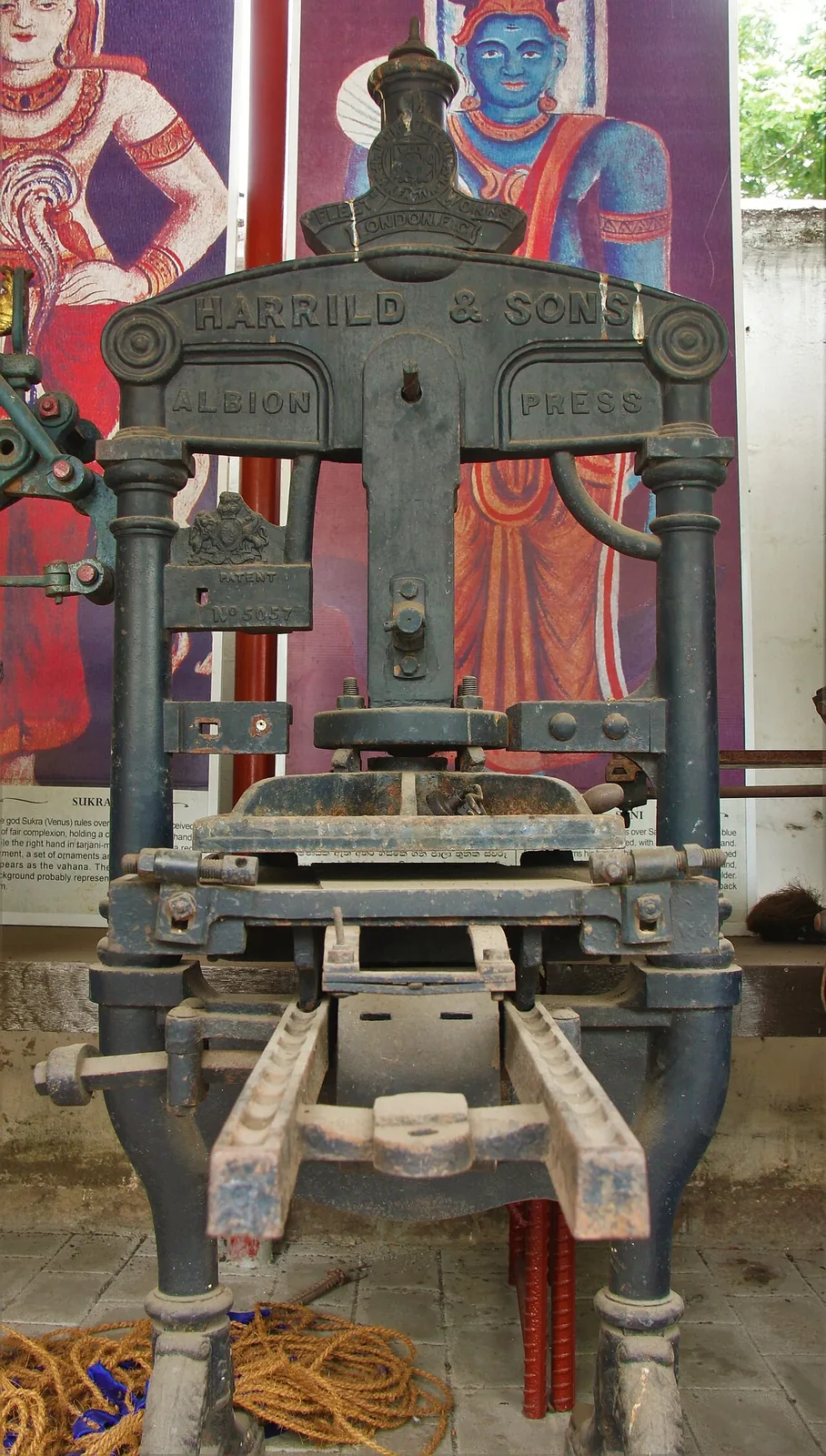
A press is a set of relationships
The Albion press is easiest to understand when it is treated as a working arrangement rather than as a sculptural object. A frame holds a bed and a platen in opposition. A forme sits on the bed; a prepared sheet is carried against it; an operator supplies force through a lever. Ink, paper, packing, and the locked type all participate in the same brief event. The result is not produced by the lever alone. It depends on how the parts meet, how evenly pressure travels, and whether the sheet returns to the same position from one impression to the next. A photograph can show the machine’s outline, but the print records its behavior.
Rochester Institute of Technology’s Cary Graphic Arts Collection lists several Albion presses among its letterpress equipment, including an Albion made in London in the 1830s and the Kelmscott–Goudy Albion. The Smithsonian’s account of iron hand presses places the change from wooden frames to iron within a broader search for more effective leverage and a larger one-pull impression. These records let a reader place the Albion within a family of presses without claiming that every surviving machine has identical fittings, dimensions, or history. A model name identifies a tradition; an object record identifies one particular object.
Force travels through the frame
In an iron hand press, the frame must resist the force created when a platen is drawn toward a bed. The Smithsonian notes that earlier wooden presses could flex, limiting the pressure they could apply over a full form. The iron frame was not merely a material upgrade for appearance. Its stiffness helped contain increased force, while changes to the lever arrangement allowed printers to use a larger platen. This distinction matters when looking at a press: the frame is part of the pressure system, not a stand around it.
The operating lever changes how the operator’s effort is applied. A long handle gives the printer room to act, while the press’s mechanism redirects that movement toward the platen. The exact path of motion varies by design. It is safer to describe a particular Albion from its own record or a clear mechanical diagram than to assume that every hand press works the same way. A visitor can nevertheless follow the basic sequence: the bed is brought into position, the paper is held in register, the platen closes, and the operator releases the mechanism before moving the bed again.
This is a slow exchange of position and pressure, not a continuous rotation. That rhythm makes hand presses useful for demonstrations and small editions, but the cycle also makes consistency an active task. The printer pays attention to the approach of the bed, the position of the sheet, and the feel of the pull. The press does not remove judgment from the process; it gives judgment a physical interface.
The bed carries the form
The bed supports the locked forme: type, blocks, and spacing material assembled into one printable surface. Its job is to present that surface to the platen without allowing the type to shift. A press can be sound while a particular forme is not ready. If the type is not secured, pressure can loosen the arrangement. If the printable faces do not sit at a common height, the sheet may receive uneven contact. A press description therefore cannot stand in for a description of composition, lock-up, or makeready.
The Albion’s visibility in working collections helps make those relationships legible. RIT uses its technology collection in classes and workshops, so the machine is encountered as something to operate and interpret rather than only as a historical display. That educational setting should not be confused with a claim that every impression made on the press represents historical production conditions. A contemporary class can show how a mechanism behaves today while still requiring separate evidence for how a nineteenth-century shop used it.
Reading the sheet as evidence
An impression can reveal contact between the type and paper, but it does not answer every question about the press. A dark area may reflect ink, packing, paper surface, pressure, or several variables at once. A deep mark in the sheet is not, by itself, proof that the machine was designed to emboss. The visible print should be read alongside the type, the paper, and the setup that produced it. When the object’s packing or its forme is no longer present, some causes remain unknown.
That caution is useful in a museum as well as in a studio. Collection pages provide maker, place, date, and provenance when those details are documented. A press’s broad design history can be compared with those object records, but the gaps should remain visible. If a label says “Albion,” the name does not certify every component as original. If a machine has been restored, the restoration record matters too. Neither uncertainty diminishes the object; it keeps interpretation tied to evidence.
Why a longer pull does not fix a pale corner
The Albion becomes easier to interpret if force and contact are considered separately. Imagine a hypothetical proof whose upper-left corner is pale while the remaining letters print clearly. Increasing the pull acts on the whole impression. It cannot selectively raise that corner of the forme. The uneven result instead directs attention toward the local relationship among printing height, packing, paper, and ink. This is a reasoning example, not a report of a test on the pictured press.
Compare that defect with a sheet whose entire image is weak. A uniform problem makes a shared cause more plausible, while a localized problem makes a local cause worth investigating. Neither appearance supplies a diagnosis by itself. What the comparison contributes is an order of questions: first describe the distribution of the defect, then consider which part of the printing system could produce that distribution. The lever's impressive movement is only one candidate in that system.
This distinction also explains why frame stiffness matters. A stiffer frame helps make applied force more predictable, but predictable force cannot compensate for every error in the prepared forme. The Albion's engineering creates the conditions for a controlled impression; preparation determines what meets the paper within those conditions. Reading the machine in this way connects the museum's account of iron construction with an observable difference on a printed sheet. The useful achievement is repeatable contact across an area, rather than the largest possible pull at a handle.
Further reading
Sources & records
Linked records provide object descriptions and historical context. Comparisons, close readings, and explicitly hypothetical examples are editorial analysis. This essay was revised on 22 October 2026; it does not report first-hand workshop research. The image source and license appear in its caption.
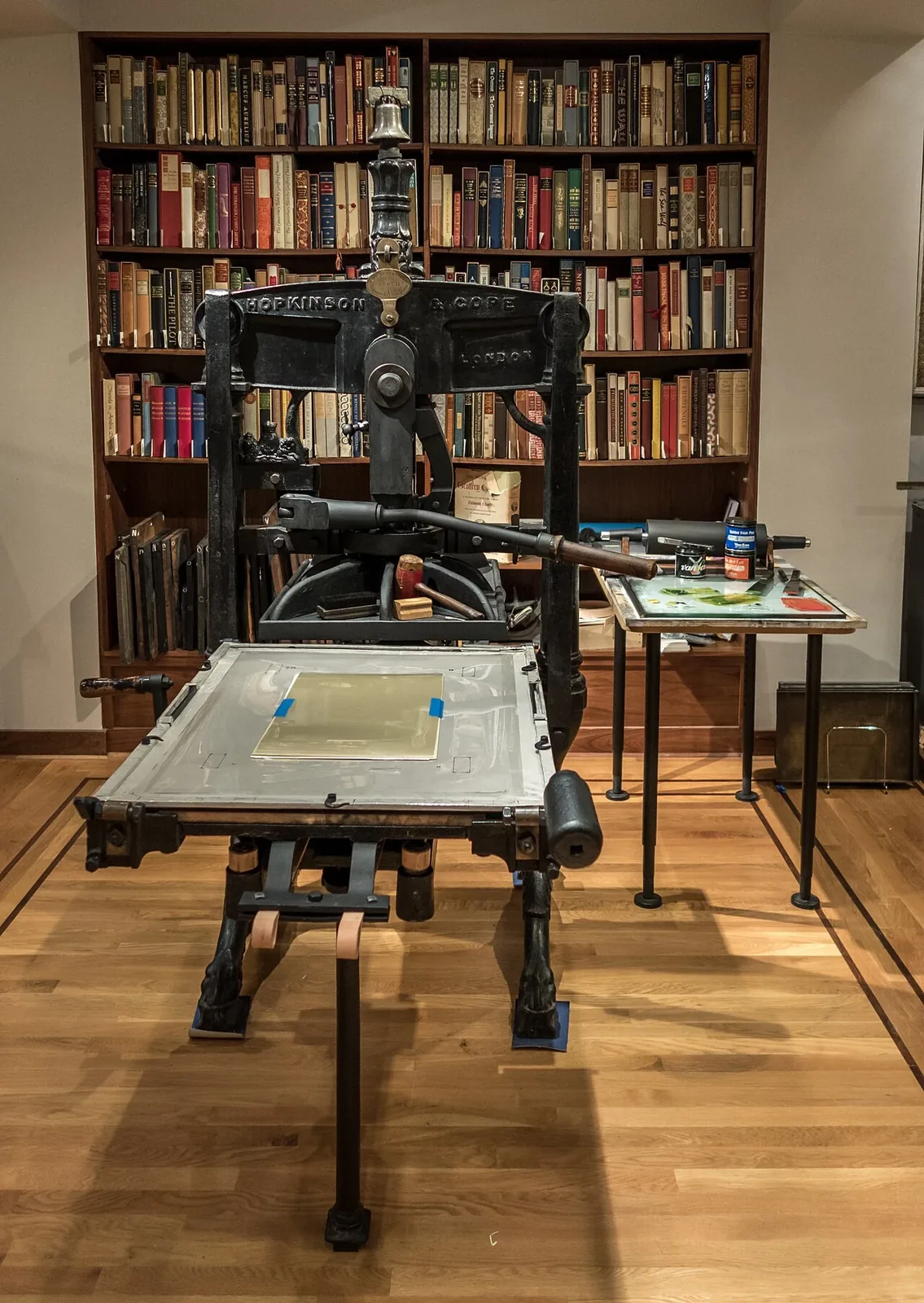
Kelmscott and the Goudy Albion
The press shown here is identified in its Commons file record as the Kelmscott–Goudy press at the Cary Graphic Arts Collection. RIT’s collection record gives the…
5 min read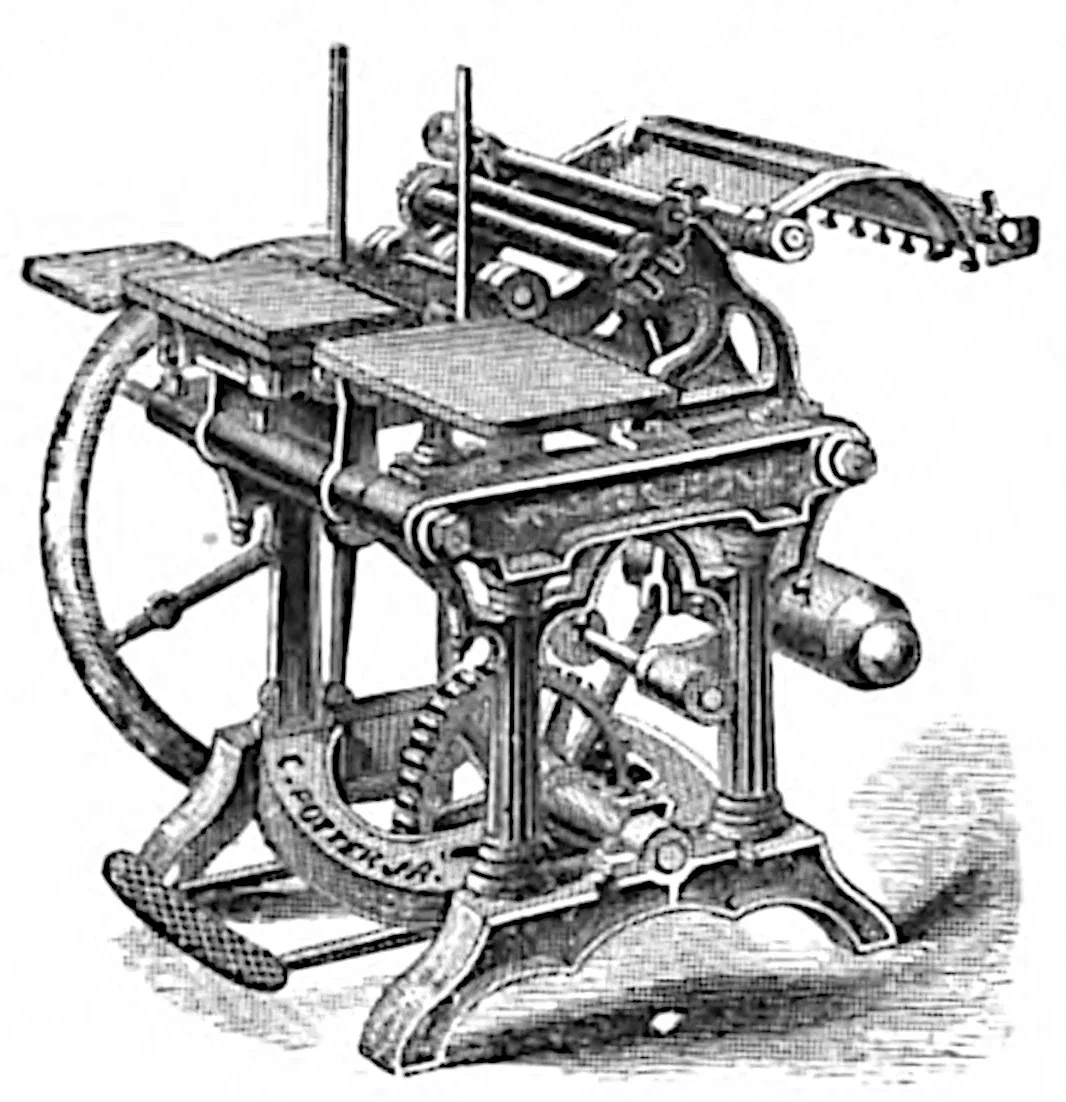
Babcock’s 1857 Jobbing Press
The file record for this cover identifies a Babcock jobbing press dated 1857. Its subject is a useful doorway into a part of printing that can disappear from…
5 min read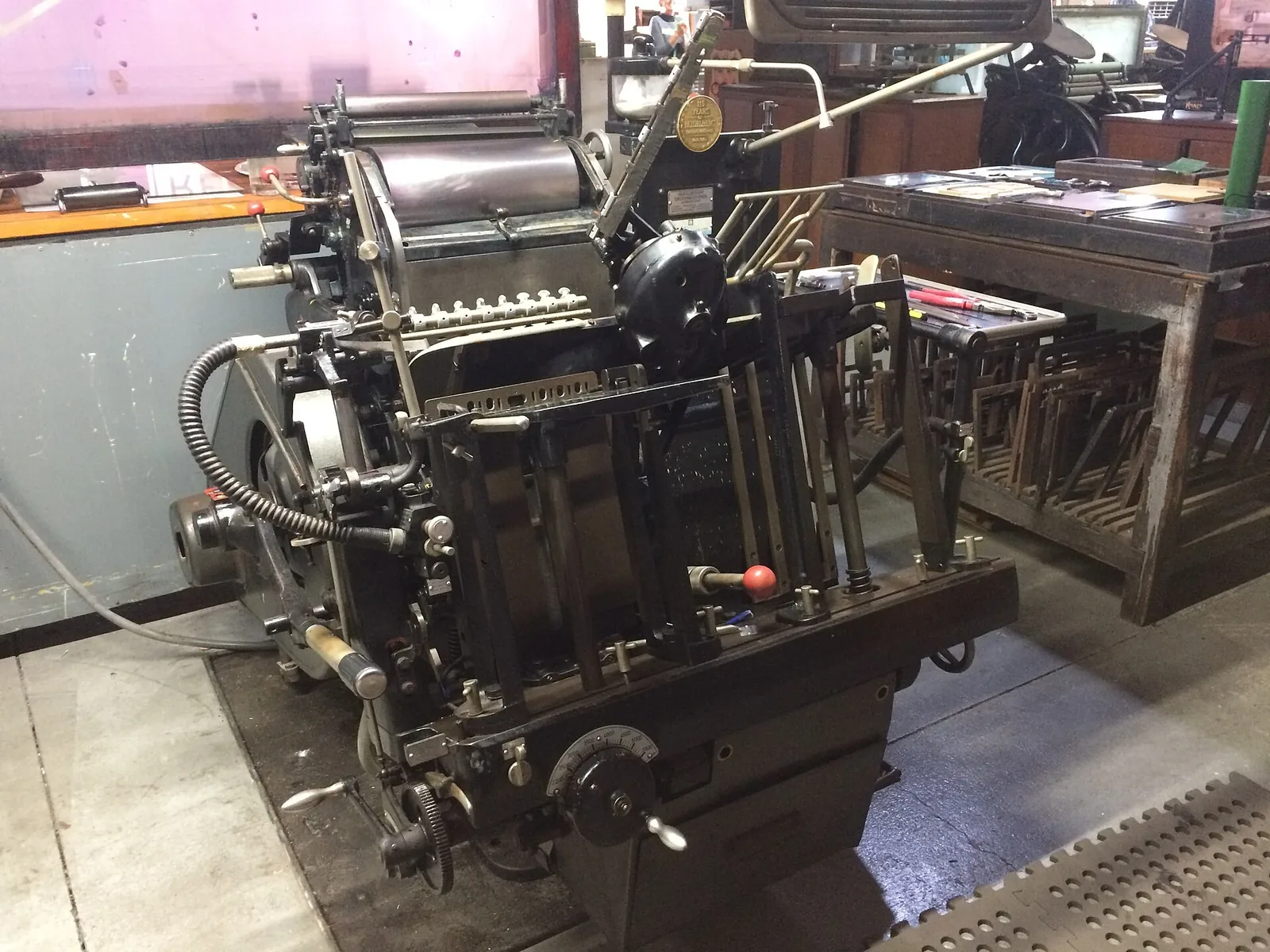
The Heidelberg Platen Press
The Heidelberg press pictured here belongs to the platen family, a group in which a flat printing surface and a flat bed meet to make an impression. RIT’s Cary…
5 min read