
The Print Field / Essay 03
Babcock’s 1857 Jobbing Press
The file record for this cover identifies a Babcock jobbing press dated 1857. Its subject is a useful doorway into a part of printing that can disappear from…
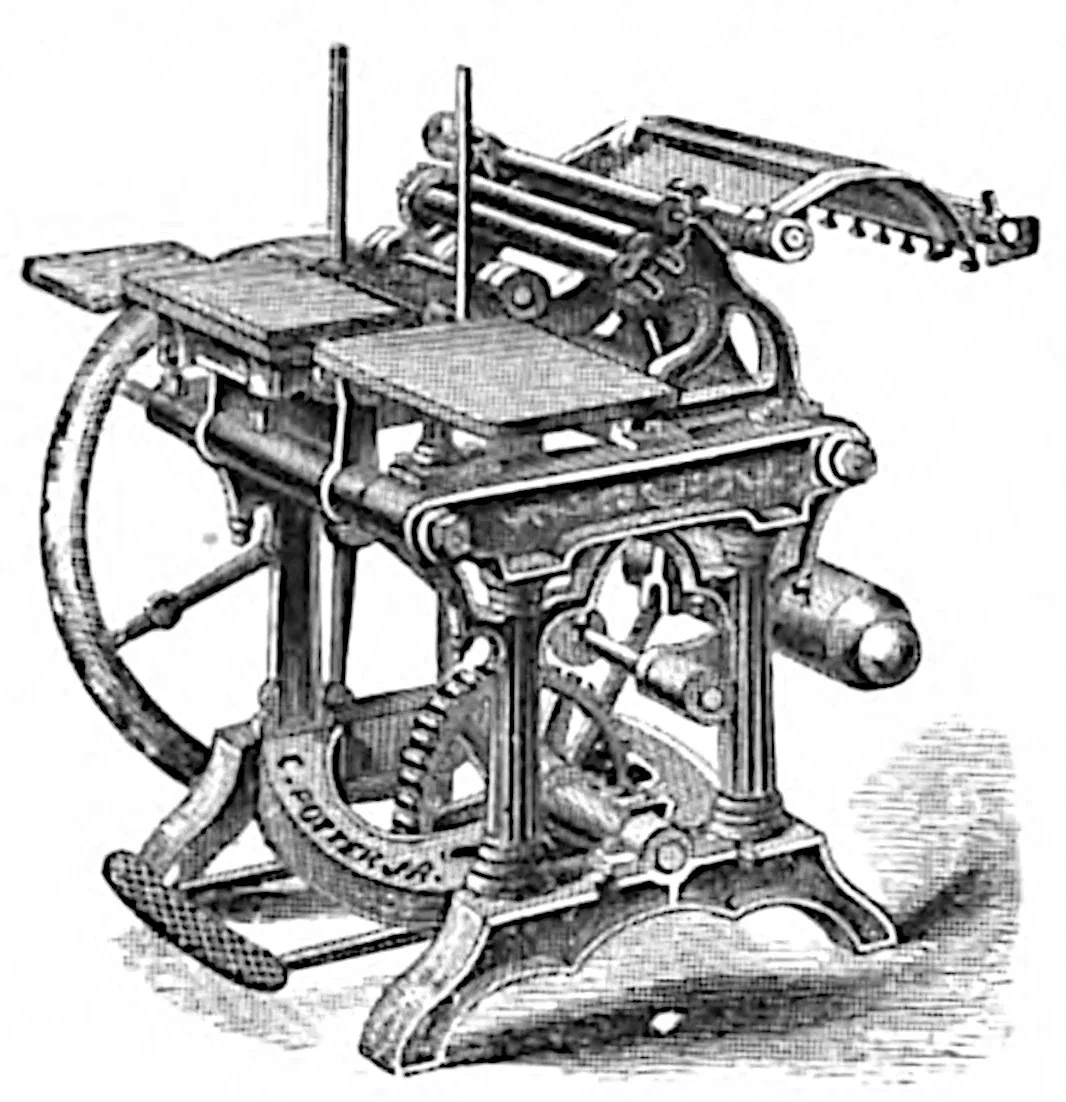
Short work changes the machine brief
The file record for this cover identifies a Babcock jobbing press dated 1857. Its subject is a useful doorway into a part of printing that can disappear from histories centered on books and newspapers: the recurring local work of notices, tickets, letterheads, forms, and small printed jobs. The Smithsonian’s account of platen jobbers describes machines developed for neighborhood printers who needed presses that were simple to set up, compact, and inexpensive. Speed mattered, but the work did not demand the same scale as a newspaper press. The design brief came from the shop’s daily mix of small commissions.
“Jobber” describes a role in the printing trade as much as a single model. The Smithsonian notes that many manufacturers produced machines in this family after early patents expired. Different models varied in construction, chase size, and operating details. The Babcock name on one image should therefore not be treated as a universal description of every jobbing press. A press’s maker and date belong to its individual record; the broader category helps explain the kinds of work it could serve.
The clamshell arrangement
Many platen jobbers use a clamshell motion: the bed and platen open and close toward one another. The Smithsonian describes the form as deriving from presses developed by Stephen P. Ruggles in Boston in the 1840s, with later makers adopting and modifying it. This arrangement made a compact self-inking press possible. Rather than moving a large flat bed under a heavy platen in the manner of an iron handpress, the jobber brings the printing surfaces together in a repeated cycle.
The relationship between the moving parts is easy to underestimate in a photograph. A platen that appears small still has to meet the forme evenly. A chase holds the type and blocks in place; rollers distribute ink; grippers or guides help position the sheet. The exact details depend on the press model, and a single image may hide them. The machine’s usefulness comes from a coordinated system: opening space for the operator, returning to the same contact position, and repeating that contact without disturbing the locked type.
Why local printers chose a jobber
A neighborhood shop could receive work that differed from one day to the next. A notice might be one color and a few hundred copies; a calling card would use a different size and arrangement; a form needed dependable repeated fields. The Smithsonian places these examples within the jobber’s intended market. The advantage was flexibility and manageable setup, not simply raw speed. A machine designed for shorter jobs could occupy less floor space and accommodate practical changes between commissions.
That flexibility had limits. The size of the chase constrains the area that can be printed in one pass. The platen’s movement, feeding arrangement, and the printer’s skill constrain how quickly and safely sheets can be handled. “Small press” is not synonymous with a trivial task: a short-run order still requires composition, lock-up, proofing, ink control, and consistent feeding. The press reduces some kinds of labor while leaving many craft decisions in the shop.
The Babcock image also reminds us that a manufacturer’s name can sit alongside a larger ecosystem. Parts, repair work, rollers, type, furniture, and local expertise all helped keep a jobber useful. An object’s present condition may include replacement parts or repairs. Unless a collection record confirms the history of each component, an observer should not claim that every visible feature belongs to the original construction.
Proof before the run
Short jobs reward careful proofing because setup changes are frequent. The Smithsonian’s history of proof presses explains that a proof is a trial impression used to check composition. The same principle applies to a jobber: a test sheet can reveal missing sorts, loose spacing, uneven contact, or an error that would otherwise be repeated across the order. The print should be examined for specific causes rather than treated as a vague pass-or-fail result.
When a mark prints too lightly, the cause could lie in ink distribution, type height, the packing behind the sheet, or the form itself. Changing several things at once may hide the real problem. A printer can isolate one adjustment, pull another proof, and compare the result. That is not an abstract laboratory method; it is a practical way to avoid wasting paper and to protect the type from unnecessary force.
Count the changeovers as well as the impressions
A jobbing press makes economic sense when the unit of work is the order, rather than an uninterrupted hour of printing. Consider two hypothetical shops producing the same number of sheets. One repeats a single design; the other divides the sheets among many small commissions. The second shop has to prepare and check more formes even if the press never moves faster. Counting only running impressions would conceal the extra work that determines when each order is ready.
This comparison explains the Smithsonian's emphasis on compact machinery and manageable setup. Space around the press, access to type, preparation of paper, and the ability to change the job all affect how useful a jobber is. A fast run offers little advantage if a short order spends most of its time waiting for composition or correction. Conversely, a slower machine may suit a varied order book when it can be made ready without an elaborate production line.
The Babcock example can therefore be read as an answer to a scheduling problem. Its historical image identifies a particular machine; the broader jobber history explains why printers needed equipment for work that changed frequently. This is an analytical model, not a reconstruction of this press's accounts. It directs attention to a neglected kind of efficiency: completing the next different job reliably. Tickets, notices, and forms mattered partly because each needed a fresh arrangement of familiar printing resources, often in quantities that rewarded flexibility more than maximum speed.
Further reading
Sources & records
Linked records provide object descriptions and historical context. Comparisons, close readings, and explicitly hypothetical examples are editorial analysis. This essay was revised on 22 October 2026; it does not report first-hand workshop research. The image source and license appear in its caption.
Albion and the Press Lever
The Albion press is easiest to understand when it is treated as a working arrangement rather than as a sculptural object. A frame holds a bed and a platen in…
5 min read
Kelmscott and the Goudy Albion
The press shown here is identified in its Commons file record as the Kelmscott–Goudy press at the Cary Graphic Arts Collection. RIT’s collection record gives the…
5 min read
The Heidelberg Platen Press
The Heidelberg press pictured here belongs to the platen family, a group in which a flat printing surface and a flat bed meet to make an impression. RIT’s Cary…
5 min read