
The Print Field / Essay 02
Kelmscott and the Goudy Albion
The press shown here is identified in its Commons file record as the Kelmscott–Goudy press at the Cary Graphic Arts Collection. RIT’s collection record gives the…
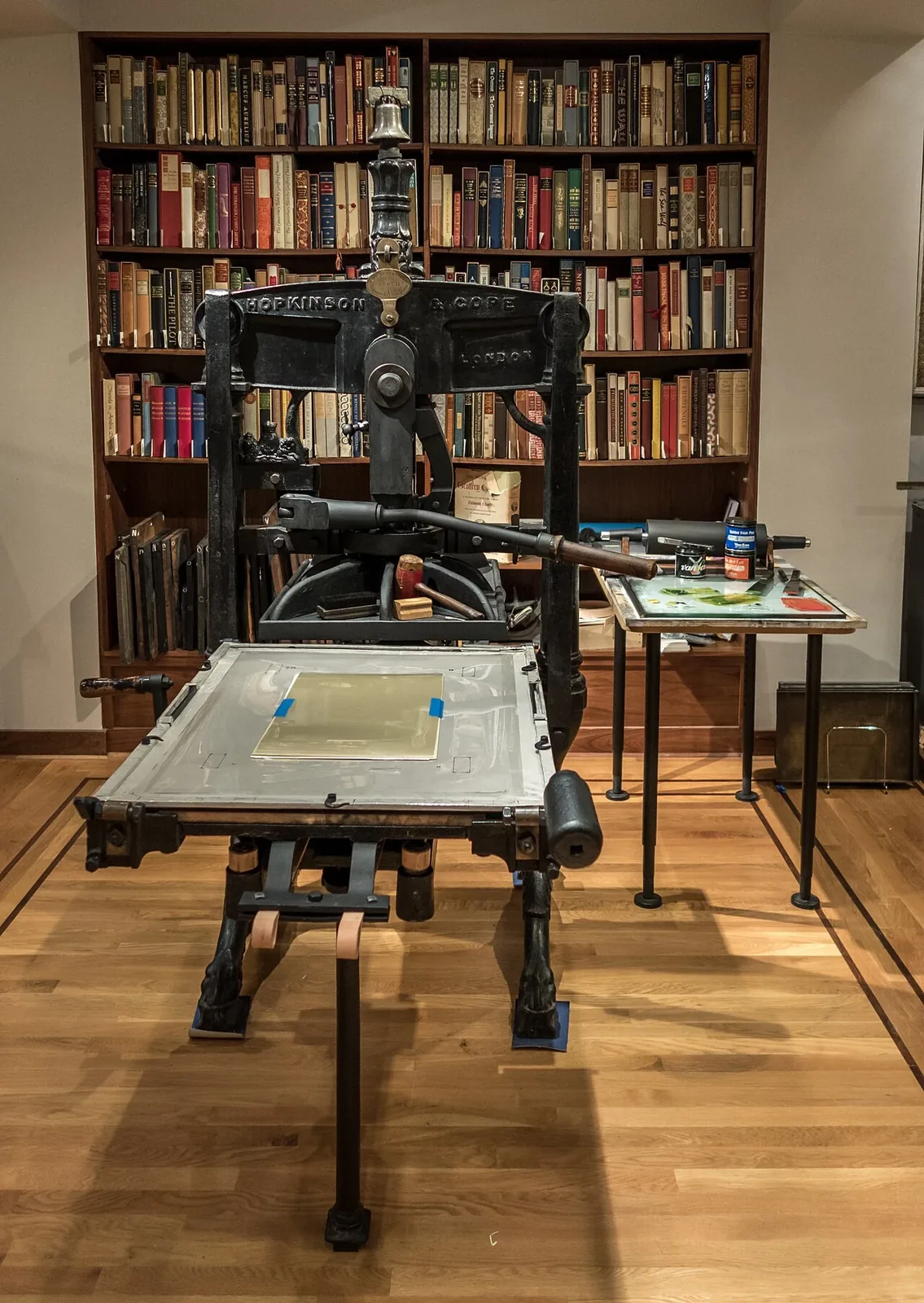
One machine, several lives
The press shown here is identified in its Commons file record as the Kelmscott–Goudy press at the Cary Graphic Arts Collection. RIT’s collection record gives the object a more complete institutional setting: it is an Albion press made by Hopkinson and Cope in London in 1891, and its listed former owners include William Morris, Frederic W. Goudy, Melbert B. Cary Jr., and J. Ben Lieberman. The same press can therefore be approached as a machine, a tool used in particular workshops, and an object whose ownership history connects several people and collections. Those are related stories, but they are not interchangeable.
William Morris founded the Kelmscott Press in 1890, according to RIT’s biographical account. Its books joined printing, type design, illustration, and page architecture into a deliberate private-press practice. A press associated with that enterprise does not explain the books by itself. The paper, type, ornaments, design choices, and labor around it also matter. Naming the press makes one part of a much wider publishing project visible; it should not turn the object into a shortcut for describing every aspect of Kelmscott production.
A record is more than a famous name
Provenance—the documented sequence of ownership and custody—helps a reader understand why a machine is preserved and how it acquired meaning. RIT’s record names multiple owners, while the current collection places the press in an active learning environment. The details matter because a well-known association can be repeated until it sounds more complete than the evidence actually is. A collection list is not a transcript of every print made on the press, nor does it establish which parts were changed during its lifetime. It does give readers a traceable path through the claims that the institution is prepared to make.
This distinction matters for the name “Kelmscott–Goudy.” William Morris and Frederic Goudy worked in different periods and settings. The compound name signals an object history shared across ownership, not a claim that the two designers collaborated on a single pressroom project. RIT’s object page lists both figures in the press’s history. Reading that list carefully prevents the label from becoming a fictional meeting between people who did not operate the machine together.
How the press enters a book’s story
An Albion is a hand-operated iron press. In the broader history of iron hand presses, the Smithsonian describes the move away from the limits of older wooden frames and toward greater leverage and larger impressions. RIT’s technology collection places the Kelmscott–Goudy press among its working letterpress equipment. Those two contexts describe design and present-day care, but the physical press is only one stage in making a book. Type must be chosen and composed; the forme must be locked; ink and paper must be prepared; proofs must be read; and each sheet must be handled and dried.
Morris’s Kelmscott Press is often discussed through its printed books because the page itself carries the design. RIT’s account of Morris notes that he designed typefaces and made books with ornamental borders and initials. That information supports a useful question: how does the page’s visual density relate to a press built to produce impressions? It does not justify attributing every decision in a particular book to the machine’s owner or maker. Design evidence comes from the book; machinery evidence comes from the press and its record.
Active use and conservation
RIT describes active use as part of the Cary Technology Collection’s preservation approach. That is a meaningful choice. A working press can communicate motion, leverage, and the sequence of printing in a way a static photograph cannot. At the same time, use puts demands on a historic object. The institution’s care decisions, equipment condition, and teaching practices shape what visitors can see. A public demonstration is evidence of present operation, not proof that an antique machine can be used without limits or that its current setup matches an earlier one.
The distinction between preservation and production also matters to visitors. A workshop may use modern paper, contemporary ink, replica type, or a teaching forme. A resulting sheet can show how the press transfers an image while leaving historical claims about a specific 1891 book to separate documentation. The printed object and the machine need their own records. Good interpretation links them without collapsing them.
A machine biography and a page biography
The Kelmscott–Goudy Albion offers two different ways to organize a printing history. A machine biography follows manufacture, ownership, relocation, repair, and present use. A page biography follows composition, illustration, paper, impression, binding, and readership. The two histories may intersect at a documented printing job, but a shared name does not make their timelines identical. RIT's list of proprietors is particularly useful for the first history; its account of Morris's designs opens the second.
For a reader comparing a Kelmscott page with this press, the productive question is therefore specific: which feature of the page actually requires evidence about the machine? The position of an ornamental border belongs initially to layout. Letter shape belongs initially to type design. The quality and evenness of contact belong more directly to impression. A named owner connects the objects historically, but the connection does not give the press sole authorship of the design.
This division gives a museum demonstration a more substantial purpose than reenacting a famous name. The moving mechanism can explain how an already composed design reaches paper, while a book opening shows the decisions made before that movement begins. Seen together, the objects reveal a collaboration of systems operating at different scales. That is the distinctive value of this Albion: its documented custody lets a visitor follow one physical instrument across changing design cultures, without reducing those cultures to the silhouette of a single machine.
Further reading
Sources & records
Linked records provide object descriptions and historical context. Comparisons, close readings, and explicitly hypothetical examples are editorial analysis. This essay was revised on 22 October 2026; it does not report first-hand workshop research. The image source and license appear in its caption.
Albion and the Press Lever
The Albion press is easiest to understand when it is treated as a working arrangement rather than as a sculptural object. A frame holds a bed and a platen in…
5 min read
Babcock’s 1857 Jobbing Press
The file record for this cover identifies a Babcock jobbing press dated 1857. Its subject is a useful doorway into a part of printing that can disappear from…
5 min read
The Heidelberg Platen Press
The Heidelberg press pictured here belongs to the platen family, a group in which a flat printing surface and a flat bed meet to make an impression. RIT’s Cary…
5 min read