
The Print Field / Essay 04
The Heidelberg Platen Press
The Heidelberg press pictured here belongs to the platen family, a group in which a flat printing surface and a flat bed meet to make an impression. RIT’s Cary…
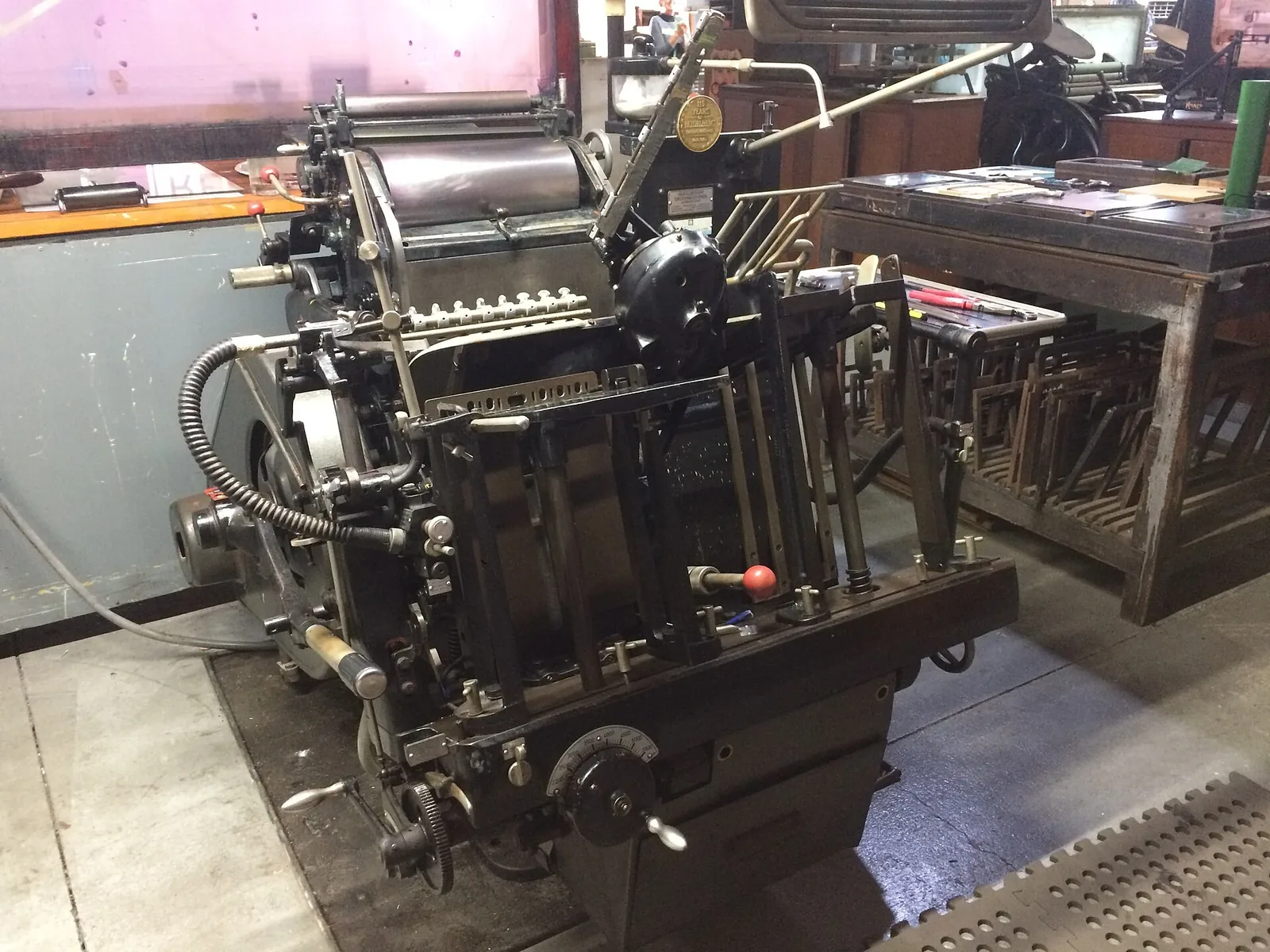
Reading a press by its cycle
The Heidelberg press pictured here belongs to the platen family, a group in which a flat printing surface and a flat bed meet to make an impression. RIT’s Cary Technology Collection lists an Original Heidelberg Windmill among its platen presses and dates the example in the collection to about 1956. The Smithsonian’s history of printing machinery explains the wider nineteenth-century transition from hand-operated presses toward faster powered machines. Together, those records suggest a useful way to approach the Heidelberg: look at its repeated cycle and the work that its mechanism was designed to coordinate.
The “Windmill” nickname is commonly associated with the moving sheet-feeding arms of the Original Heidelberg, but a photograph may not show the motion that gives the name meaning. A still image captures one position in a cycle. It does not establish the press’s operating speed, condition, or safety status. The machine should be understood through its documented model, the movement of its parts, and a demonstration by a qualified operator rather than by guessing from its silhouette.
From hand pull to powered rhythm
RIT describes its platen presses as an evolution from iron handpresses: semi-automated form rollers brought ink to the printing surface, and mechanized feeding and inking later allowed faster output. That progression did not happen through one device alone. Press designs developed alongside motors, roller materials, feeders, delivery systems, and shop procedures. A powered platen press represents a coordinated machine, not simply a handpress with an electric drive attached.
The Smithsonian makes a related point in its account of printing machines: increasing press speed required improvements in the other components as well. A faster cycle could damage rollers or expose weaknesses in paper handling. In other words, speed raises system demands. A printer who wants to understand a platen machine needs to examine how the sheet enters, how the forme receives ink, where the impression occurs, and how the printed sheet exits without colliding with the next cycle.
The word “platen” can also refer to more than one machine scale. Small tabletop presses, neighborhood jobbers, and larger powered presses share a basic contact principle but differ in their mechanisms and intended work. RIT’s collection groups the Original Heidelberg with freestanding platen presses, while also documenting tabletop models and cylinder proof presses separately. That catalog structure prevents a broad family resemblance from being mistaken for identical operation.
Feed, impression, delivery
The press cycle can be read as three linked tasks. First, a sheet must be presented to the form in a consistent position. Second, the printing surfaces meet under pressure. Third, the sheet must leave the printing area without being damaged or misregistered. A mechanism may automate parts of that sequence, but the quality of the result still depends on correct setup and appropriate materials. The printer’s attention shifts from supplying every movement by hand toward monitoring the machine’s timing and repeatability.
That shift changes the shape of training. A handpress makes the operator’s movement obvious; a powered press can hide several actions inside one continuous cycle. A demonstration should therefore make the path of a sheet visible and explain which parts are moving. When a press is not running, diagrams and slow demonstrations can be more informative than a fast production run. The goal is not to treat motion as spectacle. It is to understand how a sheet is located, printed, and cleared.
The impression is a setup decision
A platen machine prints through contact between a forme and a sheet supported by packing. Too little contact can leave weak marks; too much force can damage type or paper and produce an unwanted indentation. Those outcomes depend on the condition and arrangement of the press as well as the substrate. The visual target is not automatically the deepest possible deboss. It is an even, legible impression appropriate to the job and the equipment.
Proofing is the point where mechanism becomes evidence. A first sheet reveals whether the type is locked, whether the sheet meets the form squarely, and whether inking is consistent. Adjustment should be incremental. If a printer changes packing, ink, and registration at once, the next impression cannot show which change mattered. The habit of comparing proofs turns a press from an opaque machine into a tool whose behavior can be observed and corrected.
Automation moves the bottleneck upstream
The difference between a hand-fed workflow and a coordinated powered cycle is not simply that one supplies more motion. In a hypothetical job, composition and proofing might take longer than the final run. Automating sheet movement would shorten only the running stage. A misplaced word in the forme would still be reproduced on every sheet until someone detected it. Greater repeatability makes preparation more valuable because the cost of a repeated preparation error can grow quickly.
Follow one imaginary sheet through the Heidelberg cycle: it must arrive in position, meet the inked forme, and leave the impression area. Each stage depends on the previous stage clearing its task. The useful comparison with an Albion is the allocation of coordination. On the handpress, the operator visibly separates several actions. In the powered system, timing links them. This changes what a visitor should watch: the relationship between movements is as informative as any individual moving part.
The resulting interpretation is less about a machine replacing judgment than about judgment being concentrated before and around the cycle. Stock preparation, proof approval, and observation of consistent delivery become conditions of useful output. RIT's collection date identifies its Heidelberg example, not every machine of that family, and the analysis does not assign a production speed to the cover photograph. What the mechanism contributes is the ability to repeat a coordinated sequence; what the shop must supply is a sequence worth repeating.
Further reading
Sources & records
Linked records provide object descriptions and historical context. Comparisons, close readings, and explicitly hypothetical examples are editorial analysis. This essay was revised on 22 October 2026; it does not report first-hand workshop research. The image source and license appear in its caption.
Albion and the Press Lever
The Albion press is easiest to understand when it is treated as a working arrangement rather than as a sculptural object. A frame holds a bed and a platen in…
5 min read
Kelmscott and the Goudy Albion
The press shown here is identified in its Commons file record as the Kelmscott–Goudy press at the Cary Graphic Arts Collection. RIT’s collection record gives the…
5 min read
Babcock’s 1857 Jobbing Press
The file record for this cover identifies a Babcock jobbing press dated 1857. Its subject is a useful doorway into a part of printing that can disappear from…
5 min read