
The Print Field / Essay 18
The Linotype Keyboard’s Frequency Map
A Linotype keyboard asks its operator for a letter, but it does not organize its keys like the familiar office keyboard. Its arrangement reflects the work of…
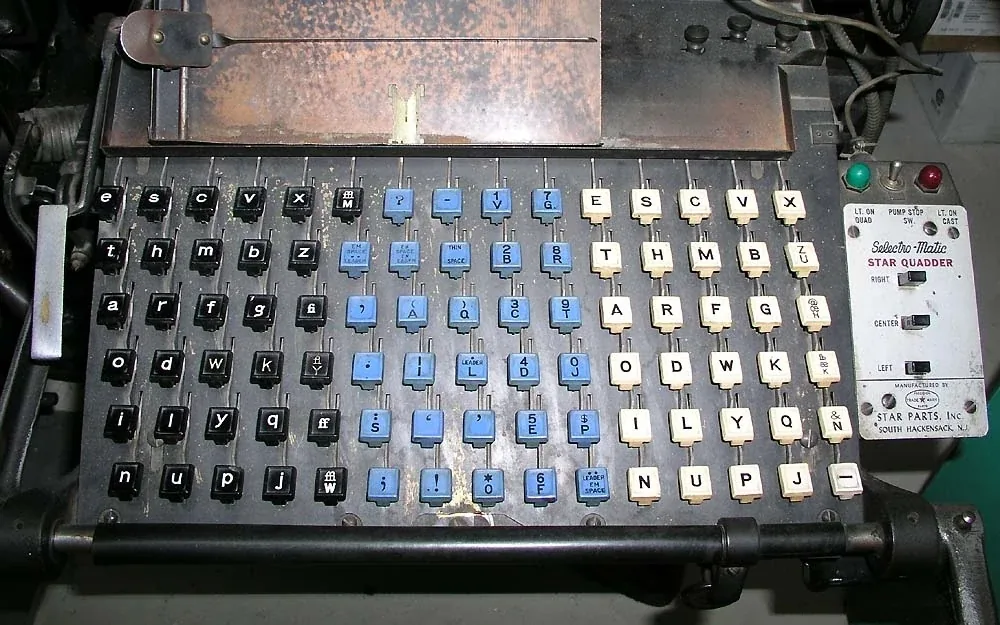
A keyboard built around a different question
A Linotype keyboard asks its operator for a letter, but it does not organize its keys like the familiar office keyboard. Its arrangement reflects the work of selecting matrices for a line of type. The Wikimedia Commons record for the pictured keyboard describes its keys as ordered by the frequency of English letters. That caption is a useful starting point, but it should be read carefully: it describes one keyboard and one language context, not a universal layout for every machine, shop, or script.
The key arrangement belongs to a mechanical system. A keystroke releases a matrix from storage; a sequence of released matrices travels toward the casting point; a completed line is cast and the matrices are returned. The National Museum of American History's account of an Intertype shows the relationship between keyboard, matrix line, casting, cooling, and proofing. Seen in that sequence, the keyboard is less a typographic surface than a control panel for a moving inventory.
Frequency is practical, but not neutral
If common letters are easier to reach, an operator can reduce unnecessary hand travel during repeated composition. A frequency-based layout translates observations about language into a physical arrangement. The choice of which language supplies those observations matters. A machine stocked and arranged for English does not automatically serve a publication set in another language. Accents, punctuation, capital forms, ligatures, and the distribution of letter frequencies can all change the set of matrices and the practical layout.
Even within English, the keyboard alone cannot make composition effortless. The operator must read copy, listen for the rhythm of words, track punctuation, manage line length, and identify errors. A key can request a matrix, but it cannot decide whether an unfamiliar surname has been spelled correctly. Speed depends on skill developed through practice as much as on physical distance between keys.
Frequency also turns a language into a design problem. A layout represents the expected work of a shop: its languages, common characters, and production priorities. If the publication changes, the inventory may need to change too. A keyboard is therefore evidence about how a machine was meant to be used, but it is not by itself evidence about the whole readership, the people who set type, or the texts that passed through the shop.
A composition system in layers
The keyboard sits at the front of a longer chain. Behind it are magazines holding matrices, mechanisms that release and transport them, a device for assembling a line, adjustable spacing, a casting pot, and a distribution path that returns matrices to their compartments. An operator's keystrokes begin that chain; they do not directly print the page. A failure farther downstream can still stop the job.
This layered view helps explain why the machine can look both familiar and alien. The keyboard invites comparison with a typewriter, yet its output is a line of metal rather than an inked ribbon or an electronic text. The operation includes heat and casting. Once a line is finished, it can be proofed and laid out with other lines in a form. The keyboard is only one interface to a much larger material workflow.
What a photograph can show
In a front-on image, key labels, spacing, and attachments may be visible. A star quadding attachment, for example, can appear alongside the keyboard in an object description, but the precise function should be confirmed from the machine's documentation rather than inferred from its shape. A photograph can document wear, layout, and the overall arrangement; it cannot confirm how consistently a particular operator used each key or which publications were composed on that machine.
The first question for a collection image is provenance: who made the photograph, when, where, and what object does its caption identify? The next is scope: does the record describe a keyboard on a specific Linotype or Intertype, or a general layout? Finally, compare the image with a museum explanation of the machine's operation. Reading these sources together prevents a close-up detail from turning into an overconfident story about every composing room.
A key layout and a character inventory solve different problems
A keyboard can make a frequently used character easier to request, but it cannot supply a character absent from the machine's inventory. This separates two design questions often collapsed into the phrase efficient keyboard. One concerns reach and familiarity at the keys. The other concerns what matrices the machine can release. A publication needing a particular accent or symbol depends on the second question even if its operator has mastered the first.
Consider a hypothetical paragraph containing many uncommon proper names. Familiar English frequency patterns would not remove the need to check those names, and a technically successful keystroke would not guarantee correct spelling. The machine can respond consistently to a wrong request. This is why the Smithsonian's account of checking matrices and proofing cast lines is relevant to a discussion of layout: a fast interface and an accurate text are different achievements.
Seen this way, the keyboard is an encoded expectation about recurring work. It places some requests within an established reach pattern and links them to a moving supply of matrices. The inventory and the reader of copy still constrain the result. That makes the photograph more informative than a curiosity beside a modern keyboard. It lets us compare access, availability, and meaning as three separate layers of composition. The layout addresses access; the magazines address availability; the operator and proofreader remain responsible for meaning. None of these layers can simply stand in for the others.
Further reading
Sources & records
Linked records provide object descriptions and historical context. Comparisons, close readings, and explicitly hypothetical examples are editorial analysis. This essay was revised on 22 October 2026; it does not report first-hand workshop research. The image source and license appear in its caption.
The Composing Stick, Line by Line
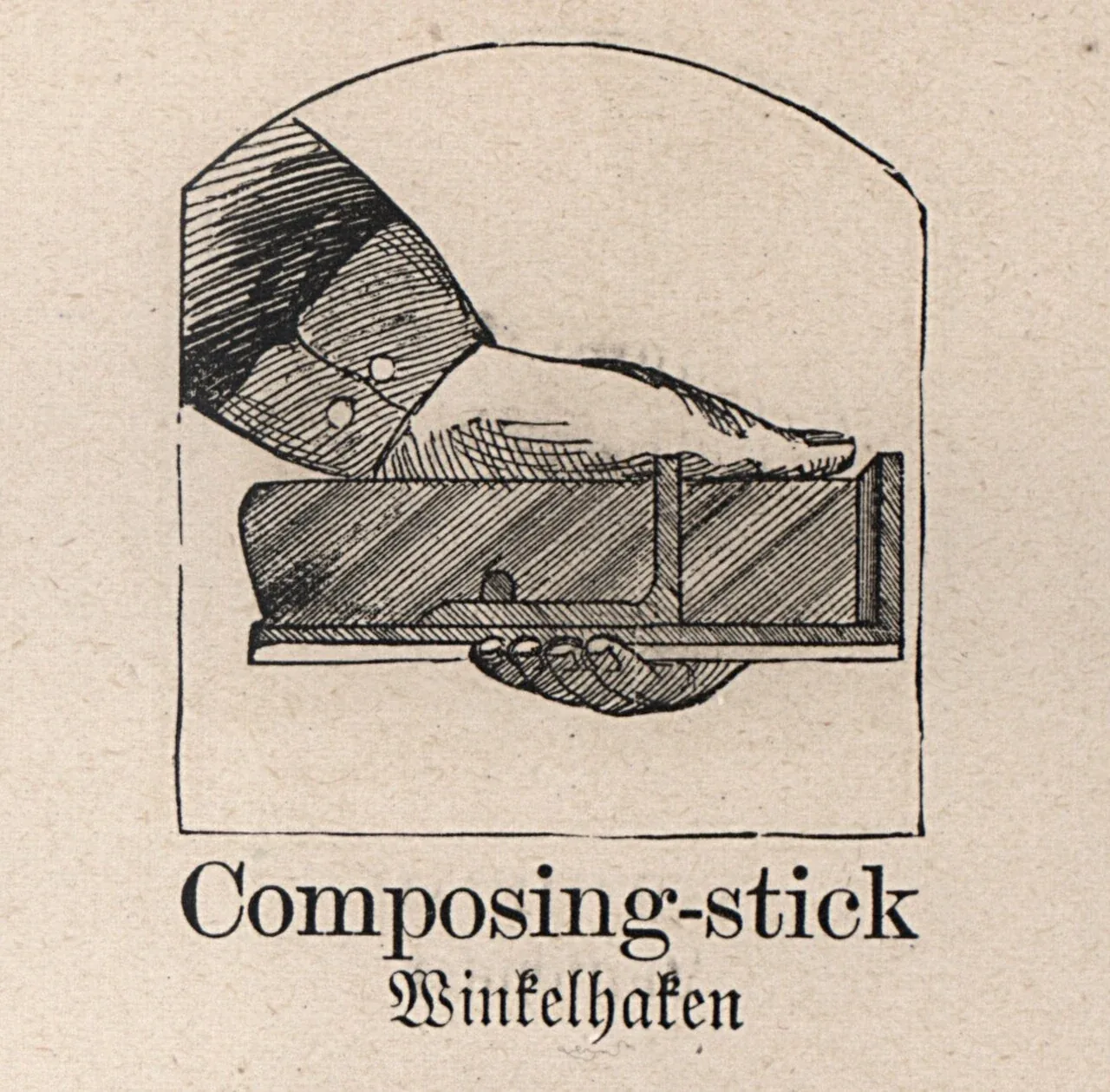
The composing stick is a small tool with an outsized role: it holds one line of type while a compositor assembles words from individual sorts. The Library of…
5 min read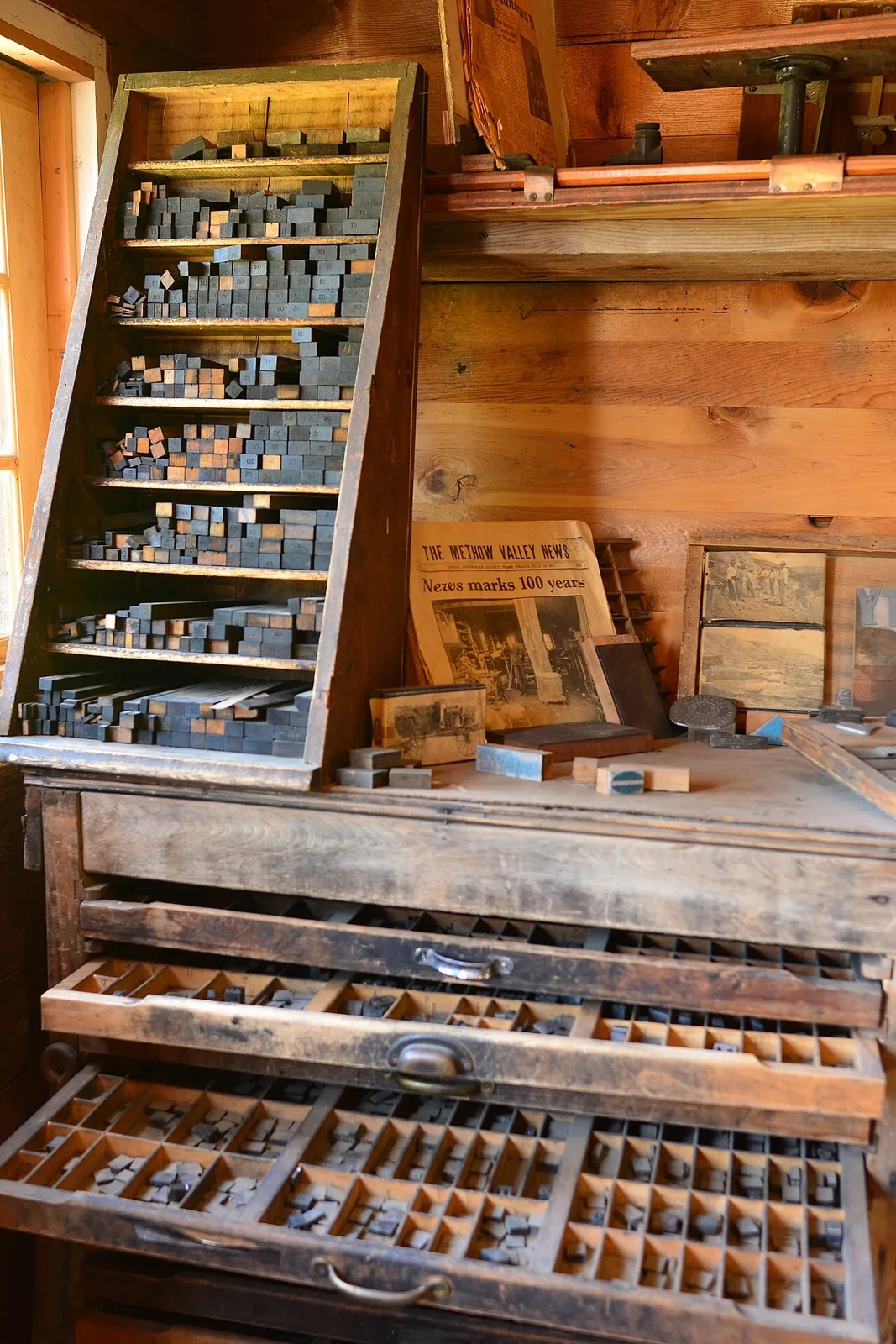
The Type Case as a Shop Index
A printer’s case is not a decorative box of letters. It is a working storage system that determines how a compositor reaches the type needed for a line. The cover’s…
4 min read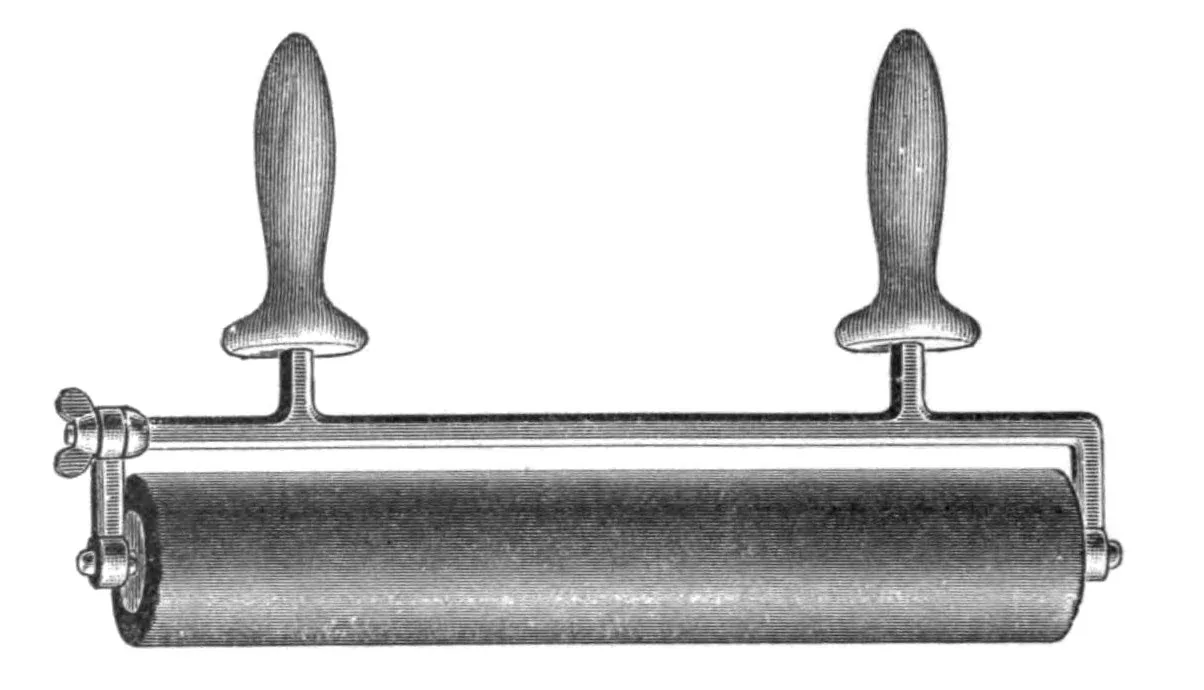
Inking with a Hand Roller
The cover reproduces an illustration of a composition hand roller from an American Type Founders catalogue dated 1906, as identified in the source file. The file…
5 min read