
The Print Field / Essay 08
Letterpress as a Teaching Practice
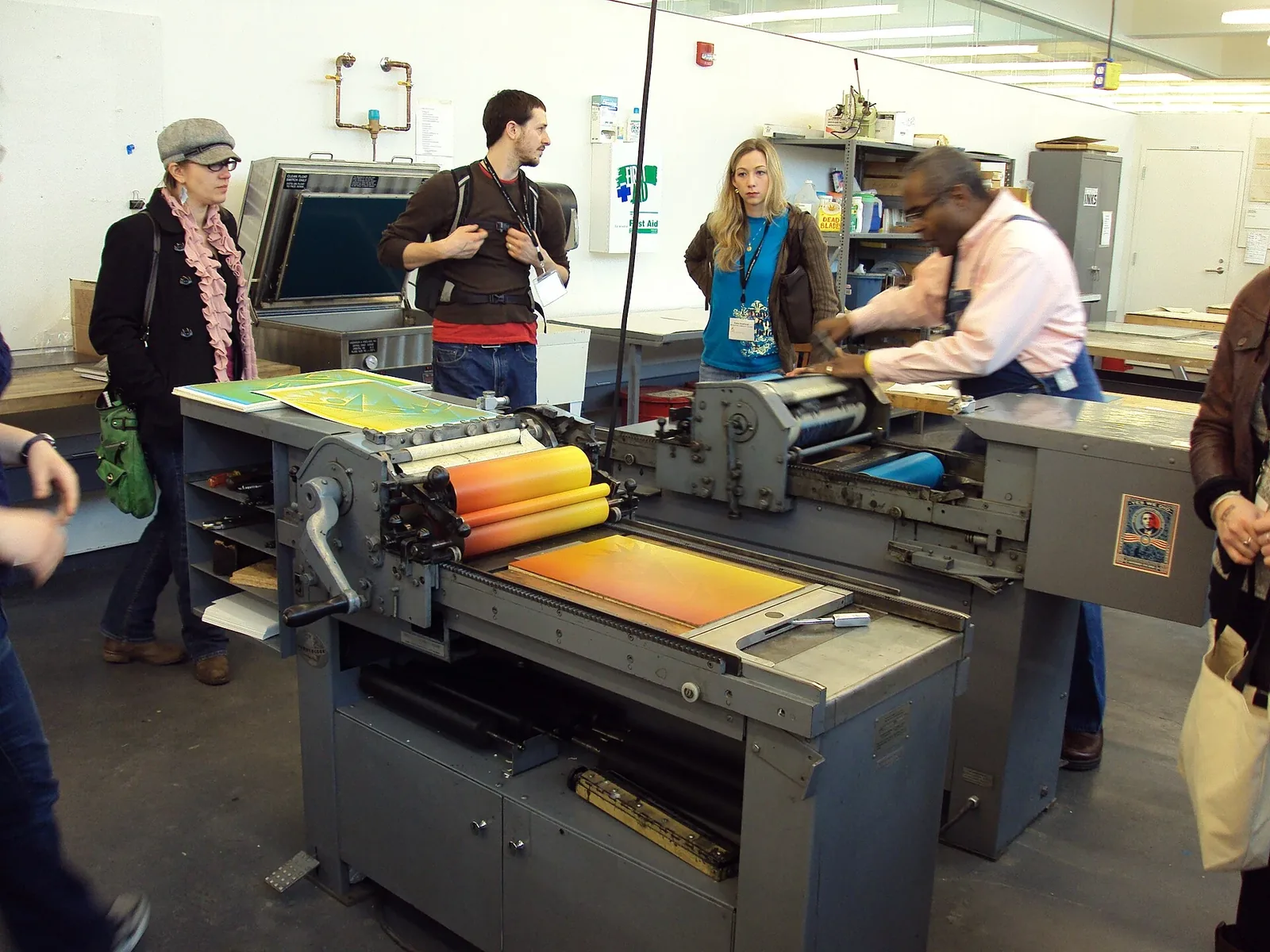
The cover image documents a letterpress printing session at Washington University in St. Louis during the 2011 Southern Graphics Council International conference.…
A pressroom is a classroom with moving parts
The cover image documents a letterpress printing session at Washington University in St. Louis during the 2011 Southern Graphics Council International conference. Its record names artist Amos Paul Kennedy Jr. and other participants working on Vandercook presses. That is enough to identify the setting as a documented workshop image. It does not tell us the full lesson plan, what each participant printed, or what every person learned. Those limits are useful: the photograph can still open a grounded discussion of how a pressroom teaches through material work.
RIT’s Cary Technology Collection describes active use of historic equipment in classes and workshops. Students, scholars, artists, and younger learners print editions with its machines. The collection’s practice shows one way a pressroom can function as a teaching space: the object is preserved through guided use, and the act of printing gives learners a concrete view of the sequence that a catalog description can only summarize. A working press turns terms such as bed, roller, proof, and registration into operations that can be observed.
Learning begins with a proof
In a workshop, a proof is not merely an early version to discard. It is a diagnostic sheet. The learner can compare the intended arrangement with the actual impression and ask why a letter is weak, why a line appears uneven, or why the paper has shifted. A response should begin with observation rather than with a dramatic adjustment. The form may be loose; the paper may not be positioned consistently; the ink may not be distributed evenly. Each possibility suggests a different next check.
This method makes printing legible because cause and result occur close together. The learner sets type, inks the form, positions a sheet, and sees the impression. A change to one condition can then be tested on a new proof. The press does not guarantee that every student sees the same outcome. It makes the relationship between setup and result available for discussion.
The press as a shared instrument
A room full of presses introduces collaboration as well as mechanics. One person may be composing while another inks, feeds, or checks a proof. In the image record, a group works on Vandercook presses during a conference. It would be inaccurate to infer each person’s role from a caption alone, but the setting does show that letterpress practice can bring people together around shared equipment. The work depends on common instructions, orderly tools, and careful attention to the next person’s setup.
This shared environment also gives equipment care a social dimension. Presses require maintenance, and tools need a known place. Ink, solvents, type, and paper must be handled according to the workshop’s safety procedures. Those procedures differ by material and institution, so a visitor should follow the instructor’s guidance rather than copy an unknown practice from a photograph. A printroom is a place to learn both the craft and the responsibilities that make it possible for others to keep working.
What a demonstration can and cannot reconstruct
Using a historic press provides insight into how a mechanism moves today. It does not reproduce an earlier shop in full. Contemporary students may work with modern paper, current inks, replica type, or safety equipment that was not part of the historical setup. A demonstration can clarify the press’s function while leaving the historical labor, workday, and commercial conditions to be researched separately.
RIT’s collection offers a clear example of this distinction: historic presses are used for education, and their active use is one part of preservation. The museum record and the workshop experience answer different questions. The record documents what the institution knows about the object; the demonstration allows a visitor to see its action. Neither replaces the other.
Design a comparison that a learner can explain
A useful letterpress lesson can be framed around a hypothetical pair of proofs rather than the excitement of operating a historic machine. Suppose both sheets come from the same composed line, and the instructor changes one documented condition between them. The learner's task is to describe the visible difference, propose a cause, and explain why the comparison supports that cause. This is a proposed teaching exercise, not an account of what participants did at the photographed conference.
The exercise separates three kinds of achievement. Making an impression shows participation in a process. Producing a legible line shows a successful result. Explaining a controlled difference shows transferable understanding. A visitor who can distinguish those achievements has a better basis for evaluating a workshop than a visitor counting finished souvenirs. RIT's account of active educational use supports the setting for this approach, while the proposed comparison supplies the article's own pedagogical argument.
Shared equipment adds another layer: the next person needs to know which conditions changed. A labeled proof and a short record of the setup can make the result discussable without relying on memory. The educational value then survives beyond the moment at the press. Learners leave with a method for connecting an intended change to an observed mark, rather than a belief that one dramatic pull reveals the whole craft. That method is why guided repetition can teach more than merely repeating the same motion many times.
Further reading
Sources & records
Linked records provide object descriptions and historical context. Comparisons, close readings, and explicitly hypothetical examples are editorial analysis. This essay was revised on 22 October 2026; it does not report first-hand workshop research. The image source and license appear in its caption.
Albion and the Press Lever
The Albion press is easiest to understand when it is treated as a working arrangement rather than as a sculptural object. A frame holds a bed and a platen in…
5 min read
Kelmscott and the Goudy Albion
The press shown here is identified in its Commons file record as the Kelmscott–Goudy press at the Cary Graphic Arts Collection. RIT’s collection record gives the…
5 min read
Babcock’s 1857 Jobbing Press
The file record for this cover identifies a Babcock jobbing press dated 1857. Its subject is a useful doorway into a part of printing that can disappear from…
5 min read