
The Print Field / Essay 49
An Illustration of Printing in La Colombe du Massis
The cover image is described as an illustration of book printing from an 1856 issue of *La Colombe du Massis*. The Pan-Armenian Digital Library catalogs the…
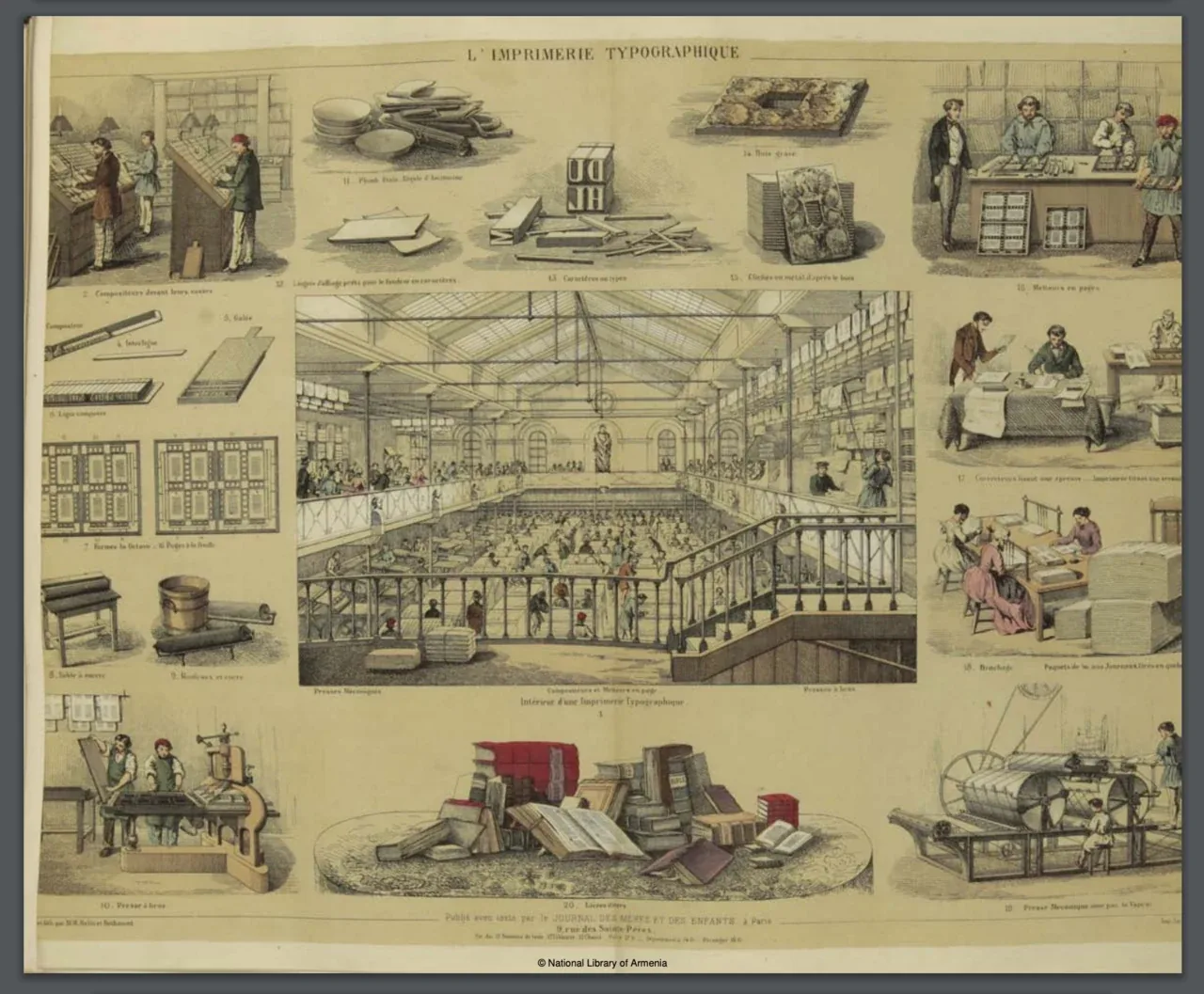
An image of printing inside an Armenian periodical
The cover image is described as an illustration of book printing from an 1856 issue of La Colombe du Massis. The Pan-Armenian Digital Library catalogs the periodical under both its Armenian title and its French title, La Colombe du Massis: Messager de l'Arménie. Its surviving run in this portal covers 1855–1858 and lists Paris as a place of publication. The issue-level source linked from the Commons file identifies the image's specific 1856 setting.
The illustration depicts printing as a subject within a publication that itself depended on printing. That recursive relationship is useful: the journal's readers encounter an image about the process that carries the journal's words. A printed illustration can make work visible, but it also reflects an editorial choice about which parts of production deserve attention.
A bilingual publication and its readers
The Pan-Armenian Digital Library identifies the serial under Armenian and French titles, gives the available run as 1855–1858, and records Paris as its place of publication. The Public Domain Review also describes the journal as bilingual and connects the printing illustration with an 1856 issue. Those sources support the publication context, but they do not establish one uniform column layout or image position for every page. Such layout claims require inspection of the relevant issue rather than a general description of the serial.
The periodical's language choices matter to print technology. Armenian type had to be available in a form that could be set, arranged, and printed. Type design, matrices, cases, and press practice helped determine what readers could see on the page. The article image may be about book printing, but its own existence depended on the type and printing resources available to the journal's publishers.
The illustration is not a production manual
The file caption labels the subject as book printing. It does not specify the exact press model or identify the depicted printer. The image can be read for visible tools and actions, but a picture alone cannot confirm which shop it represents or whether it is an idealized scene. The original issue can supply surrounding context; a catalog description can establish title and date; further research would be needed to link the scene to a named workshop.
This distinction is important because a nineteenth-century illustration of printing may be descriptive, symbolic, or editorial. A press shown in an image can stand for a broader craft rather than document one actual room. Readers should treat the label as an identification of subject, not as proof of a specific machine or printer.
The journal's design carries Armenian letters
The two languages invite a specific question about page design: how are readers helped to move between scripts, text, and illustrations? Column divisions, headings, type size, and image placement could each contribute, but their actual arrangement has to be read in the scan. This is a proposed line of analysis, not a claim that a single two-column design governed the complete run. A bilingual title establishes the publication's language setting while leaving its detailed visual organization to the pages themselves.
An illustration inside a bilingual periodical can function differently for different readers. A shared image may guide a reader across a language boundary, while the text anchors it to a particular argument. Without examining the full issue, one should not claim what article the image accompanied or how readers responded to it. The digitized issue allows future readers to restore that relationship by opening the source page.
An archive preserves the issue, not just the picture
The Commons file provides a convenient reproduction and a public-domain record. The Pan-Armenian Digital Library preserves issue-level metadata and scanned periodical volumes. These sources should be linked together: the first identifies the reused image file; the second provides the publication record and surrounding pages. Converting the image to WebP for the local site changes its encoding, not its composition, and the source link remains attached for attribution.
Periodicals are especially valuable to print historians because they show design repeated over time. A researcher can compare mastheads, columns, ornaments, and image placement across issues. A single 1856 illustration offers one point in that sequence. The library's 1855–1858 run provides a larger context for studying how the journal's material appearance changed or remained stable.
A publication can picture the system that makes it possible
An illustration of printing inside a printed periodical creates a useful double perspective. The reader sees a representation of production while holding, or now viewing a scan of, its result. The pictured process and the actual making of the issue are related topics, but they are not necessarily the same workshop or machine. The image can explain or symbolize a craft without documenting the room where this journal was printed.
The periodical record gives the comparison a specific setting: an Armenian and French serial associated with Paris and a digitized run of 1855–1858. Its two languages raise a practical question about the publication's own material resources. Different scripts require suitable type and page organization. Those requirements are a reason to study the issue, not proof that a particular layout or typeface appeared on every page. The scan has to answer those visual questions.
This keeps the article distinct from a general machine diagram. A diagram isolates a relationship for explanation; an illustration inside a journal also has an editorial position among neighboring texts and images. Restoring that position could reveal whether the picture introduced an article, supplemented a description, or served another function. Until the relevant page is established, the role should remain open. The relationship suggests that a printing image belongs to two material histories at once: the activity it represents and the publication that carries the representation. The archive makes it possible to investigate their connection without simply assuming they coincide.
Further reading
Sources & records
Linked records provide object descriptions and historical context. Comparisons, close readings, and explicitly hypothetical examples are editorial analysis. This essay was revised on 22 October 2026; it does not report first-hand workshop research. The image source and license appear in its caption.
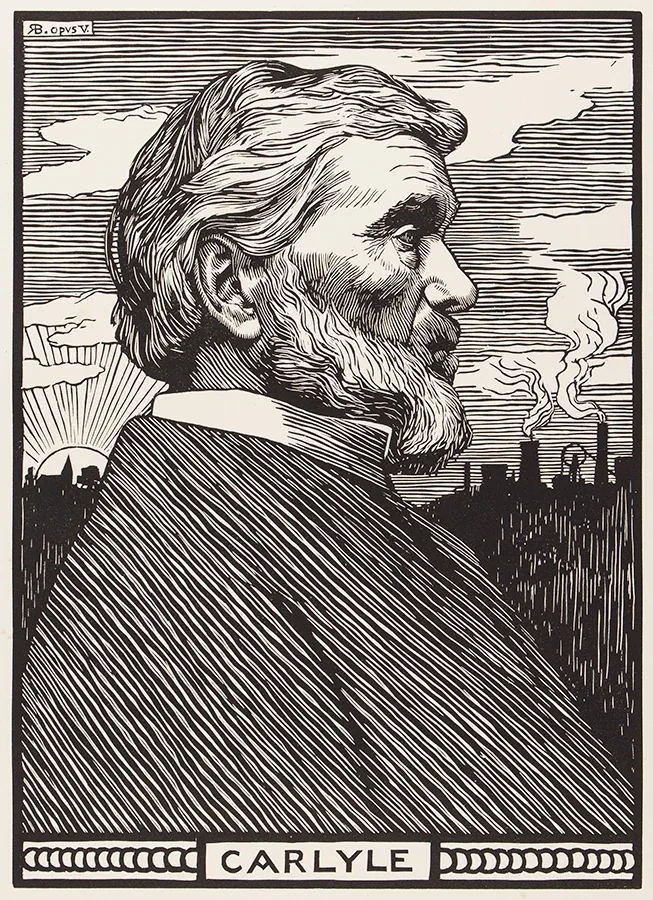
Robert Bryden’s Carlyle Woodcut
The file record identifies this image as Robert Bryden's woodcut of Thomas Carlyle, made for *Some Woodcuts of Men of Letters of the Nineteenth Century*. The file…
5 min read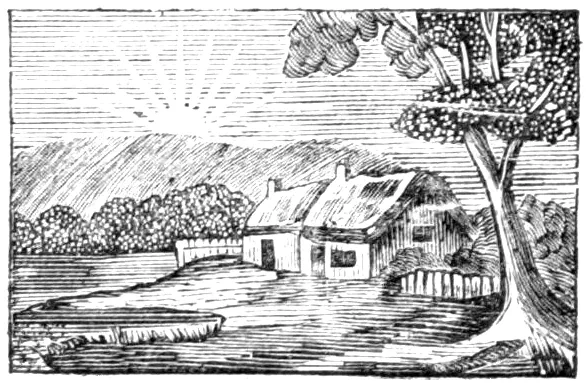
Popular Irish Stories: A Glasgow Chapbook
*Popular Irish Stories* appeared in Glasgow in 1850 as number 23 in a “New and Improved Series.” The National Library of Ireland catalogue describes it as a 24-page…
5 min read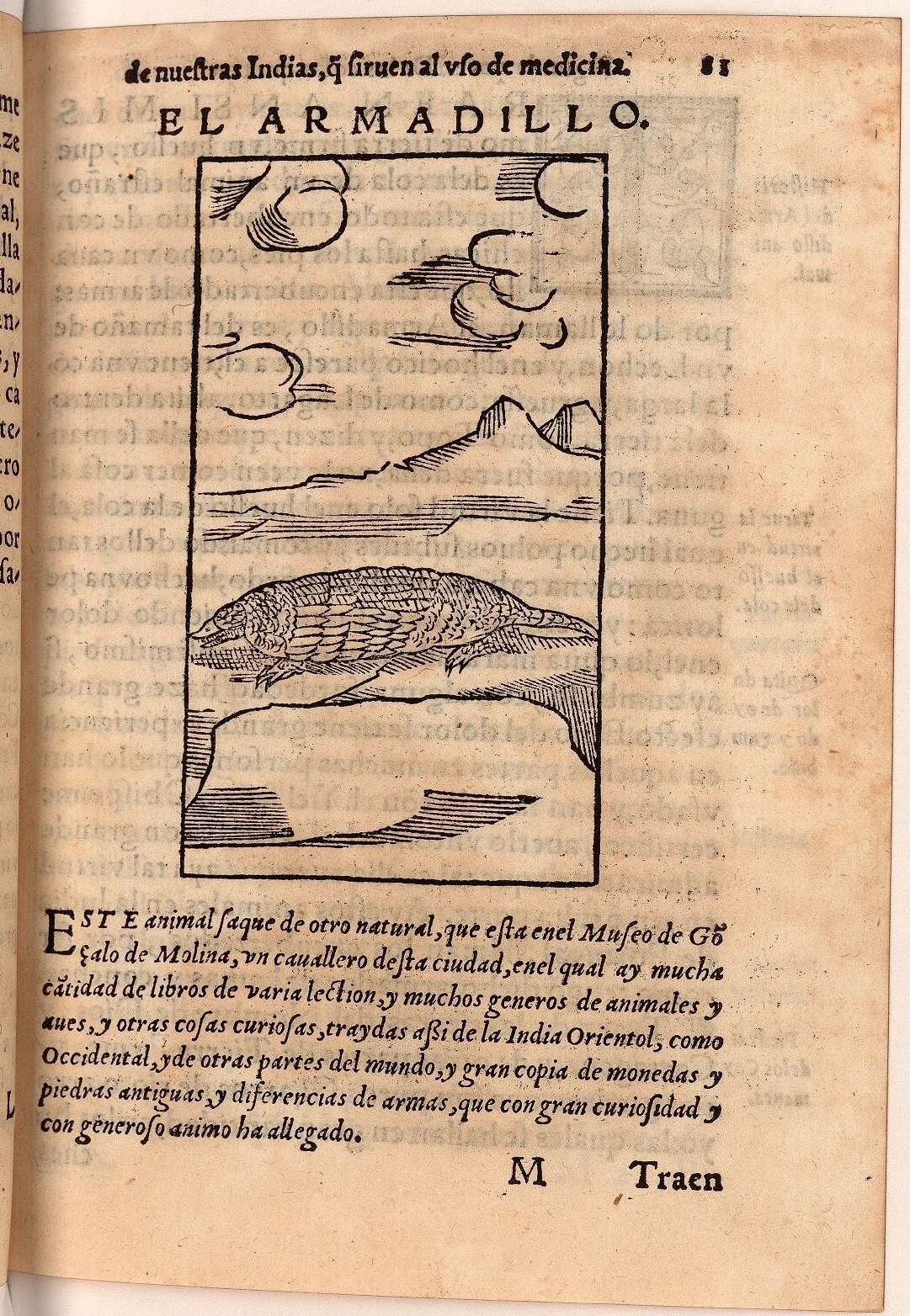
Monardes’s Armadillo Woodcut
The Commons record identifies this image as a woodcut illustration of an armadillo from Nicolás Monardes's 1574 *Historia medicinal*. The illustration belongs to a…
5 min read