
The Print Field / Essay 07
A Jobbing Press in Colombo
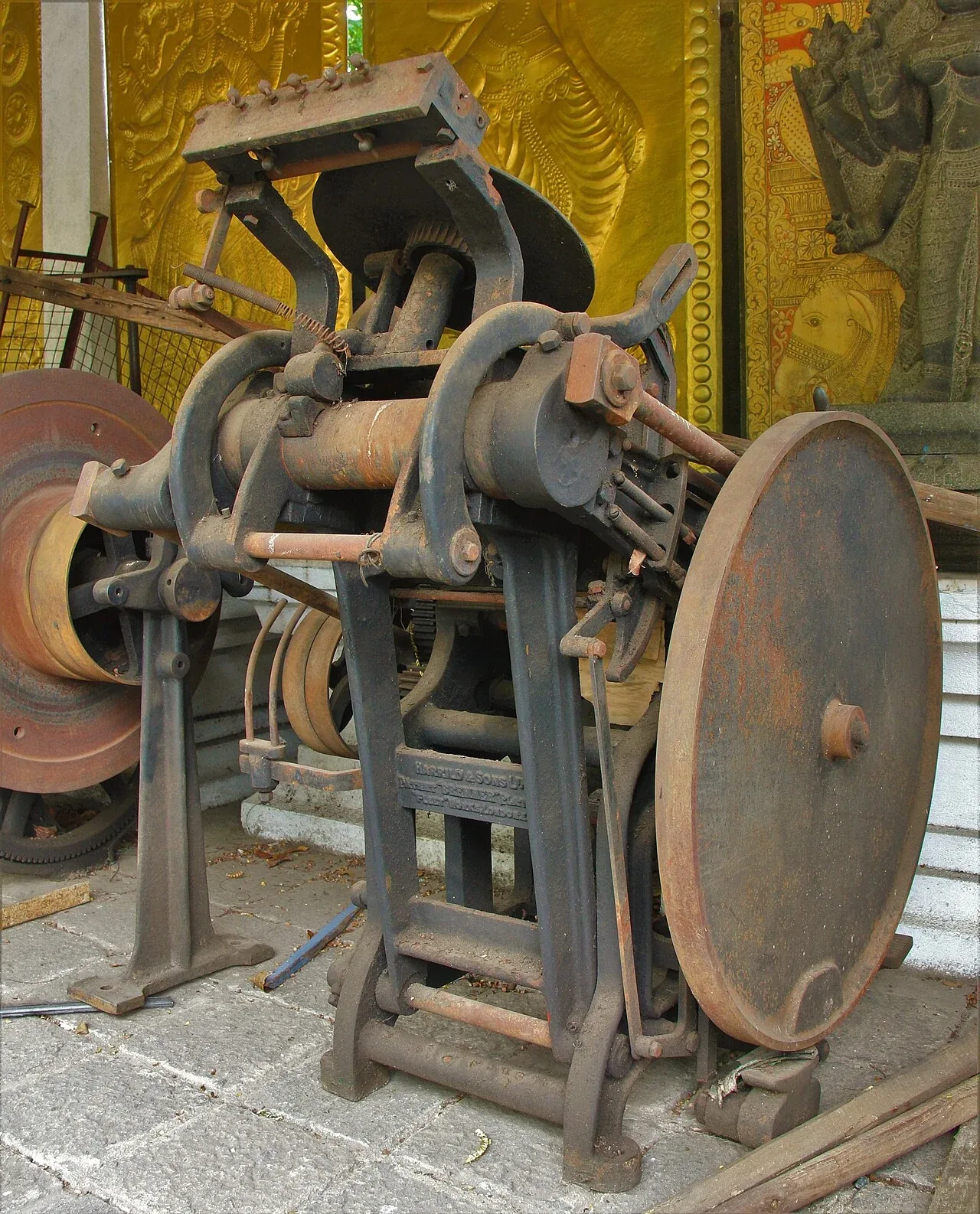
The cover record identifies this jobbing press as a machine made by Harrild & Sons in London and found at the Gangaramaya Temple in Colombo, Sri Lanka. That caption…
A press identified by place
The cover record identifies this jobbing press as a machine made by Harrild & Sons in London and found at the Gangaramaya Temple in Colombo, Sri Lanka. That caption places a particular press in a particular setting, but it does not by itself explain how the machine arrived there or how it was used. The distinction is important: the image is evidence of the object and its recorded location, while the history of the people, jobs, and institution around it requires additional sources.
The Smithsonian’s overview of platen jobbers offers a useful technical context. It describes compact presses developed for neighborhood printers who handled posters, notices, tickets, letterheads, and other short-run work. They were intended to be straightforward to set up and economical in space. A jobber made practical sense where a shop needed a flexible machine for varied local work rather than a high-speed press dedicated to enormous runs. That category helps explain what the press could do, but it should not be mistaken for documentation of the jobs made on this specific Colombo machine.
The label is not the workflow
A jobbing press is a machine within a trade. The term includes different makers and designs, and the Smithsonian notes that many models appeared as the market developed. A caption that calls a machine a “jobbing press” tells us something about its family, but not necessarily its exact mechanism. Some platen jobbers use a clamshell arrangement; others differ in how the platen moves, how the rollers are guided, or how paper is fed. A careful account checks the exact object and does not transfer every detail from one model to another.
The work associated with jobbers helps make the design logic concrete. A shop could print a short notice, then reset the forme for a different job. That flexibility made composition and setup a constant part of the day. Each change called for a locked arrangement of type, an appropriate chase, an ink adjustment, and a proof. The press could repeat the impression, but the printer had to make each new arrangement ready for that repetition.
What the setting invites us to ask
Seeing the press at a temple invites questions about how printing equipment is preserved, displayed, or used in a public place. Those questions cannot be answered from the press alone. The object record should be paired with local institutional histories, archival photographs, and accounts of printing in the region. For this caption, the reliable starting point is modest: it identifies a press, a maker, and a location. A reader should avoid turning those three details into an unsupported story about religious publishing, language, or the machine’s route to Colombo.
That caution does not mean a caption is unimportant. Place names make collections searchable and connect technical artifacts to the communities that preserve them. If the object is later matched with a newspaper, print shop, or archival account, the record can grow. Until then, an accurate description is better than a fluent invention. The question mark in an archive is not a defect; it marks where future evidence can be added.
The small-run printer’s trade
The Smithsonian’s description of platen jobbers emphasizes a kind of work that many readers still encounter indirectly: the local sign, business card, ticket, invoice, or short notice. These items are ephemeral, but their production required design and coordination. Type needed to fit a defined space. Paper had to be cut to a manageable size. Ink had to transfer across the forme. The jobber’s compact scale suited such work, while the printer’s knowledge connected the press to the customer’s needs.
Because the machine is used for short jobs, the important measure is not simply impressions per hour. Setup time, changeover, waste, maintenance, and the size of each order all affect productivity. A small press may be more useful than a larger machine if it can be prepared quickly and handle the scale of work that comes through the shop. This is why machinery histories should include the kinds of customers and tasks a press was designed to serve.
Trace the machine's route without inventing its orders
The London maker and Colombo location establish two points in this press's record. They do not establish the route between them. A useful object biography would distinguish manufacture, sale, shipment, installation, later ownership, and display. These are separate events that could leave different documents: a maker's plate, an invoice, a shipping entry, a workshop photograph, or a collection accession. This sequence is a research framework, not a claim that those documents survive for the Gangaramaya machine.
The distinction matters because present setting can otherwise become an invented explanation of original function. A press photographed at a temple might be associated with preservation, display, or printing, but its surroundings alone cannot choose among those histories. The caption anchors the object geographically. The Smithsonian's jobber account explains the broad class of work such machinery served. Neither identifies a particular Colombo customer or publication.
There is nevertheless an original historical question here: what happens to a production tool when its manufacturing identity survives more clearly than its working archive? The nameplate can keep an overseas maker visible, while the people who prepared type, repaired rollers, and read the resulting sheets become harder to recover. That imbalance suggests where local research would add the most value. A history centered only on imported machinery would remain incomplete; a history tied to surviving local jobs could show how the machine entered everyday communication. The pictured press is the starting object for that distinction.
Further reading
Sources & records
Linked records provide object descriptions and historical context. Comparisons, close readings, and explicitly hypothetical examples are editorial analysis. This essay was revised on 22 October 2026; it does not report first-hand workshop research. The image source and license appear in its caption.
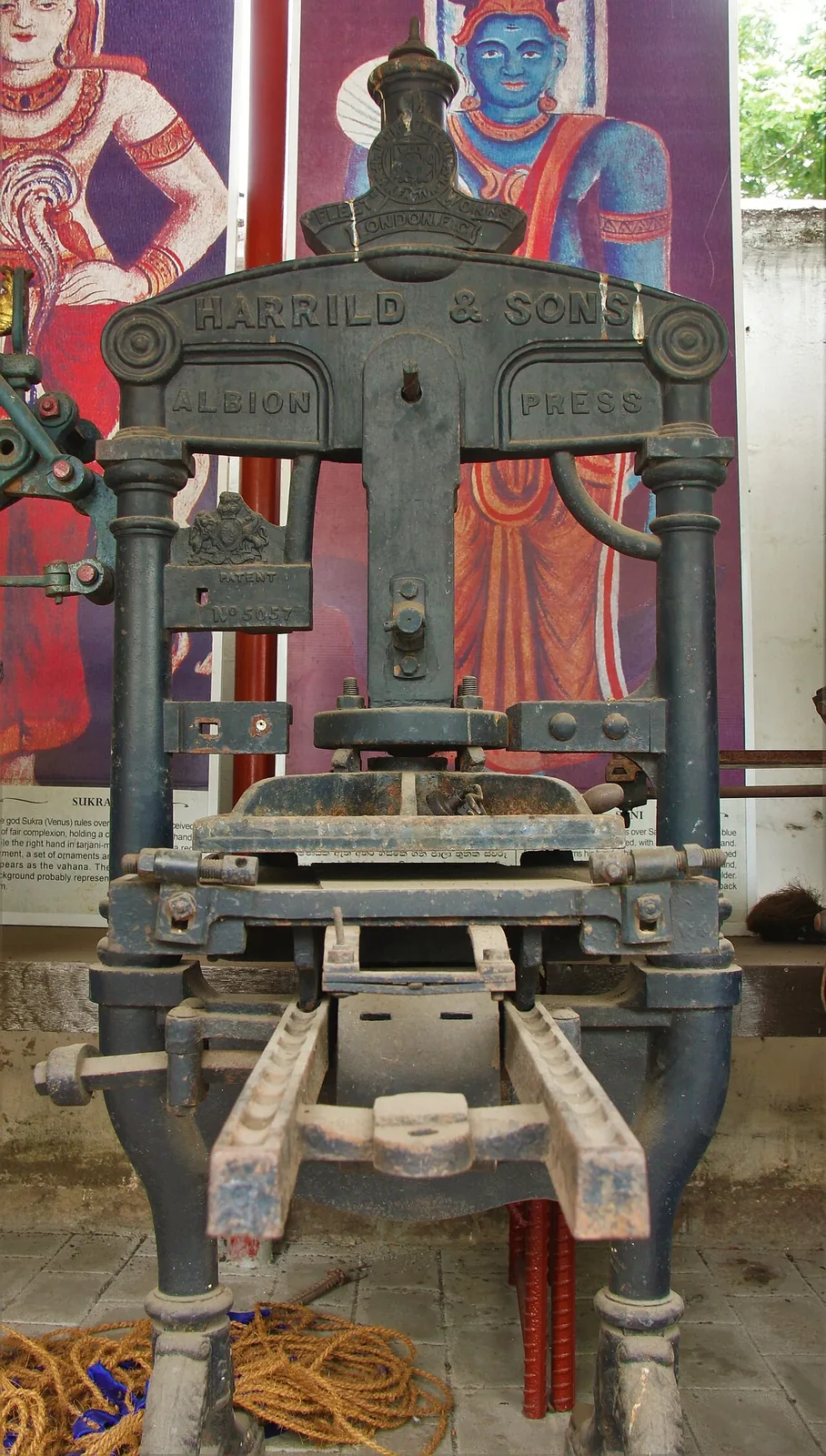
Albion and the Press Lever
The Albion press is easiest to understand when it is treated as a working arrangement rather than as a sculptural object. A frame holds a bed and a platen in…
5 min read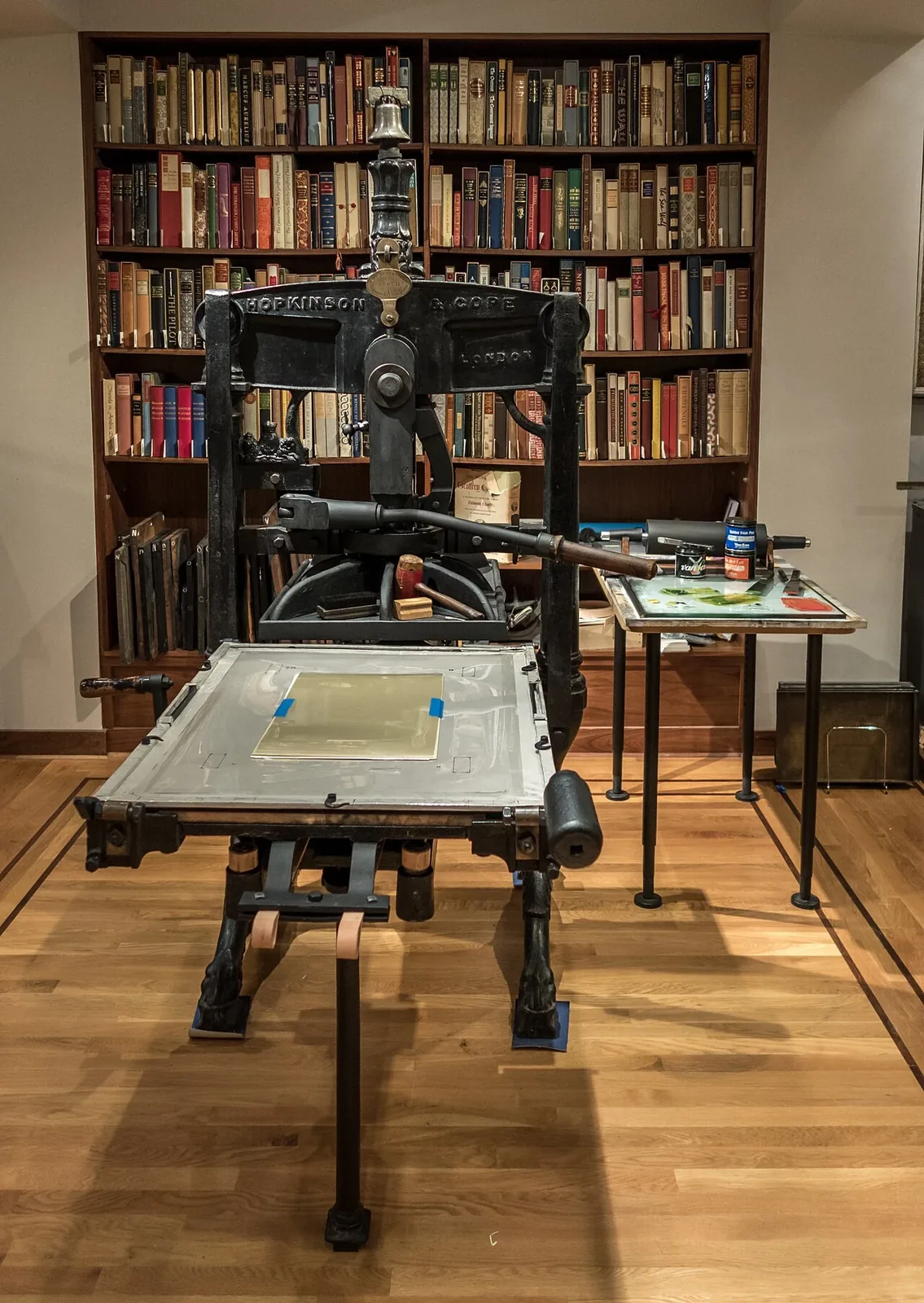
Kelmscott and the Goudy Albion
The press shown here is identified in its Commons file record as the Kelmscott–Goudy press at the Cary Graphic Arts Collection. RIT’s collection record gives the…
5 min read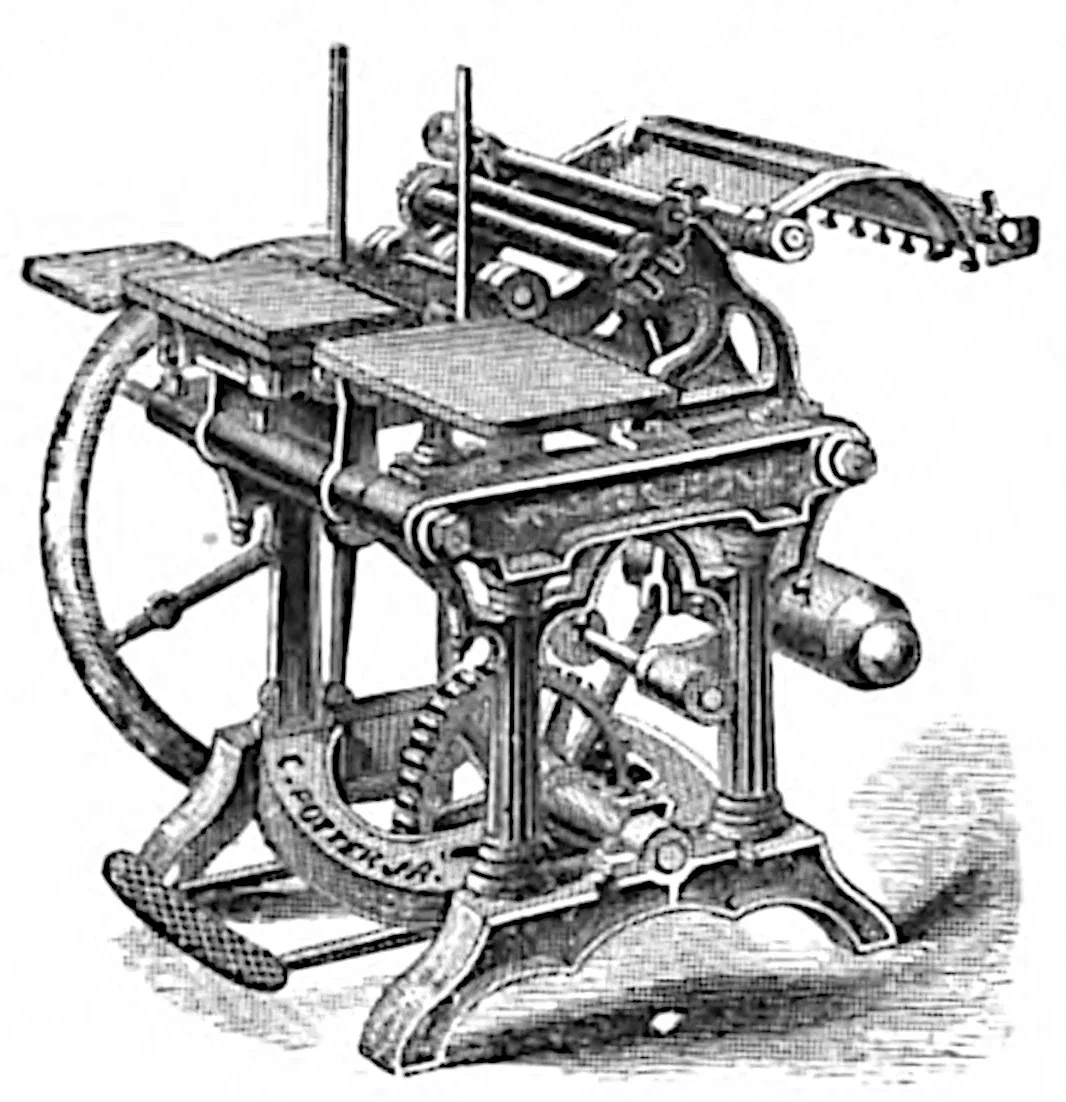
Babcock’s 1857 Jobbing Press
The file record for this cover identifies a Babcock jobbing press dated 1857. Its subject is a useful doorway into a part of printing that can disappear from…
5 min read