
The Print Field / Essay 36
Gwen Frostic’s Cards and the Heidelberg
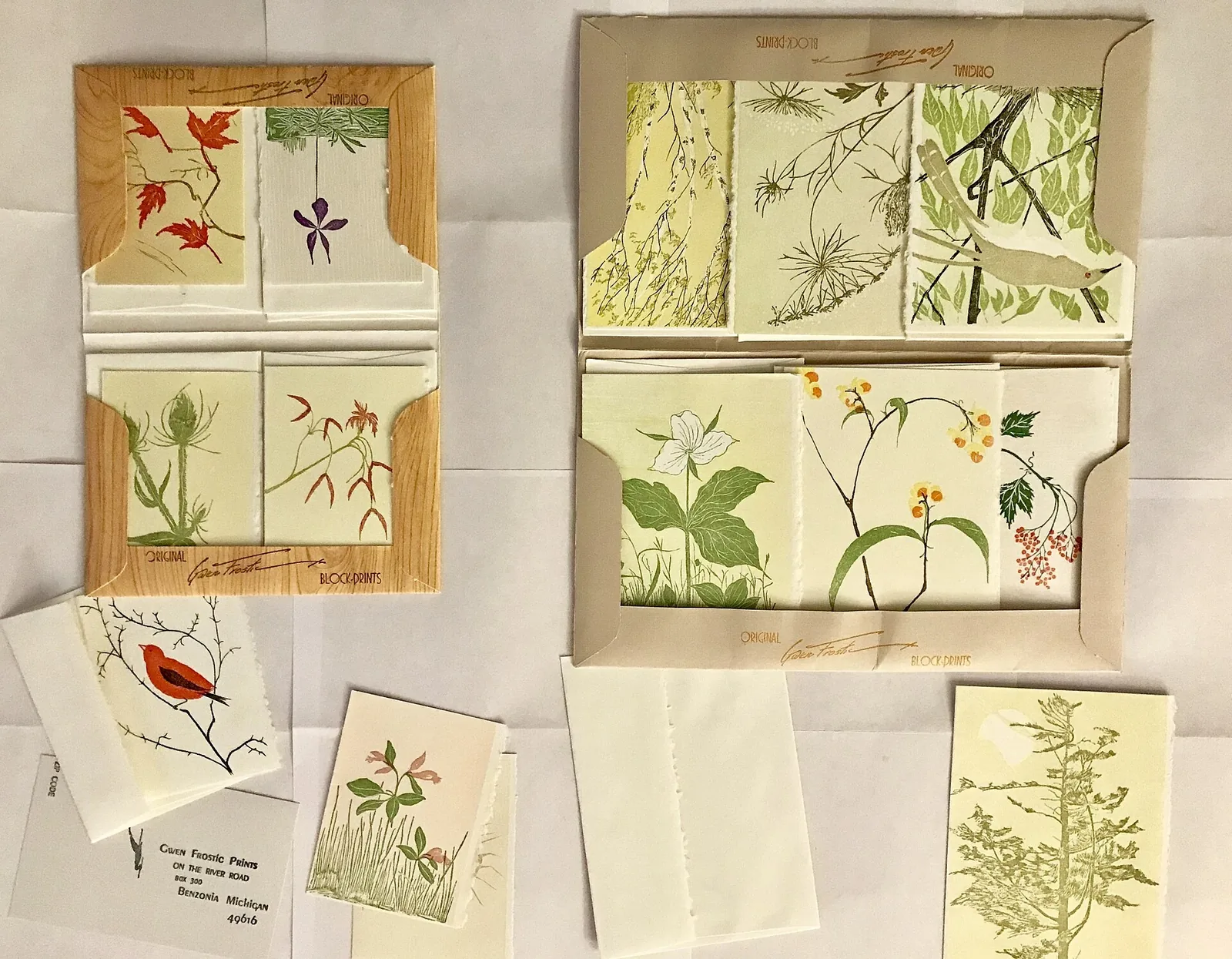
The cover photograph shows greeting cards associated with Gwen Frostic and identifies a Heidelberg press in the printing process. The Henry Ford's collection holds…
A small card travels farther than a press
The cover photograph shows greeting cards associated with Gwen Frostic and identifies a Heidelberg press in the printing process. The Henry Ford's collection holds a concrete example of Frostic's printed work: a birthday card titled “Hi! — and a Happy Birthday to You!” from about 1980. Its record notes that Frostic carved linoleum blocks and created block prints for books, note cards, and greeting cards over several decades. That museum record provides a grounded frame for understanding the card as both an artwork and a reproducible object.
Frostic's greeting cards show how relief printing can become part of ordinary correspondence. A card is handled, read, displayed, and sometimes saved. Its image enters a private exchange, unlike a poster designed for a wall or a book illustration that sits within a sequence of pages. The format changes how a print is encountered: the image is close, the sheet is small, and the printed words can address one recipient directly.
The block and the press share the work
Frostic is documented by The Henry Ford as carving linoleum blocks. In relief printing, the maker cuts away areas that should remain blank and leaves raised surfaces to take ink. The block establishes the image; a press applies controlled contact between the inked relief and paper. The cover caption names a Heidelberg press, while The Henry Ford documents a specific birthday card and its material details. Those are related records, but they may not describe the same individual print run.
A Heidelberg platen press can repeat a contact efficiently. The block still determines what is printed. The operator must bring paper to the right position, ink the raised surface, and manage pressure. A card's small dimensions make registration and handling visible: the image has to sit within the sheet with room for text and margins. The catalogued birthday card measures 4.5 by 3.375 inches, a scale suited to being held and mailed.
The process combines hand-made decisions with mechanical repetition. Carving is specific to the maker; each impression is made through a press; folding, trimming, and writing may follow. The print's appearance depends on the block, ink, paper, and press, not on the press alone. A machine can provide consistent pressure, but it cannot decide how much of a plant's stem or a bird's wing should remain in the image.
Cards create an intimate scale
A greeting card has an outside and an inside, and those surfaces divide its message. The printed image may appear before the recipient opens it; the personal greeting can be added later. This allows the maker's artwork and the sender's words to occupy different roles. A single printed design can be shared by many senders while the handwritten message remains individual.
That structure also affects what a collection preserves. The Henry Ford holds a specific card from around 1980, catalogued under its title and object number. It documents paper, color, dimensions, and creator. The collection record shows that the object exists and how it is classified, but it may not record the recipient, sender, or route through the mail. Those social details can survive on the card itself if it was written, or in related papers if they exist.
Nature becomes a repeated image
Frostic is described in the museum record as carving nature-inspired designs. A linocut can simplify leaves, birds, or other forms into bold contours that remain legible on a small card. The block's cut lines can suggest texture; a large uncut area can carry a strong field of ink. The medium does not force a single style, but it lends itself to designs in which shape and contrast matter.
Repeated imagery allows a personal visual language to travel. A nature print may appear across a book, note card, or greeting card, each format changing its surrounding context. The same block can be used again, while the paper size and accompanying text alter the recipient's experience. The card is therefore not only a reproduction of an image; it is an application of that image to a social form.
What the records do and do not connect
The card in The Henry Ford's collection is dated circa 1980 and identifies Frostic as its creator. The photograph in this article has a separate Commons source record and credits its photographer. Its caption names the cards and a Heidelberg press. Without a matching inventory number or direct provenance link, we should not say that the pictured card is the exact Henry Ford object or that the press shown printed that museum copy.
That precision strengthens the story. We can say that Frostic produced linocut designs for cards and that a Heidelberg press is documented in the cover photograph. The museum's artifact record supplies a specific example of her card work. The press photograph suggests a production setting, while the catalogued card shows what reached a recipient. Together they illuminate a craft practice without confusing two separate objects.
A repeated design becomes a particular greeting
A greeting card has two kinds of authorship that need not occur at the same time. The printmaker establishes a repeatable design. A sender may later turn one copy into a particular act of correspondence through selection, writing, and delivery. The same printed image can therefore participate in different relationships without changing its block. This is an analysis of the format, not a claim that the catalogued Henry Ford card preserves a named sender's message.
The format also distributes attention across a sequence. A cover image may be encountered before an interior greeting, and a personal addition can change how the printed text is read. That sequence differs from seeing an isolated reproduction in a collection database. A museum can preserve the card's dimensions, material, and maker while leaving the original exchange undocumented. The missing exchange should not be invented, but the object's capacity to support one can still be explained.
This is where the Heidelberg photograph and the birthday-card record complement one another. One helps describe repeatable production; the other anchors a specific small printed object in a collection. They do not establish that the photographed press made that exact sheet. The distinction allows a stronger argument about Frostic's work: a carved image can travel through an efficient printing process and then acquire an individual social purpose in someone's hands. Repetition and personal address belong to different stages of the card's life, and neither cancels the other.
Further reading
Sources & records
Linked records provide object descriptions and historical context. Comparisons, close readings, and explicitly hypothetical examples are editorial analysis. This essay was revised on 22 October 2026; it does not report first-hand workshop research. The image source and license appear in its caption.
Rocks in Bretagne
The Commons object description identifies Ingeborg Bernhard's linocut as *Rocks in the Bretagne, France*, dated 1977, with dimensions of 21 by 30 centimetres. The…
5 min read
Carving a Chandigarh Stamp in Linoleum
The photograph shows a sheet of linoleum being carved for a stamp. Its caption identifies the design as a stamp featuring Chandigarh's Open Hand Monument, the Rock…
5 min read
Yvonne Drewry’s Convolvulus Linocut
The Commons file record identifies this image as a linocut of convolvulus flowers by Yvonne Drewry, dated 1975. The photographed impression is the starting…
5 min read