
The Print Field / Essay 05
The Columbian Press and Leverage
The Columbian press belongs to the history of iron handpresses, where changing the way force was applied allowed printers to make larger impressions than the older…
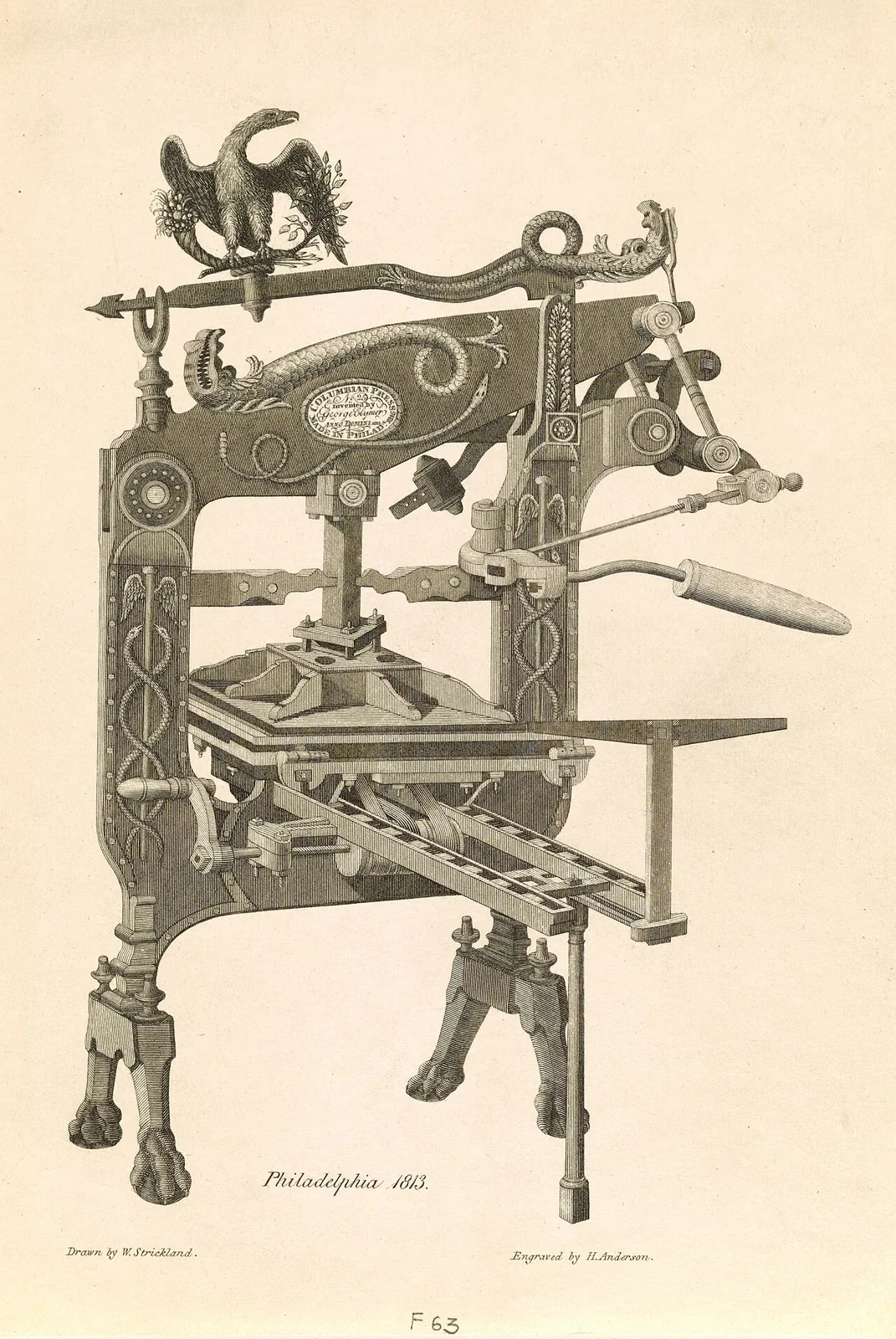
The counterweight is not decoration
The Columbian press belongs to the history of iron handpresses, where changing the way force was applied allowed printers to make larger impressions than the older wooden frame could comfortably support. The Smithsonian’s press collection identifies the Columbian as the first American iron-framed hand press, introduced by George Clymer around 1813. Its design became known for an eagle-shaped counterweight and a system of levers. The striking silhouette is memorable, but the important story is mechanical: how the press manages force while the platen approaches the bed.
The older common press relied on a screw and a long bar. According to the Smithsonian, the wooden frame’s elasticity and the screw’s limited leverage meant that a full sheet form was printed in two pulls, each covering half the form. Iron handpresses explored lever systems that increased mechanical advantage. More force at the platen made a larger one-pull impression possible, but it also required a frame capable of containing that force. The Columbian is one documented answer within that broader search.
Leverage in a working machine
A lever does not create energy; it trades distance and movement for force. A long movement at the handle can produce a shorter, stronger movement at the printing surface. In a press, the operator’s pull is transformed by linked components into pressure between platen and bed. The counterweight can help balance or return parts of the mechanism, depending on the press design. A viewer should be careful not to infer the exact action of every linkage from a photograph: the Smithsonian’s object records and diagrams are better evidence for a specific model.
The practical outcome is a change in what can be printed per cycle. A larger platen can meet a larger area of type at once, which changes the rhythm of a shop. It does not eliminate setup work. The form still has to be composed and secured; the paper has to be positioned; the ink has to be prepared; and the impression has to be checked. A more effective mechanism expands capacity only when the rest of the process is ready to use it.
Why the Columbian traveled
The Smithsonian records that Clymer found limited demand for the press in the United States and took it to England, where it became a success. It also notes that no American-built Columbians are known to survive. These details correct a simple national-origin story. An invention can emerge in one place, find its market elsewhere, and then influence makers on both sides of the Atlantic. The press’s name is not a guarantee that its production, ownership, or surviving examples all belong to a single country.
The same collection history says that other builders soon produced their own iron presses. That response shows why a design is more than a single object. Its mechanism can become part of a competitive field, where makers adjust weight, frame shape, leverage, and working clearances. A printer chooses among machines that solve similar problems in different ways. The surviving Columbian provides a starting point, not a complete account of all the presses that followed.
Reading the press without turning it into a legend
The eagle finial and counterweight invite symbolic interpretation, but the machine’s operation should lead. Ask where the operator applies force, which element moves, and how the platen reaches the type. Then consider what the press changes compared with the wooden two-pull press. The Smithsonian record supports the mechanical and historical outline. A press in a different collection may have a separate maker, date, or repair history, so its object label must be read independently.
There is also a useful difference between an invention and a working practice. A press design can enable a one-pull impression, but printers still need to decide how to arrange the sheet and form. A technical possibility does not tell us how often a shop used it, what kinds of jobs it took, or how many impressions a particular operator made. Those claims require documentary evidence beyond the shape of the machine.
Separate the power stroke from the return stroke
The Columbian's counterweight is easiest to understand by dividing a press cycle into two problems. The first is producing contact between paper and printing surface. The second is restoring the mechanism to a position where another sheet can be prepared. A device associated with the return movement should not automatically be credited with supplying the printing force. Keeping the two movements separate helps explain why a visually prominent part can matter without being the entire source of mechanical advantage.
The same distinction improves a comparison with the older wooden press. A larger impression per pull changes the number of printing actions required for a given forme. It does not necessarily halve the total time for an order, because paper handling, inking, preparation, and proofing remain. The mechanical gain and the shop's overall gain are related but unequal quantities. A precise history asks which part of the cycle actually became shorter or more capable.
This reading also makes the eagle more interesting as a designed object. A conspicuous form can help people remember a machine while participating in its working arrangement. Symbolic reading and mechanical explanation need not compete, provided their evidence remains distinct. The Smithsonian documents the Columbian's introduction and migration to England; the comparison here explains what a reader can learn by separating force, recovery, and handling. The press's contribution lies in reorganizing a cycle, rather than in a decorative emblem promising effortless work.
Further reading
Sources & records
Linked records provide object descriptions and historical context. Comparisons, close readings, and explicitly hypothetical examples are editorial analysis. This essay was revised on 22 October 2026; it does not report first-hand workshop research. The image source and license appear in its caption.
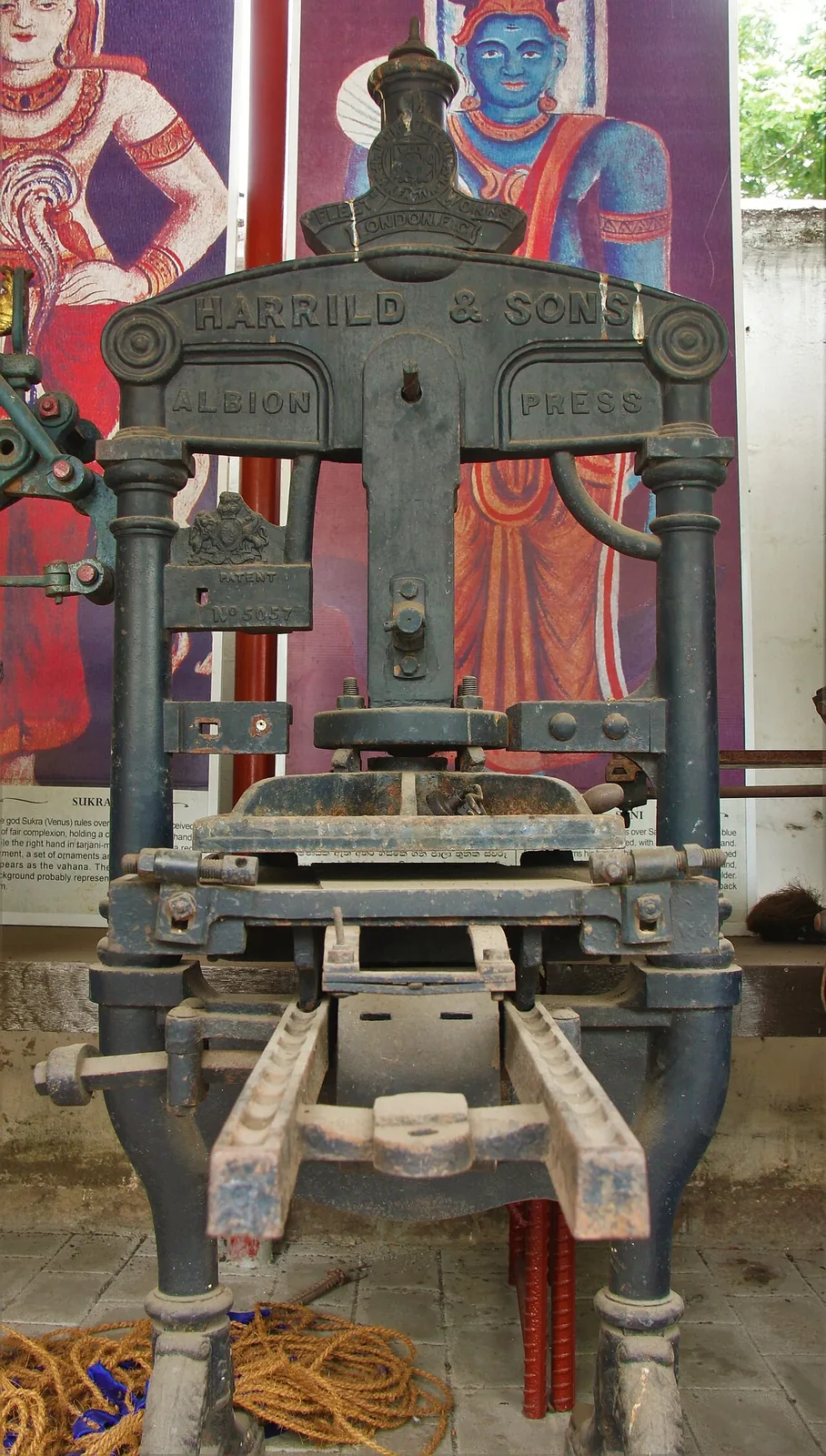
Albion and the Press Lever
The Albion press is easiest to understand when it is treated as a working arrangement rather than as a sculptural object. A frame holds a bed and a platen in…
5 min read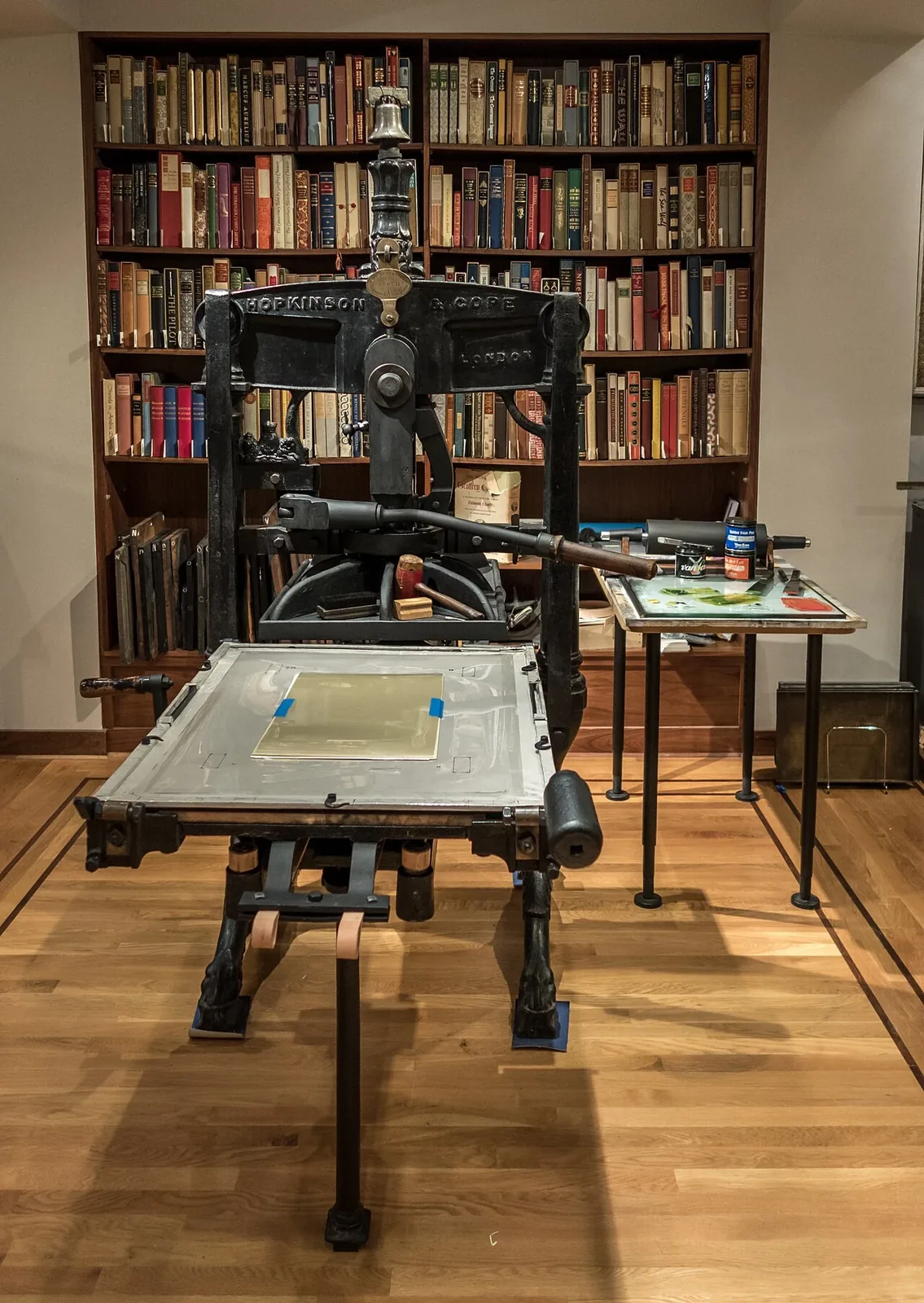
Kelmscott and the Goudy Albion
The press shown here is identified in its Commons file record as the Kelmscott–Goudy press at the Cary Graphic Arts Collection. RIT’s collection record gives the…
5 min read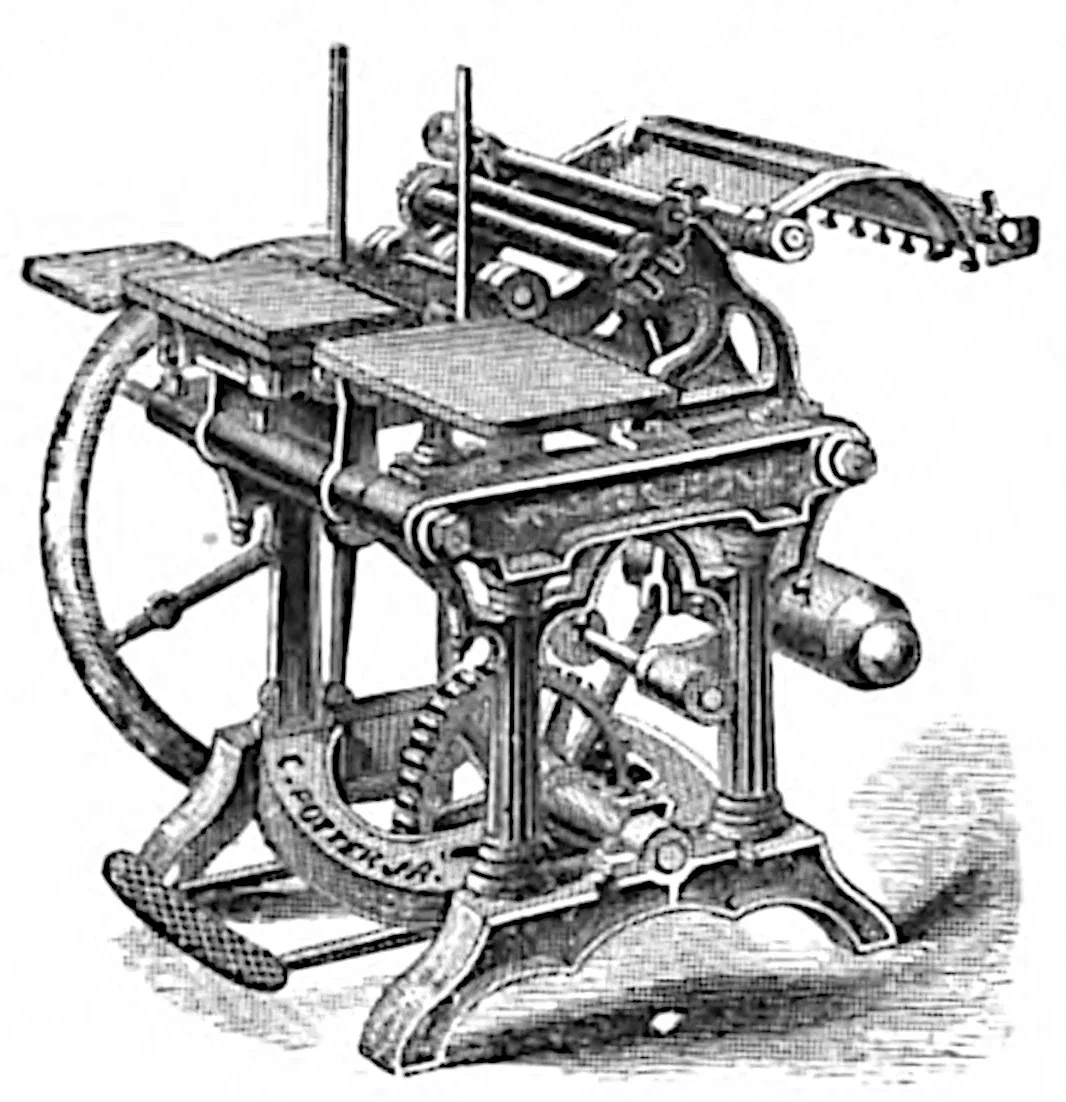
Babcock’s 1857 Jobbing Press
The file record for this cover identifies a Babcock jobbing press dated 1857. Its subject is a useful doorway into a part of printing that can disappear from…
5 min read