
The Print Field / Essay 10
A Pressman at the Cocce Press
The Library of Congress record for this Farm Security Administration and Office of War Information photograph identifies a New York pressman at the Cocce press on…
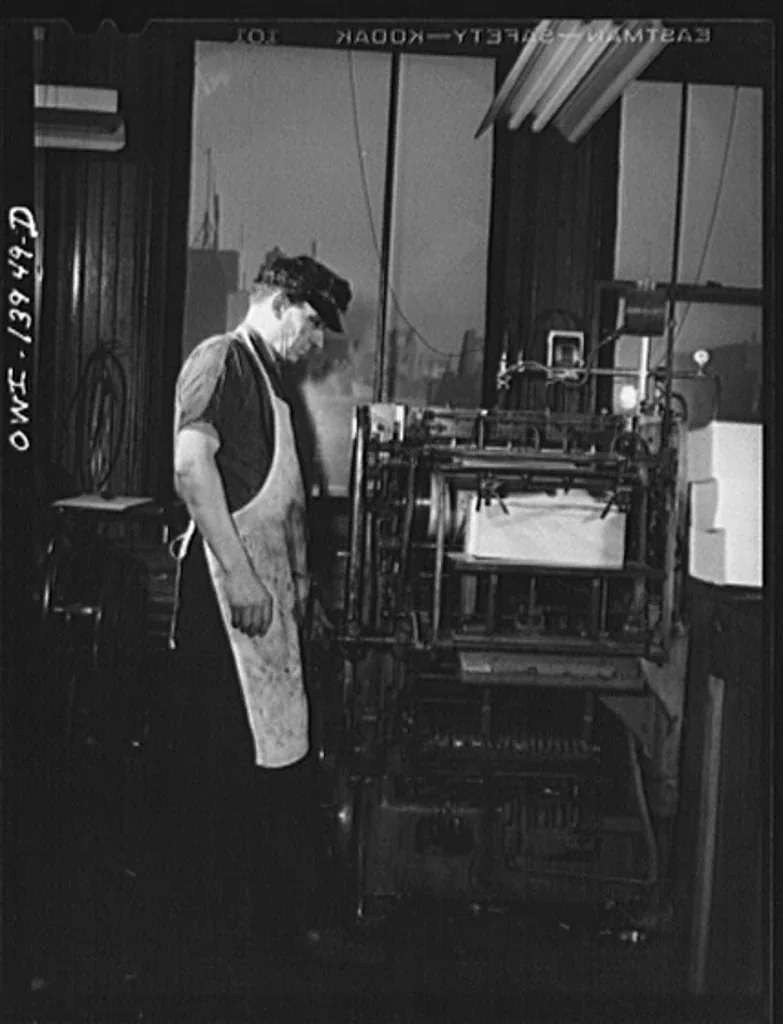
A photograph with a narrow title
The Library of Congress record for this Farm Security Administration and Office of War Information photograph identifies a New York pressman at the Cocce press on Barrow Street. The record names photographer Marjory Collins and places the image in the collection of federal black-and-white photographs. The photograph’s Wikimedia Commons title repeats the pressman and street, but the Commons file page does not supply a fuller description. For historical claims, the Library of Congress’s collection record and its guidance about the FSA/OWI photographs should lead the way.
A photograph is precise in some ways and incomplete in others. It can preserve a person’s posture, a machine’s visible parts, and a room’s arrangement at one moment. It cannot, without captions or related records, tell us the full shift schedule, the number of copies produced, or the relationship between the shop and its customers. The absence of those details is not permission to fill them with a familiar story about a print shop. It is a reason to separate visible observation from documented information.
Work appears in small actions
The title names a pressman, a machine, and Barrow Street. That compact caption makes labor visible as a person working beside a press, rather than presenting machinery as an anonymous force. In printing history, this distinction matters. A press may be described through its model or date, but a shop’s output also depended on people who prepared a forme, handled paper, watched registration, and checked impressions. The photo’s record does not identify every person or task; it does preserve a worker as part of the machine’s setting.
The pressroom can be read through details, but each inference needs a boundary. If a visible handle or roller can be identified, it may support a description of the machine. If the image does not reveal the press’s model, a writer should not assign one by resemblance alone. The Library of Congress notes that the FSA/OWI collection contains photographs made by government photographers in the course of their official duties. That collection context explains the photograph’s archival origin; it does not automatically explain the photographer’s intention for this particular frame.
The shop and its neighborhood
Barrow Street gives the record an urban location. A street address can help researchers connect the photograph to directories, newspapers, maps, and other archival material. The title alone does not establish what other businesses shared the block, how long the press remained there, or which publications came from it. Those questions would require additional records. A location is a research handle: it allows the next search to be more focused without pretending that the answer is already known.
The FSA and OWI photograph collection was created within a specific federal documentary context. The Library of Congress’s collection information describes the photographs and their transfer into the archive. When a reader encounters an image of industrial work in that collection, it is useful to keep the documentary frame in mind. A photograph can be both a record of a real scene and part of a larger collection assembled for institutional purposes. Understanding that context helps avoid treating every image as a neutral, exhaustive account of a workplace.
Reading machinery from one frame
The press itself invites technical questions. Is the impression made by a flat platen or a cylinder? How is paper fed? Where do ink rollers contact the form? Is the machine powered or operated by hand? A still image may answer some of these questions and leave others uncertain. Comparing the scene with museum descriptions of press types can help, but a match should be labeled as an identification only when the visible features and archival record support it.
The Smithsonian’s press collection shows how many forms of letterpress equipment existed: common presses, iron presses, jobbers, proof presses, and powered machines. That variety cautions against using “printing press” as if it described one universal device. A careful caption identifies what is certain and explains what remains unresolved. When a model cannot be established, it is more accurate to discuss a printing press in a shop than to assign a name.
Build the explanation around a sequence of frames
One pressroom photograph compresses a process into a posture. A hand near a machine might belong to preparation, observation, feeding, or a pause. The title identifies a pressman, but it does not convert the single exposure into a complete sequence of work. This is why a photograph of labor should be read differently from a labeled mechanical diagram: the photograph preserves a moment, while the diagram usually organizes relationships for explanation.
A research exercise can make the difference concrete. Start with the Collins frame and list only features that can be located: worker, machine, reachable controls, paper, and surrounding space where visible. Then list the movements that would have to occur for a sheet to pass through the press. A second photograph or item description could confirm some of those movements. Without that evidence, they remain candidate steps in an explanation, not reported actions of this worker.
The method changes the historical emphasis. Instead of treating the person as scale beside a large machine, it asks how the workspace distributes attention and access. Which operations could be observed from that position? Which are hidden from the camera? These questions are specific to documentary photographs of work and differ from naming a press model. They give the Cocce image a useful role in this journal: it shows how a technical process becomes visible through a photographer's framing, and why an account of machinery also needs an account of how labor is represented.
Further reading
Sources & records
Linked records provide object descriptions and historical context. Comparisons, close readings, and explicitly hypothetical examples are editorial analysis. This essay was revised on 22 October 2026; it does not report first-hand workshop research. The image source and license appear in its caption.
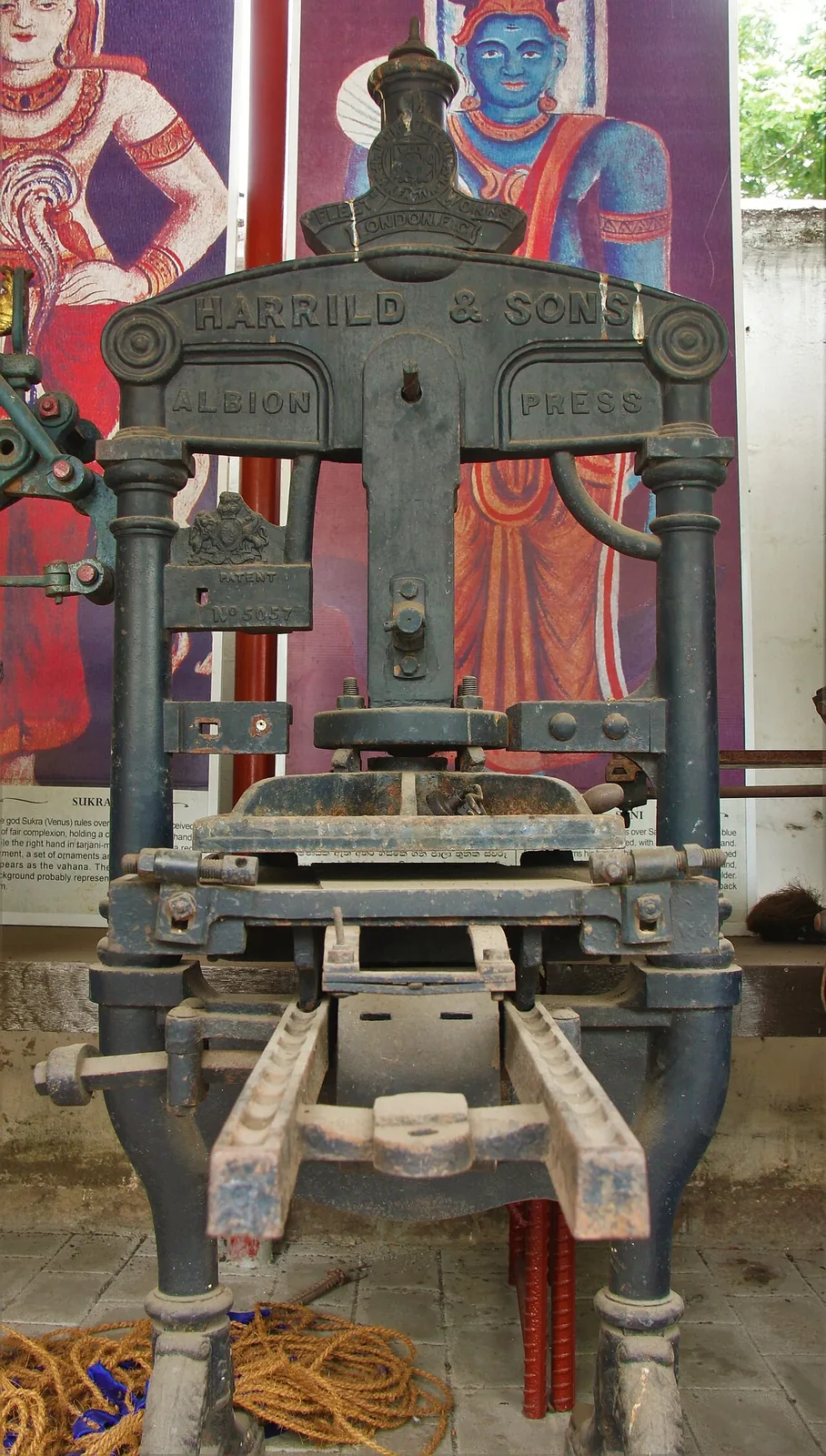
Albion and the Press Lever
The Albion press is easiest to understand when it is treated as a working arrangement rather than as a sculptural object. A frame holds a bed and a platen in…
5 min read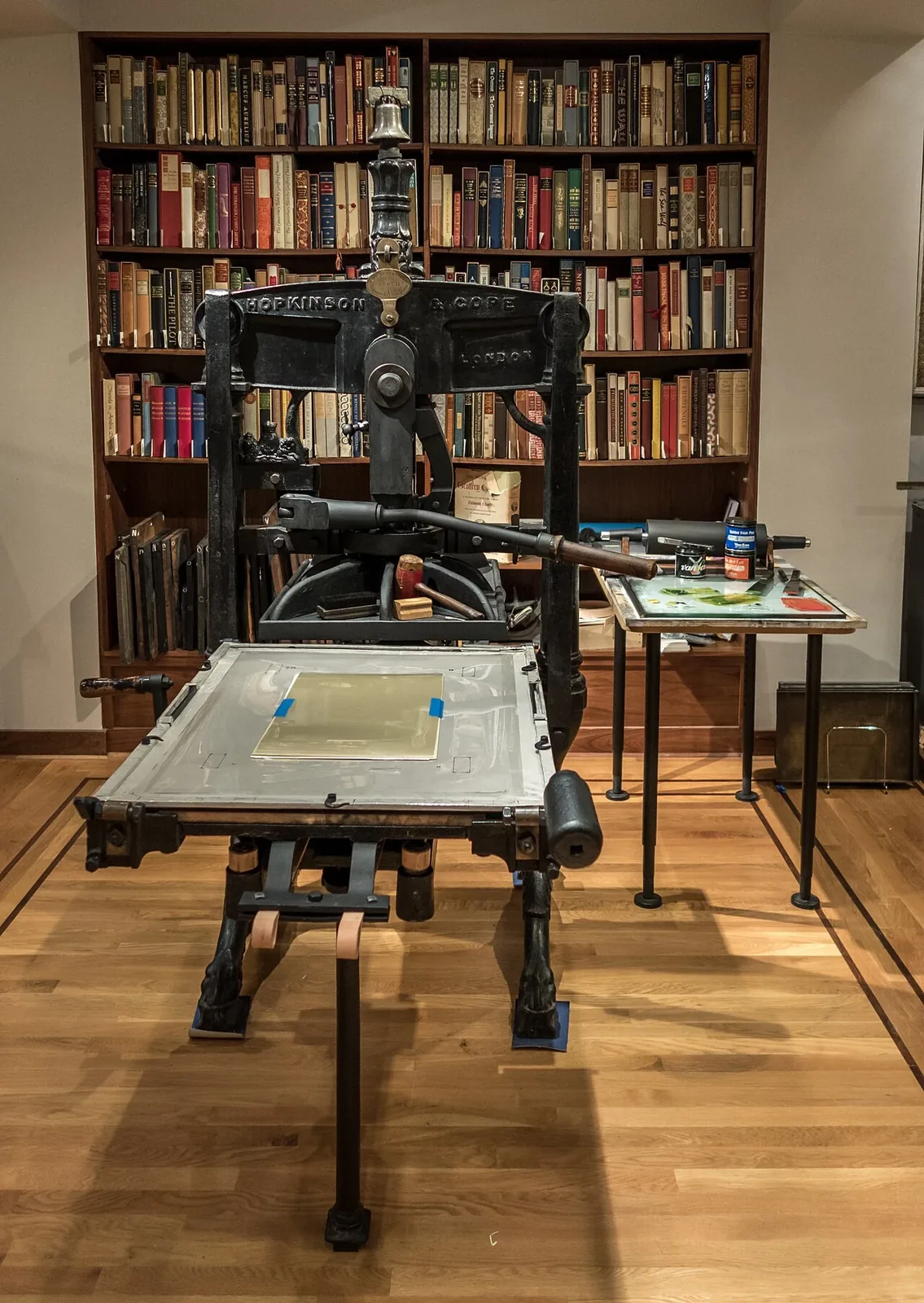
Kelmscott and the Goudy Albion
The press shown here is identified in its Commons file record as the Kelmscott–Goudy press at the Cary Graphic Arts Collection. RIT’s collection record gives the…
5 min read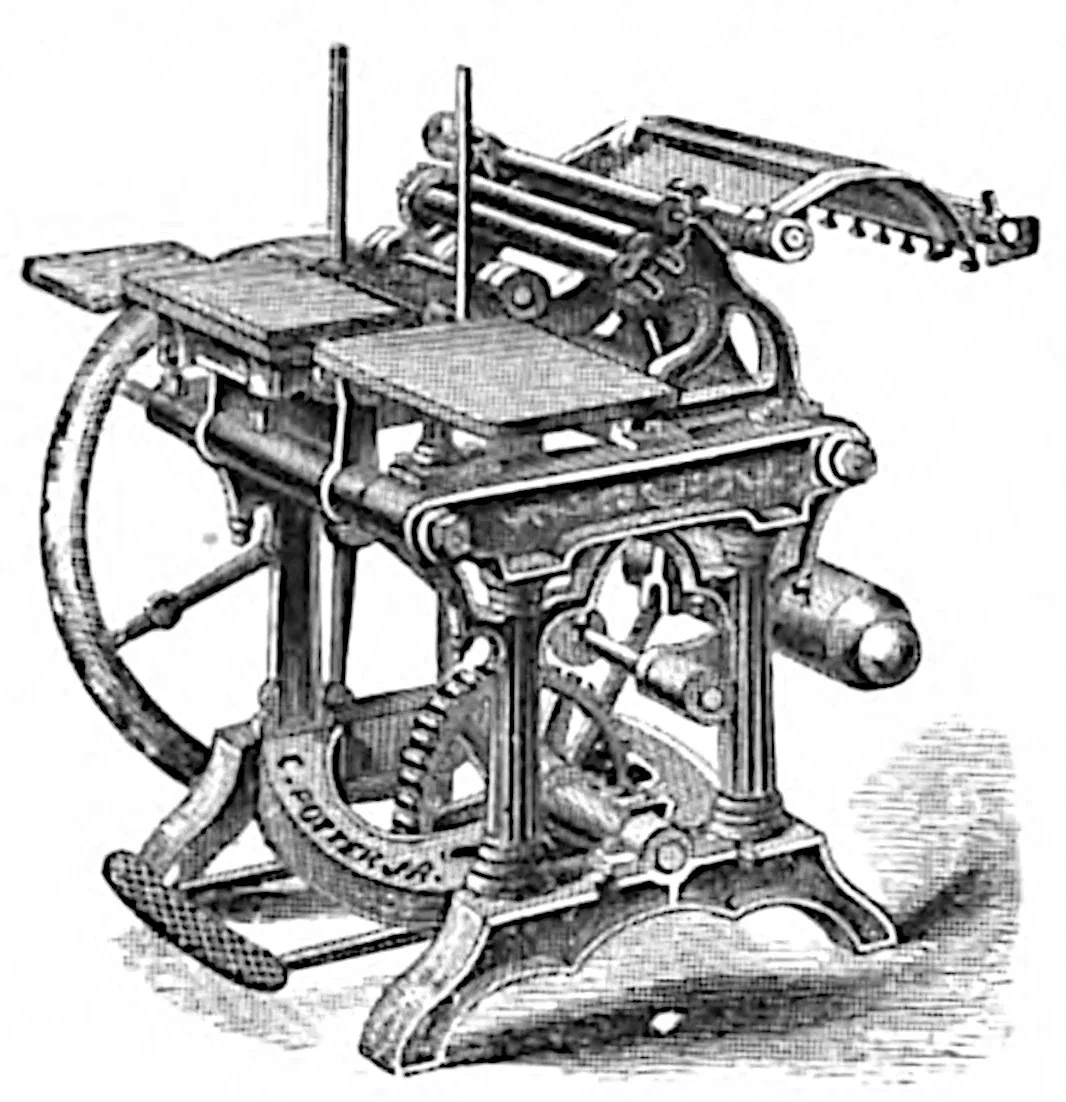
Babcock’s 1857 Jobbing Press
The file record for this cover identifies a Babcock jobbing press dated 1857. Its subject is a useful doorway into a part of printing that can disappear from…
5 min read