
The Print Field / Essay 28
Maud Hunt Squire’s Clam Diggers
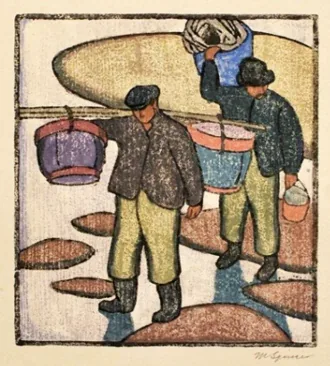
The cover file identifies Maud Hunt Squire's *Clam Diggers* as a colour woodcut dated 1917, with Mary Ryan Gallery named as the reproduction's source. Those are the…
A shoreline cut into wood
The cover file identifies Maud Hunt Squire's Clam Diggers as a colour woodcut dated 1917, with Mary Ryan Gallery named as the reproduction's source. Those are the particulars used here; they are attributed to the file rather than presented as a newly authenticated object history. The print's title connects figures with an activity on a shoreline, while its medium makes the relation between cut surfaces, colour, and repeated shapes a useful subject for analysis.
Woodcut is a relief process. The artist cuts away parts of a wooden surface, leaving the raised areas to take ink. In a colour woodcut, more than one surface or printing stage can contribute to the final image. The visible impression may contain evidence of boundaries, overlaps, and carved marks, but it cannot always reveal the exact sequence used. That sequence should be drawn from technical records, a catalogue essay, or direct examination rather than guessed from a digital image.
The title directs attention to people at work along a shoreline. “Clam diggers” names an activity, not an individual story. A viewer can describe the figures and their relation to the beach if those details are visible, but should not assign identities or historical conditions without supporting documents. The print is an artistic representation; its date does not automatically make it a documentary record of a particular labor event.
Color woodcut is a set of decisions
Color printing makes the block structure more complex than a single inked surface. The printmaker has to decide which shapes belong to which color, whether colors will overlap, and how the paper returns for each impression. The number of blocks is not provided in the cited source, so no count is assigned here. Close looking can still reveal whether the image uses distinct areas of color to separate figures, water, ground, or sky.
Wood can retain fine cuts and broad planes, but the printmaker must work with the grain and the carving tools. A line removed from the block becomes an unprinted line in the final impression. The process can reward strong contrasts, yet color woodcuts can also achieve subtle effects through layered color and careful registration. The medium offers possibilities; it does not predetermine a single style.
One useful exercise is to compare the positive and negative shapes. Where does the eye see an object because of a dark outline, and where does paper itself create the form? Which color carries the greatest visual weight? If the image were reduced to one ink, what relationships would disappear? Such questions describe what the print does without pretending to reveal every intention behind it.
A catalogued object and an interpretive image
The file description and the reproduced image answer different questions. The former supplies a title, maker, date, and medium. The latter permits a reading of relationships among figures, shore, and color where visible. A fuller museum or exhibition catalogue could establish how this impression relates to other Squire prints, but such a relationship is not established by the single file. The interpretation here uses the named work as its unit of comparison rather than reconstructing a collection that the cited record does not describe.
A reproduction's gallery credit should also be kept distinct from the ownership of an original impression. The source named in a file can identify where an image was obtained without establishing the current collection, edition number, or complete provenance of every sheet carrying the design. Those particulars require a record tied to an identifiable impression. The Commons page remains linked so readers can inspect the source and attribution actually used, rather than being directed to an unrelated file title.
Work, place, and looking
The phrase “clam diggers” suggests a repeated, physical task. The print can make that repetition visible through the arrangement of figures or the rhythm of carved shapes. A viewer may see gestures of bending, reaching, or moving across the shore, but each description should be checked against the image. The art-historical context can support a discussion of visual organization; it should not be stretched into a claim about wages, labor conditions, or the identities of people depicted.
The difference between an artwork and a documentary photograph is not a measure of truthfulness. A print can be an attentive visual statement while remaining shaped by artistic decisions. Its carved surface preserves a composed image, not an unfiltered scene. Research can add information about the artist, the object, and its collections, while the image continues to invite observation.
Distinguish the repetition of work from the repetition of printing
Clam digging and woodcut printing can both involve repeated actions, but their connection in this article is a comparison rather than a claim about Squire's intention. In the depicted activity, a viewer may look for recurring bodily positions and their relationship to the shore. In the material process, carved surfaces make an image repeatable. One repetition belongs to the subject; the other belongs to how the subject reaches multiple sheets of paper.
Keeping the two apart avoids an easy metaphor becoming invented evidence. A series of bent figures might contribute a visual rhythm, but it does not document the length of a workday or the organization of a particular labor group. Likewise, a repeatable block does not tell us the edition size. The title and the image open questions of activity and arrangement, while the file description anchors the work's maker, approximate date, and woodcut identification.
A useful reading can therefore begin with intervals rather than imagined biography. How are bodies separated? Do areas of color connect the figures with the shore or distinguish them from it? Which relationships would disappear if the print were described only as a scene of manual labor? These questions ask the reproduction to support an argument about organization. They let the article explain why the image is a composed print, with a particular economy of shapes, instead of using an evocative title to manufacture an undocumented account of the people represented.
Further reading
Sources & records
Linked records provide object descriptions and historical context. Comparisons, close readings, and explicitly hypothetical examples are editorial analysis. This essay was revised on 22 October 2026; it does not report first-hand workshop research. The image source and license appear in its caption.

Flatbed Letterpress Anatomy
A flatbed letterpress diagram turns an industrial machine into a set of relationships. The bed holds the locked type or relief forme. The ink system prepares the…
5 min read
Registration in a Two-Colour Linocut
A two-colour linocut is not simply a black-and-white print with a second ink added at the end. Each color depends on a carved surface, an inking decision, and a…
5 min read
Fons Heijnsbroek’s Linocut Still Life
The Commons record describes this 1988 linocut as an untitled abstract still life by Dutch artist Fons Heijnsbroek. Those details are enough to guide a first…
4 min read