
The Print Field / Essay 29
John Drew in Linocut
Alfred J. Frueh's *John Drew* is a color linocut dated 1915. The Library of Congress catalog describes it as a monolithic bust portrait caricature of the…
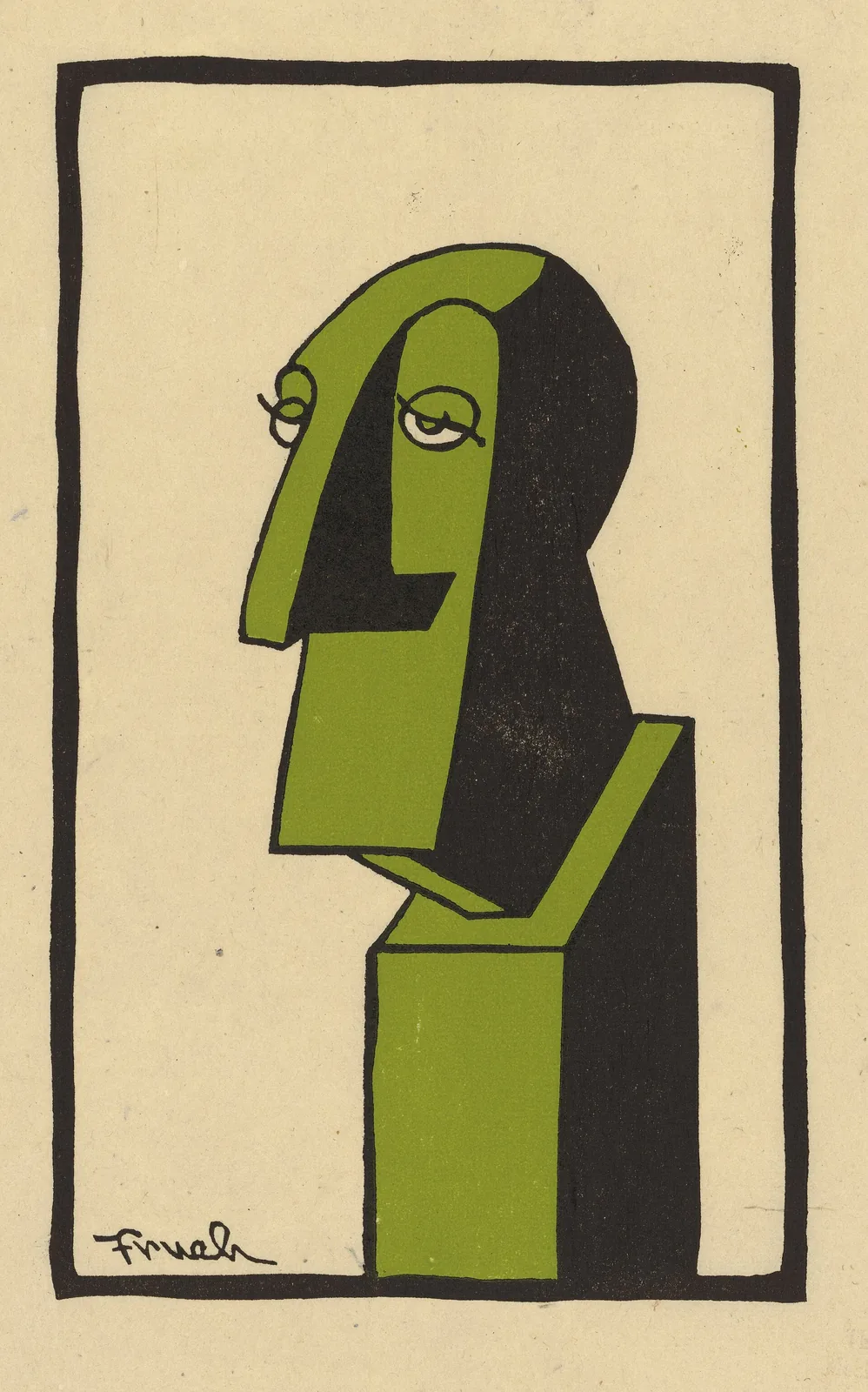
A portrait built from a few decisive shapes
Alfred J. Frueh's John Drew is a color linocut dated 1915. The Library of Congress catalog describes it as a monolithic bust portrait caricature of the turn-of-the-century American stage actor and records the medium as one color linocut print on paper. The National Portrait Gallery's Catalog of American Portraits also lists John Drew and Alfred J. Frueh among its print records. Together these sources identify the sitter, artist, date, and form without requiring a viewer to invent a backstory from the image.
The word “monolithic” is a useful description of the print's visual effect. A linocut can reduce a face and shoulders to linked areas of ink and paper, with carved channels defining selected features. In a portrait caricature, simplification can intensify a recognizable gesture or silhouette. The image is not a neutral likeness: it is an artist's constructed interpretation, reproduced through a relief block.
The medium makes every line a choice
Linoleum is cut away in the areas that should remain blank. Raised areas hold ink and transfer it to paper under pressure. The print appears reversed from the block, so the maker must plan letterforms, directional details, and contours accordingly. A carved line can create a white channel inside a dark region; an uncut plane may become the largest field of black. The final portrait records these decisions in a compact visual vocabulary.
The Library of Congress gives the print's sheet size as 29.8 by 18.8 centimetres. That scale matters. A viewer encounters the portrait close enough to inspect the edges and internal lines, yet the image can be read as a strong silhouette from farther away. The catalogued dimensions let a reader understand the physical object more accurately than a screen image alone, which may be resized or cropped.
Caricature and recognition
Caricature does not necessarily mean mockery. It can use selection and exaggeration to make a face or public persona more legible. The LOC caption identifies John Drew as an American stage actor and describes the image as a caricature. Those statements support a reading of the print as a stylized portrait. They do not specify which facial feature Frueh intended to emphasize, what Drew thought of it, or how the image was received when first published.
The viewer can still analyze the likeness. Which contours define the head? Where does the contrast gather? Does the portrait depend on posture, profile, or the framing of the shoulders? These questions stay close to the printed image. Research about Frueh's work or periodical publication could add context, but the image itself should not be used to make unsupported claims about the sitter's private character.
A print moves through more than one collection
The file selected for this article is described as coming from the National Portrait Gallery, while the Library of Congress holds a catalog record for the print in the Alfred Bendiner Memorial Collection. The Smithsonian Catalog of American Portraits separately lists multiple John Drew prints by Frueh. These records may refer to different impressions of the same design. They should not be combined as if every collection page described one physical sheet.
That distinction is fundamental to print research. A block can produce multiple impressions, and different institutions may hold separate copies. The artist and design remain connected, but each object has its own dimensions, condition, provenance, and acquisition record. A digital file may reproduce one institution's impression and carry a rights statement specific to that digital asset. The artwork's history and the photograph's license are related but not identical questions.
Why linocut suits a caricature
The broad relief surface supports strong areas of contrast. This can make a face readable with fewer marks than a detailed drawing. Cutting also fixes each contour into a printable surface. Once the block is inked, pressure transfers the relief image to paper. The process can reproduce a design consistently across an edition, though individual impressions may vary with ink, paper, and printing conditions.
The medium's capacity for boldness does not mean the work was technically simple. The artist had to consider reversed orientation, fragile ridges, line thickness, and the way the print would hold detail at its chosen scale. A portrait that looks immediate can be the result of careful planning. The material makes those choices visible, even when the catalog does not document each tool or studio step.
Recognition survives through selective loss
A caricature does not preserve every feature equally. It makes recognition depend on a selection: silhouette, posture, the placement of a contour, or the balance between a dark field and an opening. The useful question for Frueh's John Drew is which relationships remain effective when detail is reduced. This is different from checking whether every feature is anatomically complete. A simplified portrait can remain identifiable because some relationships carry more recognition than others.
Try comparing the outer boundary with the internal marks in the reproduction. The boundary organizes the head and shoulders as a mass; internal cuts divide that mass into a readable face and clothing where visible. Neither description proves what Frueh intended to emphasize. It does provide a way for another reader to test whether a proposed interpretation depends on the actual arrangement rather than on prior knowledge of Drew's profession.
The institutional records add another important limit. The Library of Congress's size and provenance describe its impression, while the cover is identified through a National Portrait Gallery reproduction. The design can connect those objects without making them one sheet. This allows two forms of precision at once: attribution and object history remain attached to their records, while visual analysis explains how the portrait uses limited marks. Its originality as an image lies in selection; the article's contribution is to make that selection discussable rather than substituting an invented account of the actor's personality.
Further reading
Sources & records
Linked records provide object descriptions and historical context. Comparisons, close readings, and explicitly hypothetical examples are editorial analysis. This essay was revised on 22 October 2026; it does not report first-hand workshop research. The image source and license appear in its caption.

Flatbed Letterpress Anatomy
A flatbed letterpress diagram turns an industrial machine into a set of relationships. The bed holds the locked type or relief forme. The ink system prepares the…
5 min read
Registration in a Two-Colour Linocut
A two-colour linocut is not simply a black-and-white print with a second ink added at the end. Each color depends on a carved surface, an inking decision, and a…
5 min read
Fons Heijnsbroek’s Linocut Still Life
The Commons record describes this 1988 linocut as an untitled abstract still life by Dutch artist Fons Heijnsbroek. Those details are enough to guide a first…
4 min read