
The Print Field / Essay 27
Ethel Spowers’s The Plough
Ethel Spowers's *The Plough* is catalogued as a colour linocut dated 1928. Te Papa's record for the closely related image *Birds following a plough* identifies the…
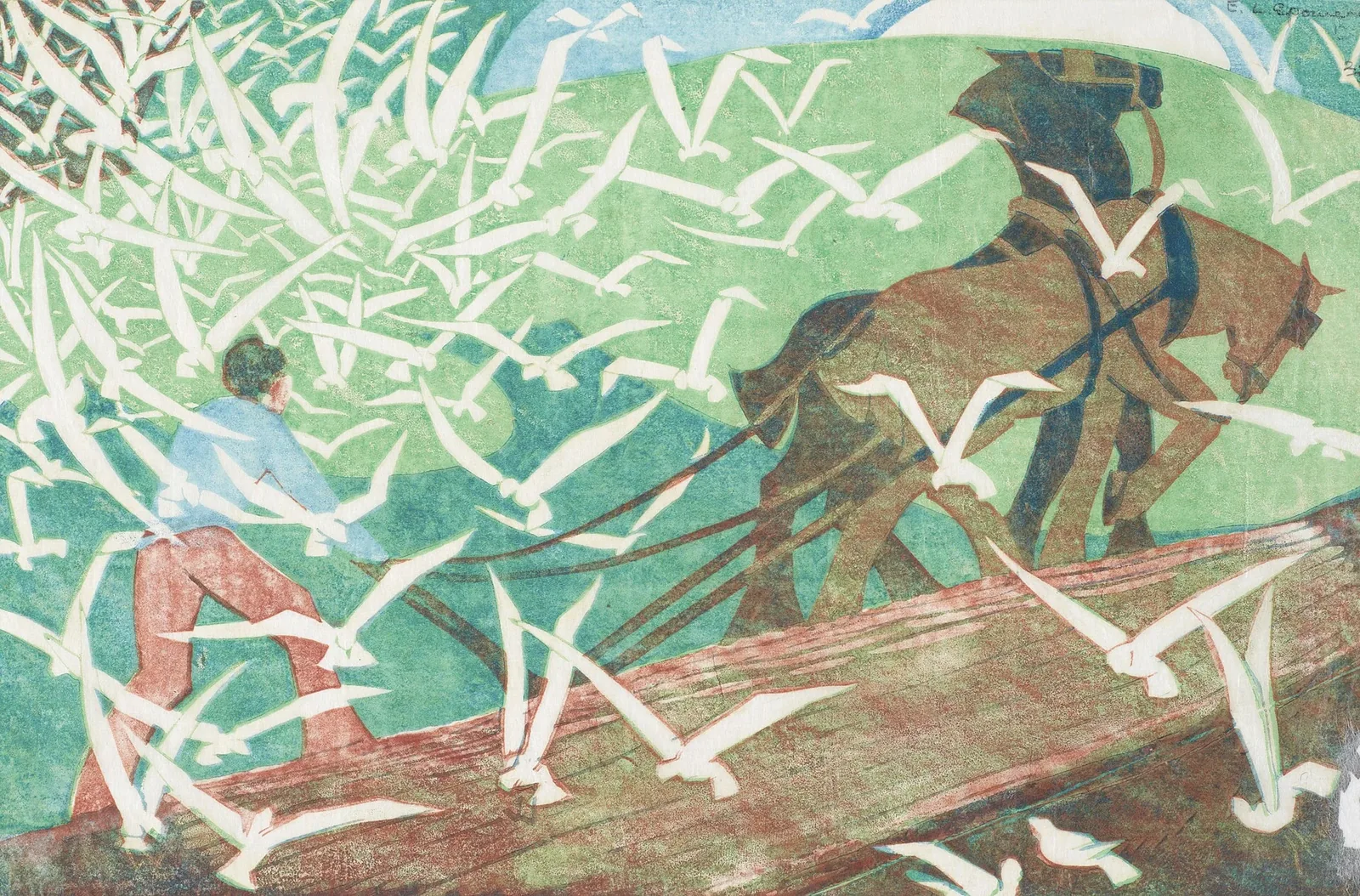
A field reduced to printable shapes
Ethel Spowers's The Plough is catalogued as a colour linocut dated 1928. Te Papa's record for the closely related image Birds following a plough identifies the artist, the linoleum-block technique, rice paper, and a production field dated 1933; its image caption also preserves the earlier title The plough; 1928. The discrepancy requires further research; these records alone do not establish a later state or edition.
The Commons cover selected for this article is captioned “The plough, 1928.” The Australian Prints + Printmaking database lists The plough as a 1928 work. Te Papa documents a 1933 print called Birds following a plough. Those labels should not be collapsed into one object without checking the image and catalogue histories. The records share the subject and the Te Papa accession reference carried by the cover description, but disagree over the year. A metadata discrepancy, reprinting, or change of state should not be chosen as the explanation without additional evidence.
The subject carries work into the landscape
A plough is both a tool and a line of action across a field. In a print, the implement, animals, workers, and furrows can be simplified into a few strong forms. Te Papa's catalogued description of Birds following a plough identifies agricultural labourers, birds, horses, and ploughs among the represented subjects. That information belongs to the 1933 object record; it provides a grounded reference for reading the composition without assuming the earlier 1928 image is identical in every detail.
The title makes the viewer expect a working landscape. The image can then be read for the relationship between human effort, animal movement, and the cut line that crosses the ground. A stylized print need not show every detail of a field to communicate its structure. It can use repeated shapes, direction, and contrast to lead the eye along the work. Descriptions of those visual effects are interpretations, not substitutes for the record's subject fields.
What linocut makes possible
Linocut belongs to relief printmaking. The artist removes areas of linoleum and inks the remaining raised surface. Because the block prints in reverse, planning must account for the relationship between the carved surface and the impression. Bold forms can work well in this medium, though linocut is not limited to simple shapes. The quality of a line depends on the tool, material, hand, and pressure; the printed paper is the record of those decisions.
Te Papa identifies the Birds following a plough entry as a colour linocut printed on rice paper, with the image measuring 317 millimetres wide by 207 millimetres high. It also records its accession number and gift history. Those specifics make the object more than an image online. A reader can distinguish its production record from the 1928 date attached to the earlier title in the caption.
Color printing adds another material question: how many blocks were used, and which colors belong to which state? The record page cited here does not provide a block count for the Te Papa impression. A separate image source may offer more detail, but without a verified catalogue statement, this article does not infer how many surfaces Spowers used. Close visual analysis can suggest layers; only an object record or technical examination can establish them.
Two dates, two records
The difference between 1928 and 1933 is not a nuisance to be edited away. It shows that the consulted records do not supply a single consistent date; the reason remains unresolved. A catalogued title may refer to the work's original conception; an impression can have a later production date. The available records should be compared rather than forced into a single timeline.
Te Papa's object page is especially helpful because it exposes more than one field: name, production, classification, material, technique, dimensions, registration number, and credit line. Those fields make it possible to see where the record distinguishes the production field from the image caption. The Australian Prints + Printmaking entry supplies a separate record for The plough as a 1928 linocut. A complete study would compare the image reproductions and consult any scholarship cited by those catalogues.
A conflicting date is a question to preserve
The two institutional records offer a useful lesson in how not to resolve a discrepancy. Australian Prints + Printmaking dates The Plough to 1928. Te Papa's Birds following a plough entry gives production as 1933, while an image caption on that page also carries the earlier title and year. These fields do not by themselves establish a sequence of states, a reprinting, or a change of title. Such explanations are hypotheses until supported by further catalogue research.
The distinction affects how the image should be described. Dimensions, paper, and registration number taken from Te Papa belong to its catalogued impression. They cannot automatically be transferred to the cover reproduction simply because the subject resembles it. Conversely, the 1928 record should not be rewritten as 1933 merely to remove the disagreement. Keeping both records visible preserves the actual problem rather than creating an apparently tidy history.
For close looking, the subject remains available: the viewer can follow the relationship among field, animal, worker, birds, and directional movement where visible. That analysis does not depend on inventing the missing bibliographic bridge. The original value of comparing these records is methodological and specific. It demonstrates how the title of a work, the metadata of an image, and the production record of an impression can diverge. A reliable account can explain the divergence's consequences while leaving its historical cause unresolved. That is more informative than presenting an unverified later state as a settled fact.
Further reading
Sources & records
Linked records provide object descriptions and historical context. Comparisons, close readings, and explicitly hypothetical examples are editorial analysis. This essay was revised on 22 October 2026; it does not report first-hand workshop research. The image source and license appear in its caption.

Flatbed Letterpress Anatomy
A flatbed letterpress diagram turns an industrial machine into a set of relationships. The bed holds the locked type or relief forme. The ink system prepares the…
5 min read
Registration in a Two-Colour Linocut
A two-colour linocut is not simply a black-and-white print with a second ink added at the end. Each color depends on a carved surface, an inking decision, and a…
5 min read
Fons Heijnsbroek’s Linocut Still Life
The Commons record describes this 1988 linocut as an untitled abstract still life by Dutch artist Fons Heijnsbroek. Those details are enough to guide a first…
4 min read