
The Print Field / Essay 24
Ethel Spowers’s Swings
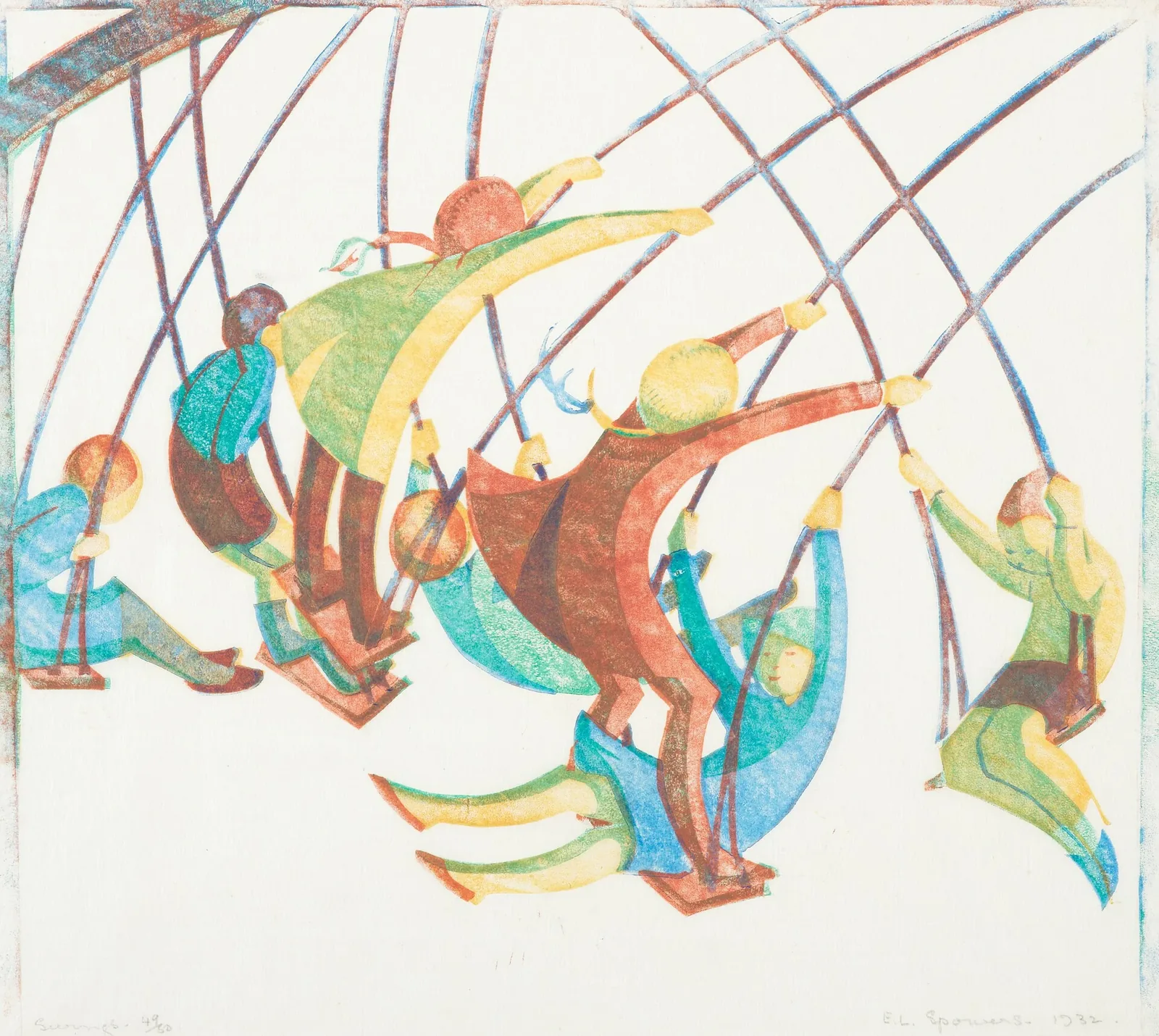
Ethel Spowers's *Swings* makes motion the subject of a still image. The work is dated 1932 and identified as a linocut in Te Papa's collection record. The National…
Motion held in a cut surface
Ethel Spowers's Swings makes motion the subject of a still image. The work is dated 1932 and identified as a linocut in Te Papa's collection record. The National Gallery of Australia describes Spowers and Eveline Syme as artists who used colour, pattern, and intersecting lines to convey the energy of children's play. That institutional interpretation offers a grounded way into the image: instead of treating it as a simple illustration of a playground, we can look at how its forms make movement visible on paper.
The work's medium matters. A linocut is a relief print: areas cut away from linoleum do not take ink, while raised areas transfer it to paper. Each cut creates a decision about the relationship between a figure and the surrounding space. Curves, repeated shapes, and strong contrasts can suggest the arc and rhythm of swinging without actually moving. The stillness of the print sharpens the question: which marks make the viewer feel a repeated action?
Play as a problem of composition
A swing follows an arc, but the print does not need to diagram that arc literally. A repeated curve can echo a path through the air. A body at the edge of a seat may suggest weight shifting. A line can connect the figure to the structure while leaving the surrounding space open. These are visual observations rather than claims about a hidden narrative. The museum record and the image should be read together: one anchors the work's identity, while the other supports close description.
The National Gallery of Australia places Swings alongside other works about children playing and moving. Its educational resource connects the artists' imagery to sport and play, noting patterns and intersecting lines that convey speed and energy. That context is useful, but it does not require every viewer to read the print in exactly the same way. A reader can ask how the composition creates energy before deciding which feeling the scene evokes.
Linoleum and the logic of repetition
Linoleum became available as a floor covering in the nineteenth century; artists later recognized its usefulness as a surface for relief printing. The National Gallery of Australia specifically notes the material's invention in 1860 and its adoption by imaginative artists for printmaking. Compared with a block of hard wood, linoleum can be cut with a different resistance and can support flowing shapes. That general material history helps explain why it suited many modern artists interested in bold, simplified forms.
The claim should stay precise: material alone does not explain Spowers's style. A cutter's technique, the design, the paper, the ink, and the artist's choices all matter. The print is not simply “modern” because it is a linocut. Its visual language comes from how the artist used the medium to organize figures, lines, and color. A close examination of the actual work would also reveal scale, texture, and ink characteristics that a digital reproduction may not show.
Reading the print's evidence
Collection records can preserve several kinds of information: an artwork's title, maker, date, medium, dimensions, acquisition history, and institutional number. Those details are not interchangeable. A collection page may say the work is a linocut and give its date without documenting the artist's precise carving process. An educational essay may interpret its visual effect without supplying a studio diary. Each source has a scope.
For Swings, Te Papa identifies the work as a linocut from 1932 and records its accession number. The National Gallery of Australia situates Spowers and Syme in a practice centered on scenes of play and movement. Together these sources support a discussion of the print's medium, date, and visual concerns. They do not establish every detail of how a specific edition was inked or printed. Keeping those limits in view lets the analysis remain both vivid and dependable.
Follow the return as well as the outward movement
Swinging is a particularly demanding subject for a static image because its movement reverses. A single diagonal can suggest travel in one direction, but a swing's action includes a return. When looking at Spowers's print, distinguish the position of a figure from the rhythm created by surrounding lines and repetitions. The position represents a moment; the rhythm can encourage the eye to imagine a sequence extending beyond it. This is a compositional reading, not a recovered statement by Spowers.
One way to test that reading is to ask what remains when the title is temporarily set aside. Can the arrangement still suggest repeated movement, or does the word swings supply most of the motion? Then restore the title and consider how naming changes the relationship among the forms. The exercise separates recognition of an activity from the visual means that make it convincing. It does not require inventing the identities or feelings of the children depicted.
The comparison with a registration study is useful. There, attention falls on how printing passes meet. Here, the more distinctive problem is how a fixed set of marks evokes an activity that cannot remain in one position. Linocut provides the surface and repeated impression, but it does not supply that rhythm automatically. The value of a close reading is to connect the particular arrangement with the experience of motion, while the institutional record anchors the work's identity as Spowers's 1932 colour linocut.
Further reading
Sources & records
Linked records provide object descriptions and historical context. Comparisons, close readings, and explicitly hypothetical examples are editorial analysis. This essay was revised on 22 October 2026; it does not report first-hand workshop research. The image source and license appear in its caption.

Flatbed Letterpress Anatomy
A flatbed letterpress diagram turns an industrial machine into a set of relationships. The bed holds the locked type or relief forme. The ink system prepares the…
5 min read
Registration in a Two-Colour Linocut
A two-colour linocut is not simply a black-and-white print with a second ink added at the end. Each color depends on a carved surface, an inking decision, and a…
5 min read
Fons Heijnsbroek’s Linocut Still Life
The Commons record describes this 1988 linocut as an untitled abstract still life by Dutch artist Fons Heijnsbroek. Those details are enough to guide a first…
4 min read