
The Print Field / Essay 30
Inking Up a Chandler & Price Press
The cover photograph records a Chandler & Price 10-by-15 press being inked up for a job. That caption captures a moment before printing: rollers and type are being…
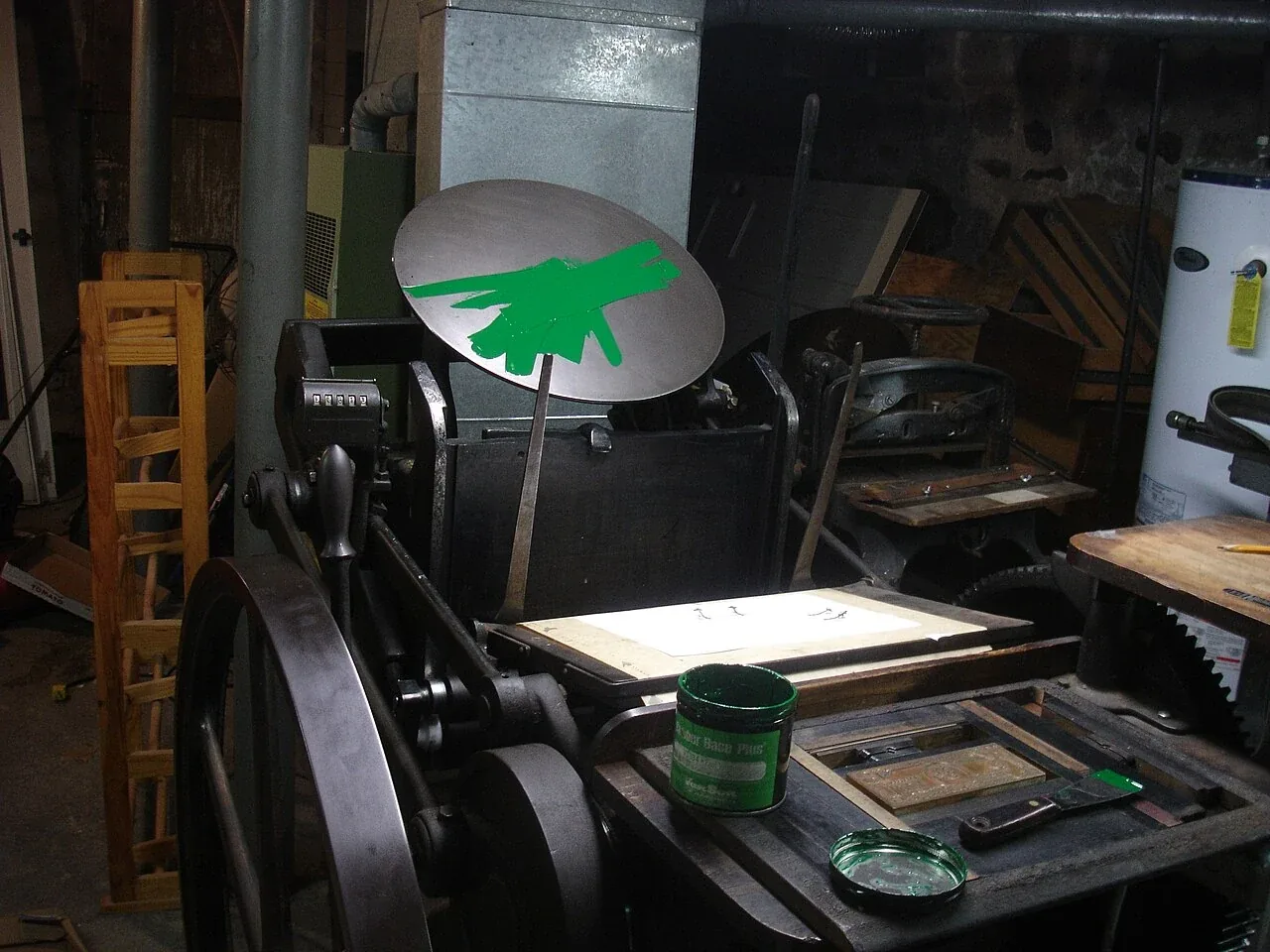
Before the first sheet reaches the platen
The cover photograph records a Chandler & Price 10-by-15 press being inked up for a job. That caption captures a moment before printing: rollers and type are being prepared, but the image does not show a finished run or identify the work on the press. The National Museum of American History's record for a Chandler & Price New Series jobber, made about 1911, identifies a platen jobber with a 10-by-15-inch chase. The shared size and maker name help situate the photographed machine within a recognizable class, while the exact model and date of the cover photograph should remain tied to its own Commons record.
“Inking up” is a practical phrase for preparing the press's ink system and printing surface. A self-inking platen press distributes ink through rollers that contact an ink disk or other inking mechanism, then carry a film to the raised type. The printer checks the result through a proof. A press can be mechanically sound and still make a poor impression if ink does not reach the form evenly, if the type surface is not prepared correctly, or if the impression is set poorly.
The machine class matters
The Smithsonian describes the platen jobber as a press designed for neighborhood printers producing posters, notices, tickets, newsletters, letterheads, and other short-run work. These shops needed machines that were quick to set up and relatively compact. The museum notes that the category included many models, not one standardized design. That variety matters when we interpret an individual photograph: a Chandler & Price press may share broad features with other platen jobbers, but model-specific details should come from its own documentation.
The 10-by-15 measurement in a press record generally refers to the chase size, not the size of every finished print. A job can be smaller than the available bed, and the actual paper dimensions depend on the layout and gripper margins. The distinction between chase size and printed image is easy to miss in casual descriptions. Object records make it possible to name the machine's capacity without implying that every sheet filled the entire area.
Ink reaches the type through a system
A printer preparing the press checks more than whether the rollers look inked. Ink must be distributed in a controlled film. Rollers contact the type, return to the inking surface, and repeat the cycle. Uneven roller condition, ink amount, or roller height can produce areas that print too dark or too weak. The exact setup differs among presses and jobs; a historic photo rarely shows enough detail to diagnose the entire adjustment.
The material of the roller has changed through the history of printing. Smithsonian's overview of printing machines points out that press speed and roller materials have to develop together: a faster mechanism can damage rollers that are not suited to its demands. That is a system-level observation, not a statement that every jobber inking session used the same compound or procedure. The relevant questions are practical: does the roller turn freely, distribute ink across the form, and return without disturbing the type?
A proof is a conversation with the press
The first proof turns an unseen setup into a visible result. The printer can look for missing letters, uneven density, register, and defects caused by the forme or ink distribution. Corrections may require resetting type, cleaning the form, adjusting rollers, or changing impression. The process is iterative. A single proof does not guarantee that the rest of the run will stay consistent, so operators continue to monitor the sheets.
A photograph of a press being inked can invite a viewer to imagine the noisy and rhythmic environment of a shop. That imagination is reasonable as an experience of machinery, but the image alone does not establish the shop's location, its staff, or the job being printed. A caption should stay with what the record documents. The machine's maker, size, and visible state can be described; its operator's identity or purpose needs corroborating evidence.
The platen brings paper and type together
In a platen jobber, the platen and bed close to transfer ink. Many presses of this broad type are described by the Smithsonian as clamshell machines: their surfaces hinge together in a closing motion. Designs vary, and not every press uses the same mechanism. The action gives the printer repeated, controlled contacts between paper and type. Feed, grippers, roller motion, and impression timing must all work in concert.
Short-run job printing made this kind of press useful. A local printer might need a sequence of different jobs rather than a single massive edition. Quick setup and modest footprint mattered alongside quality. The category therefore tells us about the scale of work the machine was designed to serve, but not what a particular shop printed without job records or surviving examples.
Readiness is a result that must be demonstrated
The photograph's phrase inking up describes a stage before a run, which makes it different from a picture of finished production. Ink on a disk or roller is evidence that material is present. It is not yet evidence that the assembled forme will print the intended image consistently. The gap between those two statements is where proofing becomes valuable: readiness must appear on paper, not merely in the appearance of an inked machine.
The 10-by-15 designation also needs a practical reading. It identifies a nominal chase size for the machine class, not an instruction that a design or sheet should fill that entire rectangle. A small job can sit within a larger available area. The surrounding arrangement, sheet handling, and position of the image still matter. Confusing nominal capacity with actual printed size would erase the very setup work that the photograph invites us to consider.
This gives the Chandler & Price article a different emphasis from a general explanation of hand rollers. The roller discussion concerns distributing an ink film. Here the question is whether the whole prepared system has reached a repeatable condition for a particular job. A machine can have ink without being ready, and a satisfactory first proof can still need monitoring through a run. Those distinctions make preparation visible as production work in its own right. The image captures the interval in which a composed page becomes a printable job, before output can be counted as completed sheets.
Further reading
Sources & records
Linked records provide object descriptions and historical context. Comparisons, close readings, and explicitly hypothetical examples are editorial analysis. This essay was revised on 22 October 2026; it does not report first-hand workshop research. The image source and license appear in its caption.

Flatbed Letterpress Anatomy
A flatbed letterpress diagram turns an industrial machine into a set of relationships. The bed holds the locked type or relief forme. The ink system prepares the…
5 min read
Registration in a Two-Colour Linocut
A two-colour linocut is not simply a black-and-white print with a second ink added at the end. Each color depends on a carved surface, an inking decision, and a…
5 min read
Fons Heijnsbroek’s Linocut Still Life
The Commons record describes this 1988 linocut as an untitled abstract still life by Dutch artist Fons Heijnsbroek. Those details are enough to guide a first…
4 min read